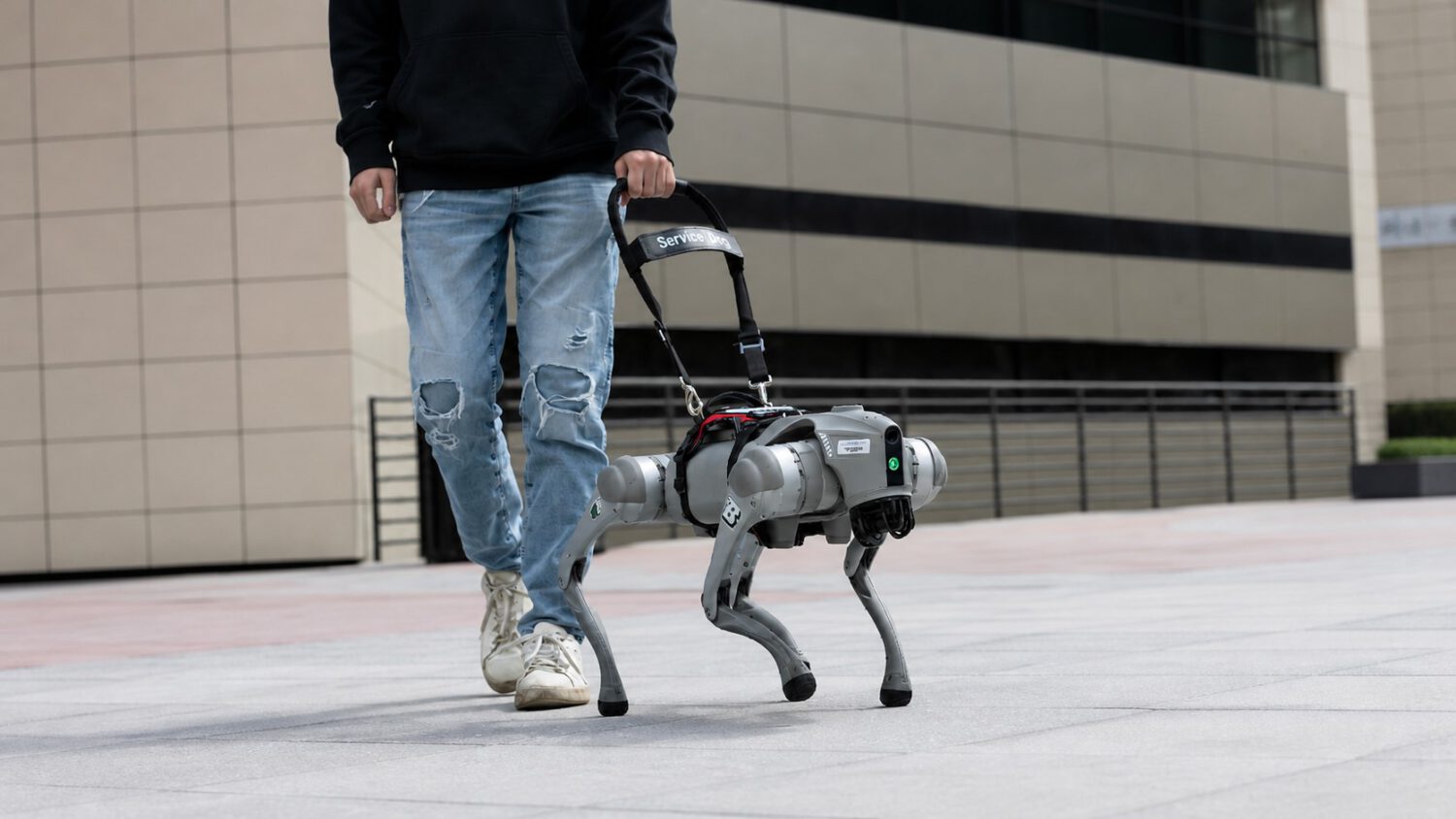
Someone was walking through San Francisco’s Dogpatch neighborhood, guiding a four-legged machine down the block with a handheld remote, and getting paid $20 an hour to do it. That was the real job behind Dimensional’s now-deleted listing for part-time robot-dog operators. The gap between that image and the company’s vision of autonomous robots handling physical labor is the most honest thing the startup has shown the public so far.
What the Job Actually Required
The listing required no robotics experience, just a willingness to carry the hardware home if things went wrong.
The listing asked operators to walk a roughly $2,000 Unitree robot dog through city streets for four to six hours. The machine weighed about 33 pounds. If it overheated and stopped mid-route, the operator was expected to carry it back to Dimensional’s office, according to Digital Trends. Control ran through a handheld remote or a mobile app: a familiar enough interface, but attached to something considerably heavier and slower than most consumer remote-controlled devices.
Why Dimensional Needed the Data
Collecting “ground truth,” one city block at a time.
The operators weren’t walking robots for show. Onboard cameras and sensors recorded the walks, generating what Dimensional founder Stash Pomichter described as “ground truth” for improving autonomous navigation, according to the New York Times. The company ran comparisons between human-controlled routes and AI-agent control, and the conclusion was direct. Pomichter told the Times that “agents are still very bad at controlling hardware.”
That single admission explains the entire job listing. The software can receive a natural-language instruction, but it still cannot reliably steer a machine through an unpredictable urban environment without a human in the loop , a limitation also seen with Snake Robots navigating complex real-world terrain. Dimensional’s broader goal is dimOS, an open-source operating system designed to let AI agents control different robot platforms through natural-language commands. Those platforms include robot dogs, humanoid machines, and robotic arms. The San Francisco walking experiment was data collection in service of that ambition, not a demonstration that the ambition has been achieved.
What Happens When a Robot Walks in Public
A sensor-laden machine on a public sidewalk raises questions the technology has not yet answered.
Pedestrian safety, privacy, and the collection of video data in shared spaces are real concerns whenever autonomous-looking hardware operates in public, even when a human is holding the remote. Debates over surveillance in Bay Area public spaces make those concerns especially pointed here. If you live near Dimensional’s Dogpatch route, those concerns are unresolved. Dimensional has described security patrol as one potential application, but the model it outlined keeps a remote human in the loop, making the machine function more like a mobile camera than an independent guard.
The experiment also drew at least one hostile response. According to the New York Times, at least one person alleged the robots could be used as weapons, and Dimensional reported those messages to police. The available reporting does not establish that any weaponization occurred.
What Comes Next
The real test is not the software alone; it is everything the software depends on.
Whether Dimensional’s approach pays off depends on whether human-collected street data eventually produces reliable autonomy, or whether the human simply stays in the loop indefinitely. Battery life, thermal limits, insurance, public-space regulations, and clear accountability when a robot causes harm are the unglamorous variables ahead , questions that parallel ongoing work in Workplace Safety around robotic hardware in real-world environments. Whether dimOS graduates from a data-collection experiment into something a business would actually deploy depends on how each one is resolved.