Ask Claude where to vote in November, and starting later this month, you will get a state-specific answer drawn from publicly available election information, not an educated guess from a language model. Anthropic announced on October 14, 2026, that it is integrating Democracy Works, a nonpartisan nonprofit that compiles voting data from state and local election sources, directly into chatbot responses ahead of the November midterms.
What the Feature Actually Delivers
The integration targets practical civic logistics, not voting recommendations.
The integration covers the questions you are most likely to ask: polling locations, identification requirements, election dates, and election results on election night and in the days that follow, according to Anthropic’s announcement. It also surfaces registration information, though Anthropic does not specify whether Claude can verify an individual voter’s personal registration record.
That sourcing distinction matters more than it might sound. Before this update, Claude.ai displayed a banner linking users to TurboVote, Democracy Works’ voter-information service, whenever questions about registration, polling places, or election dates came up. The planned integration moves the answer inside the conversation itself, drawing on Democracy Works data collected from state and local election sources.
What Anthropic’s Own Data Shows
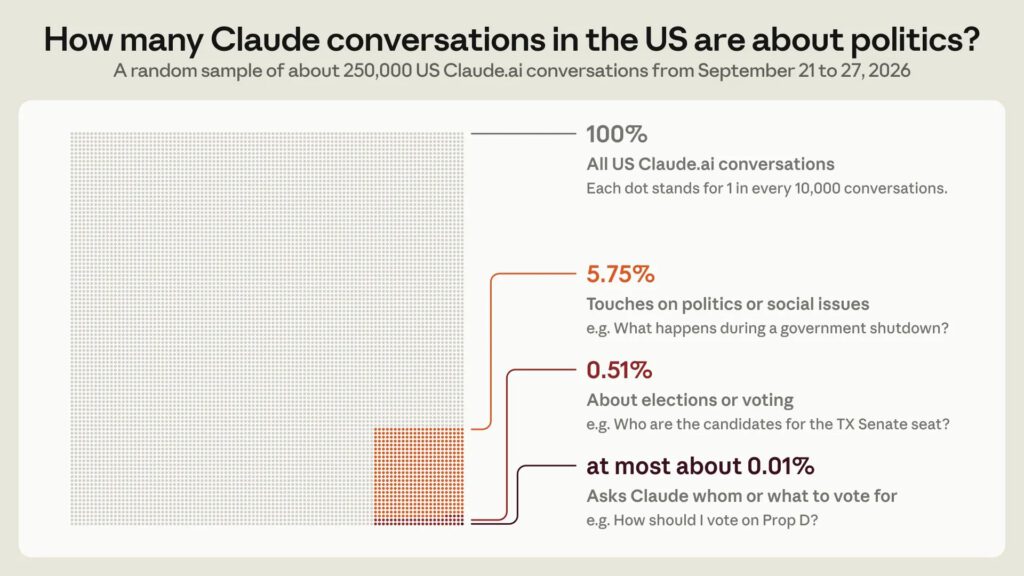
All figures below come from Anthropic’s own analysis of approximately 250,000 U.S. Claude.ai conversations and have not been independently audited.
Political, public policy, and social-issue conversations accounted for about 5.75% of U.S. usage on the consumer app. Election- or voting-specific queries represented roughly 0.51%. Requests asking Claude whom or what to vote for, the category carrying the most obvious influence risk, came in at about 0.01% of U.S. conversations. Anthropic expects political and election-related queries to rise as Election Day approaches.
What Claude Will Not Do
Anthropic’s usage policy draws explicit limits around election-related interactions.
Claude cannot be used to deceive voters, spread false information about candidates or voting procedures, impersonate election officials, disrupt election operations, or suppress turnout, per Anthropic’s announcement. The company also said it has worked on detecting misuse, evaluating Claude for political bias, and testing protections against coordinated misuse and influence efforts.
Claude previously directed election questions to TurboVote through a referral banner. Embedding Democracy Works data inside responses moves the answer meaningfully closer to what civic infrastructure requires. Still, stale data or uneven state coverage could create real problems. Voters who treat a chatbot response as the final word, rather than a starting point, assume a risk the feature does not eliminate.
What This Means for How You Get Civic Information
Accuracy and transparent sourcing will matter more than interface polish as AI assistants pursue live data partnerships for elections.
AI assistants that integrate live election data are positioning themselves as intermediaries between voters and official election authorities. That is a role with real consequences. As more AI companies pursue these partnerships, the reliability and provenance of those answers will matter far more than how smoothly the interface delivers them.