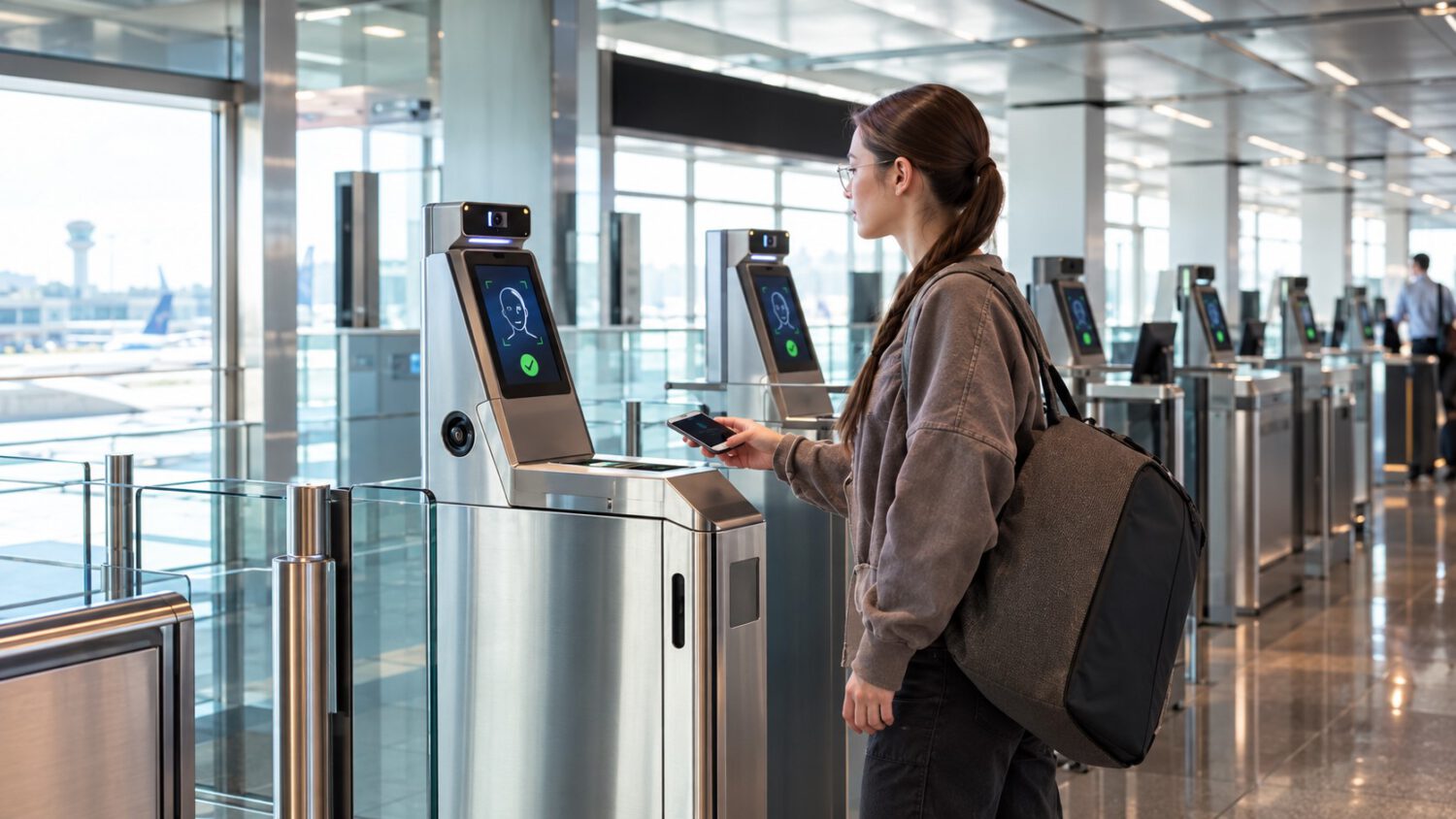
You walk toward the gate. No passport presented. A camera reads your face, the barrier opens, and you’re through. That’s the new reality at East Midlands Airport, which became the first UK site to deploy contactless facial-recognition eGates on 6 October 2026, with all 13 existing eGate airports scheduled for the same upgrade by early 2027. The government calls it a convenience upgrade. The more useful question is what you’re actually handing over to get it.
Five Seconds Saved, Six Years Stored
The speed claim is real, but the retention period is the part of this story worth reading twice.
Official testing found the system was “up to 25% faster” than passport scanning, according to the Home Office. That figure is a maximum result from controlled conditions, not a guaranteed saving for every traveler at 6 a.m. during a Ryanair rush at Stansted.
Five seconds is the headline. The retention period is the story. Under the UK government’s published biometric retention guidance, facial images captured at eGates may be stored for up to 30 days for British citizens. For other nationalities who become eligible to use the contactless gates as the rollout expands, that figure rises to up to six years.
The guidance confirms those collection and retention windows. It does not establish that every image is necessarily stored for the full permitted period, nor does it clearly explain whether, or under what circumstances, images may be used outside border-control functions. That distinction matters, and the Home Office should be stating it clearly and publicly, rather than leaving passengers to locate it in policy documents. This pattern of opaque data retention echoes concerns raised about secretly tracking users in other government-linked digital systems.
Phil Douglas, director general of Border Force, offered his assessment: “This is a win for travelers coming to our brilliant country.”
Face First, Passport Second: What’s Actually Changed
This is not a minor UX tweak; it is a fundamental reordering of what credential is primary at a national border.
Previously, eGates required you to place a biometric passport on the reader before any facial comparison took place. Now the face comes first. The passport becomes a backup, and you may be asked to place it on the reader or speak to a Border Force officer if further checks are required. You must still carry a valid passport at all times.
What the government and airports have not adequately addressed is the accountability infrastructure around that shift. The cited rollout guidance does not publish false-match rates or demographic performance data across different passenger groups.
The same guidance does not explain whether a clear opt-out pathway or alternative lane exists for passengers who do not want biometric capture as their primary entry method. It also does not describe an accessible redress process for passengers who are misidentified. These are not edge-case concerns; they are basic requirements for a system that places your face, rather than your document, at the front of the queue.
Children aged eight and older, provided they are at least 120cm tall, may use the gates when accompanied by an adult. The published rollout material does not address what consent looks like in that context, which is its own open question.
What passengers have not yet received from the cited public rollout material is a full accounting of where their face goes after the gate opens, who can access it, and what happens when the camera gets it wrong. Incidents like the one in which records exposed personal data at scale illustrate precisely why clear access controls around stored biometrics cannot be an afterthought. Speed is not the only metric worth measuring at a border.