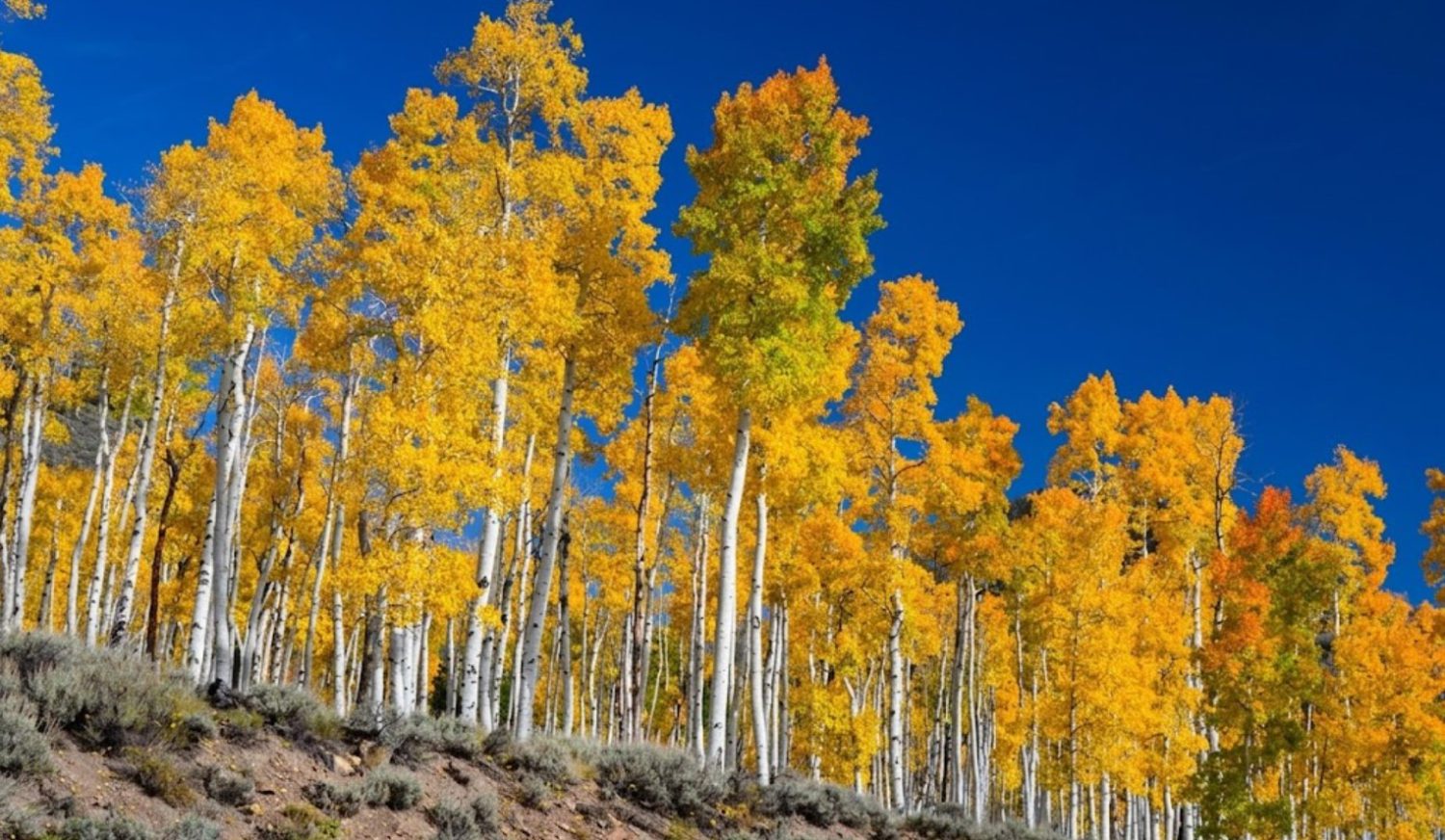
When you look at Pando, you see a forest. You’re wrong. Every trunk rising from the soil in this corner of Fishlake National Forest, Utah shares one genetic identity, one underground root system, and one name — Pando, Latin for “I spread.” Roughly 47,000 stems across 106 acres, amounting to an estimated 6,000 tons of living material — making it a serious contender for the heaviest organism on Earth. It’s also struggling to survive.
One Root, 47,000 Faces
Unlike a typical forest of unrelated trees, Pando spreads primarily by cloning itself through its roots rather than by seeds.
Each visible trunk is technically a ramet — a stem, not a separate tree — sprouting from one shared root network through clonal reproduction. Think of it less like a forest and more like a distributed computing system: thousands of nodes, one underlying architecture, one genetic identity confirmed by testing. The organism expands laterally, pushing up new shoots rather than scattering seeds, replacing its visible parts while the root system below persists across centuries.
Key facts worth knowing:
- Pando covers approximately 106–108 acres in Sevier County, Utah
- Estimated mass of ~6,000 tons puts it among the heaviest known organisms — though Oregon’s Armillaria ostoyae fungus competes for that title
- Age estimates range from several thousand to tens of thousands of years; a recent peer-reviewed genetic study places the most constrained range at roughly 12,000–37,000 years, while older speculative figures exceeding 80,000 years remain unconfirmed
- Individual trunks live only 100–130 years, making precise age verification genuinely difficult
- Genetic testing confirmed all ~47,000 trunks share one genotype
- Conservation fencing now protects sections of the grove from browsing pressure
Ancient System, Modern Problem
Pando’s survival depends on a regeneration cycle that human-altered herbivore populations are now quietly dismantling.
Pando survives by continuously replacing dying trunks with new shoots — suckers pushed up from the roots. Mule deer and elk are eating those shoots before they mature. Strip out the next generation fast enough, and the organism’s age structure skews entirely toward old, dying stems with nothing coming up behind them. It’s a pipeline problem: all legacy content, zero renewal.
Ecologists have described Pando as an iconic symbol of the pressures facing aspen ecosystems — a system robust enough to survive millennia now losing ground to deer populations shaped by human land-use decisions, including road access and hunting regulations that push herbivore pressure beyond natural levels.
The US Forest Service has responded with fencing and exclosures that allow protected sections to regenerate, with plans to bring approximately 76 acres under permanent protection. Results are promising in spots. But debate continues among conservation researchers about whether fragmenting Pando into fenced parcels actually preserves it as one unified system — or just saves the pieces.
That tension matters beyond Utah. The strategies tested here will shape how land managers approach clonal forest conservation under mounting herbivore pressure and climate change across the American West. An organism that has replaced itself piece by piece for potentially thousands of years is now losing that battle because of deer and the human decisions that govern them. Whether Pando keeps spreading — or quietly stops — depends on the choices made in Fishlake National Forest over the next decade.