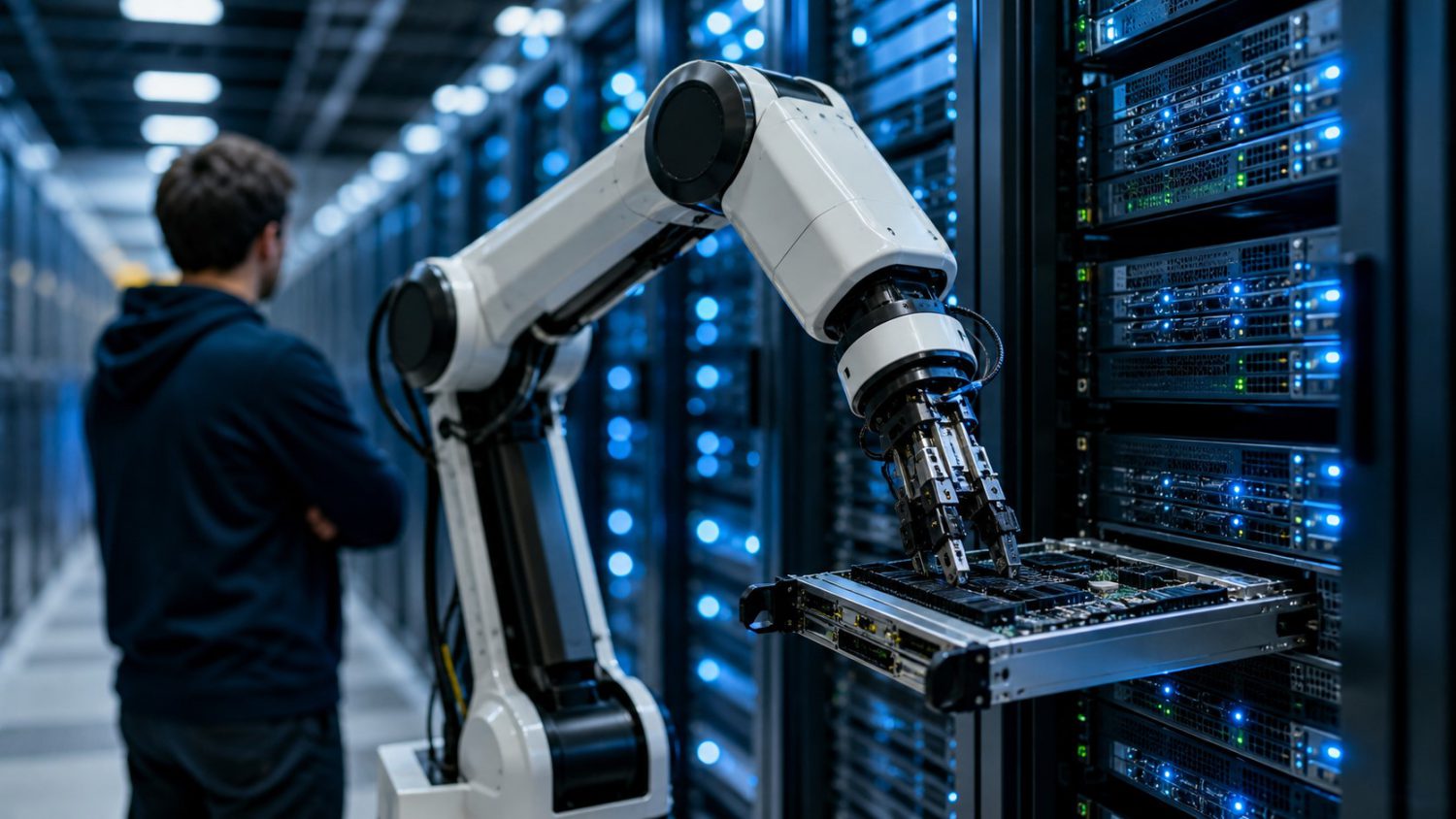
A dual-arm robot from Watney Robotics is pulling a network cable from a rack port and reinserting it — slowly, methodically, under camera supervision from somewhere else entirely. No technician in the aisle. This is Meta’s data center robotics program at its Altoona, Iowa campus. Not a roadmap. Not a concept video. It’s running now, and the company’s “we need more workers” messaging is doing a lot of heavy lifting against a much thornier reality.
What the Robots Actually Do
Three vendors, three tasks — none of them fast, all of them pointed in one direction.
Meta’s pilots span a portfolio of systems targeting different physical jobs that currently require on-site technicians:
- Watney Robotics dual-arm bots handle network cable insertion and removal in server racks at Altoona, Iowa — piloting since mid-2025
- A Kinova Gen3 robotic arm manages server power cycling, interacting with front-panel controls; a separate, simpler finger-like actuator handles button-pressing on devices like Mac minis via remote trigger
- ABB wheeled platforms with scissor-lift risers and six-axis arms reseat hardware components at Meta’s Prometheus campus in New Albany, Ohio
- Every system currently requires human supervision — staff move robots between aisles, open cage doors, and verify camera feeds before tasks are marked complete
- Robots are slower than skilled technicians and struggle with cable clutter and tight spaces
“It’s coming for us all, unfortunately.” — unnamed Meta data center worker, as reported by Wired
The 80% Number Deserves a Closer Read
One worker’s estimate about one specific role — not a confirmed outcome, not a company target.
That figure — robots absorbing up to 80% of some technician workloads — comes from a single unnamed worker describing what might happen if the cable-swapping robot works as intended. It’s task-specific, hypothetical, and today’s robots haven’t come close to that efficiency.
Meta spokesperson Francis Brennan framed the program differently, telling Ars Technica the US is in its “biggest infrastructure boom since World War II” and that the company needs “more workers, not fewer.” Both statements can be true simultaneously. That’s what makes this uncomfortable.
The Longer Game Is What Workers Are Actually Afraid Of
Today’s clunky robots aren’t the threat — the pace of iteration is.
The real anxiety isn’t a robot that moves slower than a tired technician. It’s what happens when Meta — reportedly projecting $130–145 billion in 2026 capital expenditure — iterates fast enough that “slower” stops being true. Workers describe a future resembling a restaurant kitchen where the head chef has been replaced by a recipe app: skilled troubleshooting hollowed into lower-paid “smart hands” executing AI-generated instructions whenever the humanoid robot gets stuck.
Robotics executive Eric Xu has publicly described a vision of mixed human-robot teams handling incident response and preventative maintenance — a more optimistic framing than the worker accounts suggest. Today’s systems are unimpressive, and the constraints are real. Yet Meta has the capital, the motive, and the infrastructure scale to keep pushing. For data center workers, the question isn’t whether these robots work yet. It’s how long “yet” lasts.