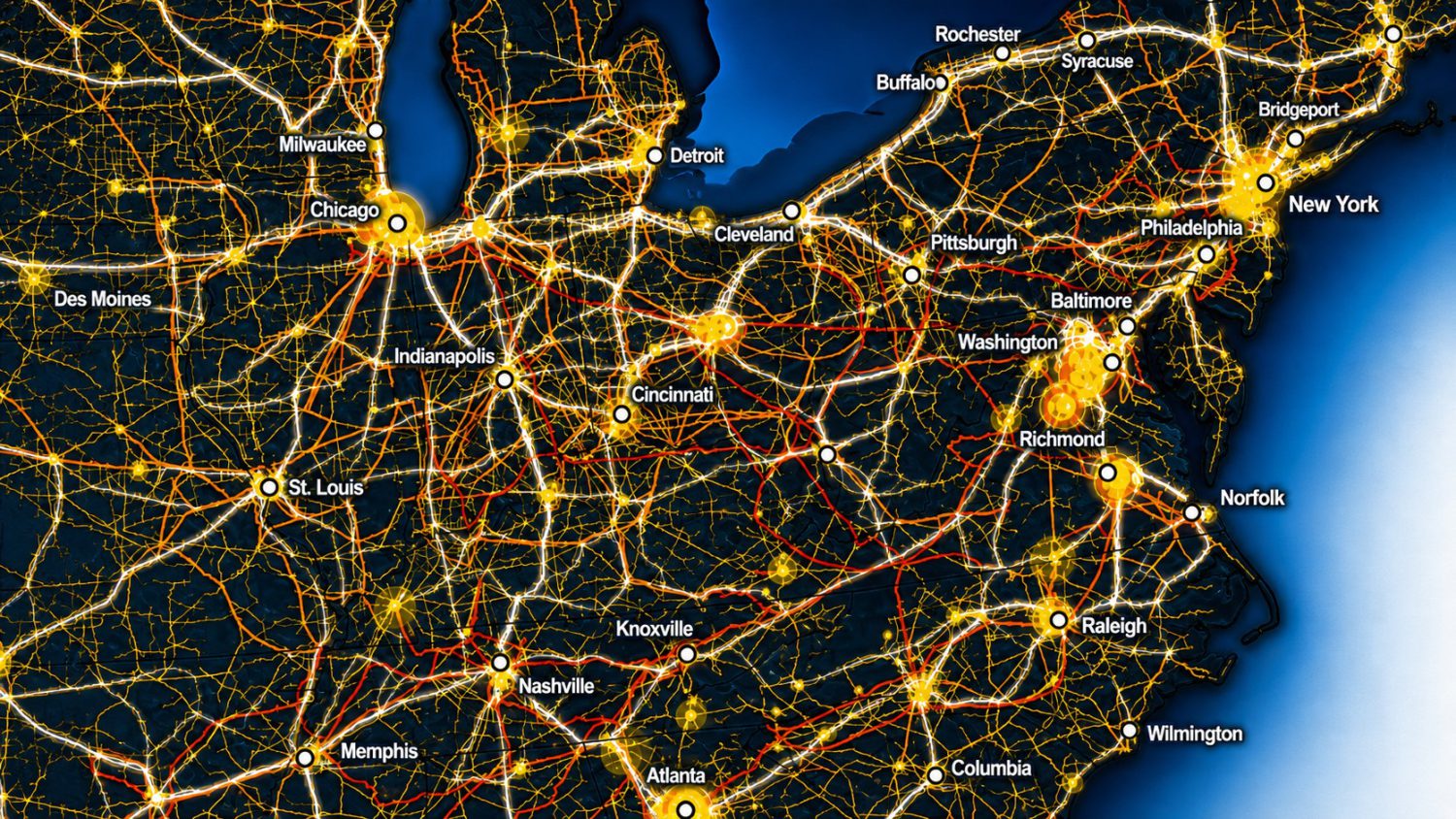
According to Data Center Map’s August 2026 figures, the United States hosts 4,767 listed data centers. China has 376. A separate Cloudscene dataset, synthesized by Brightlio and Statista, puts the U.S. at 5,427 facilities — roughly 46% of all global data centers. The UK (568), Germany (533), and France (393) all rank above China in absolute count. On a per-capita basis, the U.S. has approximately 50 times more listed data centers per person than China, according to Programs.com’s 2026 analysis. If someone tells you America is falling behind, ask them to show their math.
What “The Race” Actually Means
Policymakers aren’t counting buildings — they’re counting leverage.
The “race with China” rhetoric isn’t about facility tallies — and to be fair to the people using it, they know that. What they’re actually worried about:
- Maintaining U.S. dominance in high-end AI compute: the massive GPU clusters that train frontier models, not the server closets running your company’s email
- Preventing China from renting U.S.-controlled cloud capacity through third countries, a strategy Forbes reported on in 2026 as the next front in the AI chip wars
- Securing hardware supply chains against compromised components in critical infrastructure
- U.S. private AI investment hitting approximately $286 billion in 2025 (deployed and committed, per MeriTalk) — which suggests the private sector isn’t exactly sleeping
CNAS expert Vivek Chilukuri put it plainly: “Whichever country throws more money and chips into big data centres will be able to train more AI models, and hence monetise AI. The U.S. can do that much more than China.” Brookings frames it as a multi-dimensional contest — compute, models, adoption, deployment — where the U.S. leads at the frontier while China advances through efficiency and deep integration into its real economy. Less a sprint, more a chess match played simultaneously on a dozen boards.
The Dual-Use Reality Nobody Advertises
Your Netflix queue and a license-plate scanner share the same landlord — and that’s worth understanding clearly.
The infrastructure powering your cloud storage, your AI chatbot, and your favorite streaming service also runs law-enforcement analytics, social-media monitoring contracts, and facial-recognition workloads. Same physical AI data centers. Both the U.S. and China rely on this infrastructure for surveillance — the meaningful differences are legal constraints and transparency, not hardware. Calling the entire build-out a surveillance project misreads the evidence. Pretending the surveillance component doesn’t exist misreads it worse.
The real tension is simpler and more uncomfortable: you’re funding expansion — through utility rates, cloud subscriptions, and tax-subsidized infrastructure incentives — that serves commercial, military, and monitoring purposes simultaneously. That’s not conspiracy. That’s just how dual-use infrastructure works. A concrete example: U.S. operatives built a surveillance app to target Alberta separatists, illustrating exactly how the same compute backbone serves civilian and monitoring ends at once.
The U.S. isn’t losing the data-center race. The scramble now is about who controls the next generation of compute and who sets the rules for using it. More is always the answer when the real prize is future dominance, not present count. Whether that future is being built for you or around you is the question nobody in the press release is answering.