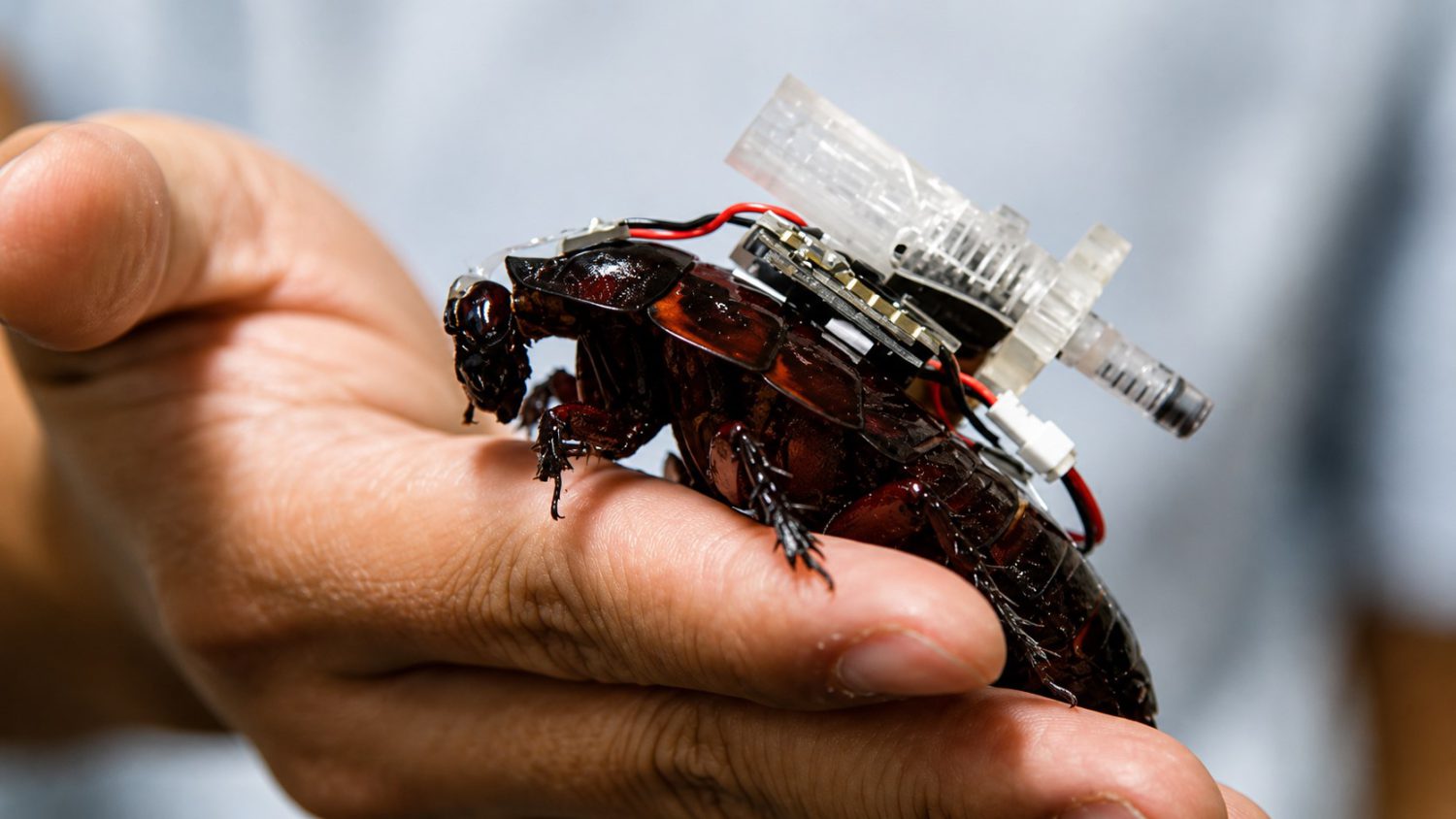
Trapped under earthquake rubble, hours from extraction, with no painkiller in sight — that scenario has a new potential answer. It has six legs, weighs roughly 34 to 40 grams, and the concept is unsettling on first encounter: researchers at the University of Queensland and the University of New South Wales have built remote-controlled cockroaches that navigate lab environments to designated targets and deliver liquid medication. They call them paraborgs — paramedic cyborg insects — and the peer-reviewed research landed in August 2026.
How the System Actually Works
A modular backpack, a needle the width of a hair, and a joystick-wielding human operator.
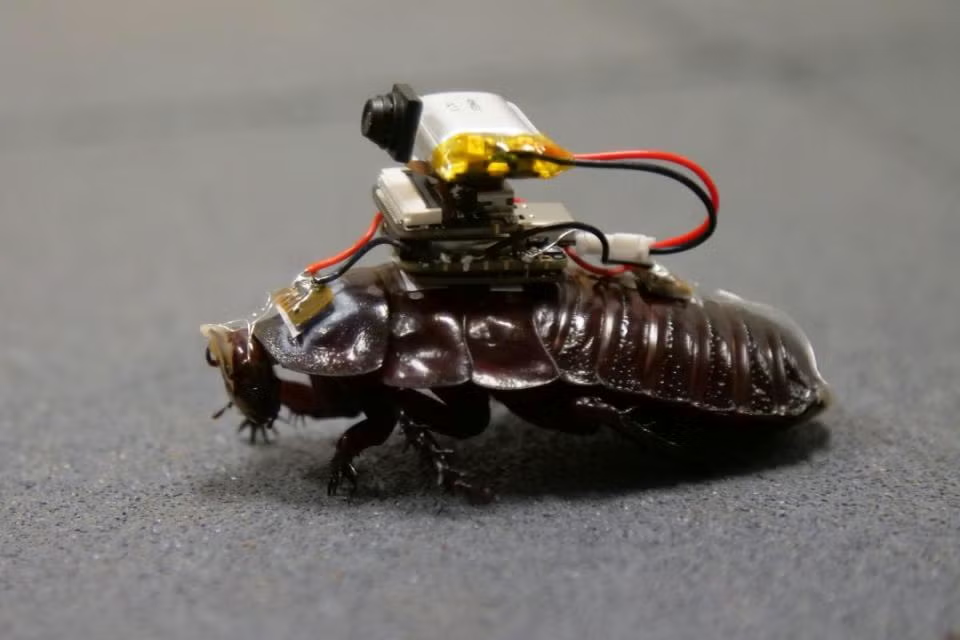
The insects used are Macropanesthia rhinoceros — giant burrowing cockroaches native to North Queensland, measuring roughly 85mm long and weighing up to 40 grams. Electrodes implanted in their antennae allow remote steering via joystick, hijacking their natural orienting behavior. A swappable backpack carries either a camera for reconnaissance or the auto-injection mechanism (AIM): a PCB-integrated launcher firing a 31-gauge, 6mm needle that delivers up to 0.5 mL of liquid drugs — such as pain relief or stabilizing agents — in future emergency scenarios. A human operator pulls the trigger. No autonomous decisions about who gets injected.
The numbers from controlled lab trials tell a measured story:
- Navigation success: 100% across 25 runs
- Full mission success (navigate, stabilize, inject): 72% (18 of 25 runs)
- Close-range injection success within 15cm of target: ~95%
- AIM bench-test reliability: ~90% needle-fire and delivery
- Tested on silicone and pig-skin tissue — no human trials conducted
“The cyborg insect has to navigate to the target, position itself accurately and remain stable enough to perform the injection.” — Hai Nhan Le, UQ PhD candidate
Seventy-two percent is a legitimate proof-of-concept result — exactly what this stage of research calls for, nothing more. No human trials have occurred. Drug stability, concentration, and biological activity inside the syringe remain uncharacterized in real bodies. Associate Professor Do Thanh Nho of UNSW frames the biomedical goal as delivering care before extraction is possible, but thorough clinical evaluation, as the team openly acknowledges, is still pending.
Where This Goes Next
Diving suits, swarm logic, and a regulatory landscape nobody has fully mapped yet.
Separate research from Nanyang Technological University has produced 3D-printed diving suits for cyborg cockroaches — waterproof shells with onboard hydrogen peroxide and manganese dioxide oxygen generators enabling underwater operation for up to three hours. That points toward a future where coordinated insect swarms could combine camera-equipped scouts, injection-capable paraborgs, and underwater units — think drone swarm logic, but biological and operating inside flooded tunnels.
Dr Thang Vo-Doan estimates five to ten years before real-world deployment, pending engineering refinement, clinical validation, and regulatory approval. There’s a certain dark poetry in where this research lands: the creature most people spend their lives trying to exterminate might one day be the thing that keeps someone alive.