Inspecting a C-5 Galaxy — one of the largest military transport aircraft ever built — is not a quick job. It means scaffolding, lifts, crews working at height for days, sometimes weeks, checking every surface for dents, corrosion, loose fasteners, and chipped paint. Multiply that across an aging fleet with personnel constraints, and you have a maintenance backlog that doesn’t fix itself. The Air Force’s answer, awarded in July 2026: a multimillion-dollar Phase III SBIR contract to Asylon Robotics, a roughly 100-person startup from Norristown, Pennsylvania, to deploy an autonomous robot dog and drone system that does the job in hours.
Two Robots, One Aircraft, Zero Scaffolding
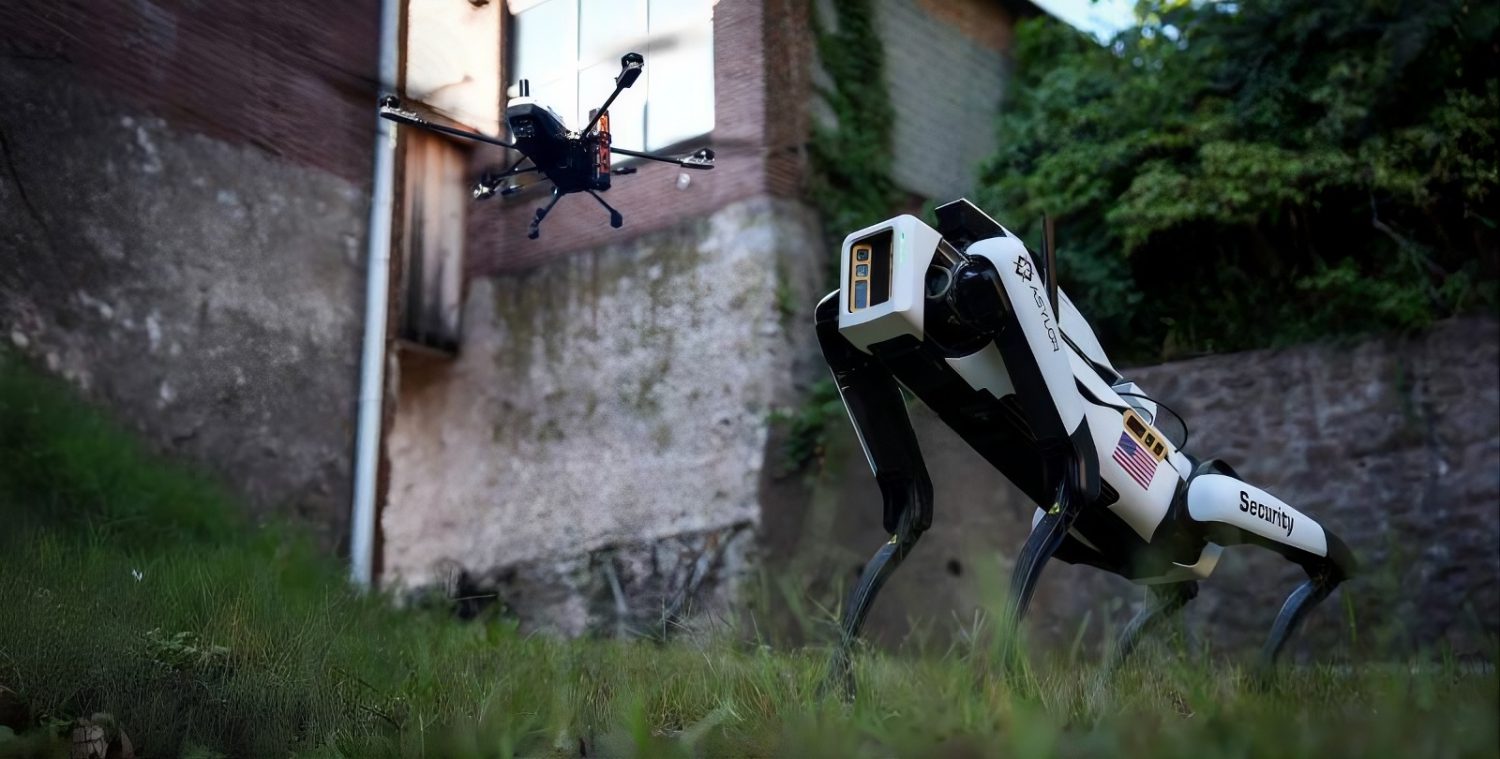
MARIA pairs a quadrupedal ground robot with an aerial drone to cover every surface of a large aircraft — autonomously.
Here’s how MARIA — Multi-modal Autonomous Robotics for Inspection of Aircraft — actually works:
- The Guardian sUAS (drone) covers the upper fuselage, wings, and hard-to-reach top surfaces using cameras and LiDAR
- The DroneDog Q-UGV — built on Boston Dynamics’ Spot platform — scans the underbelly, landing gear, and lower sides
- Both run a common hardware and software package; combined output creates a 3D digital twin of the aircraft exterior
- The DroneIQ platform aggregates imagery, point-cloud data, and metadata into interactive inspection workflows
- Initial targets: Lockheed C-5 Galaxy and C-130 Hercules at Warner Robins Air Logistics Complex, Georgia
Pre-programmed inspection routes eliminate the variability that comes with human crews. Every pass covers the same points of interest, in the same sequence. That consistency isn’t just efficient — it creates a repeatable baseline for tracking aircraft condition over time, something like a recurring diagnostic scan that actually accumulates useful data across inspection cycles.
“Picture the DroneDog underneath the aircraft… [and] the Guardian sUAS… [inspecting] the top… Working in unison, they’ll autonomously do digital mapping of the aircraft and be able to identify anomalies, defects or other things the customer… is asking us to pay attention to,” said Anthony McCarty, Asylon’s SVP of Government, according to Aviation Week.
Worth noting: MARIA flags visible anomalies for human review. DroneIQ is a decision-support tool, not an autonomous judge. Experienced maintainers still make the calls — the robots keep them off the scaffolding and give them better data to work with. AI-assisted detection is only as good as what the camera sees, and that limitation isn’t lost on anyone paying close attention.
From Security Patrols to Airframe Checkups
Asylon’s pivot from perimeter security to aerospace maintenance brings real regulatory complexity alongside the impressive hardware.
Asylon previously focused on autonomous security patrols — drone-and-robot-dog systems guarding perimeters. Warner Robins is its first aerospace maintenance customer. That pivot carries real regulatory weight: flying drones around aircraft in controlled airspace requires FAA compliance and BVLOS (beyond visual line of sight) operational expertise. Asylon’s leadership includes advisors with that experience — less photogenic than the robot dog footage, but considerably more important to getting this off the ground.
The company has also floated the concept of humanoid robots eventually performing physical maintenance tasks alongside MARIA’s inspection platforms. That remains speculative — nowhere near current deployment — but it signals where the longer-term roadmap points.
If this works on a C-5 at Warner Robins, the model travels. Other Air Force logistics complexes, other military branches, commercial MRO operations. The robot dog stopped being a novelty the moment it started doing infrastructure work.