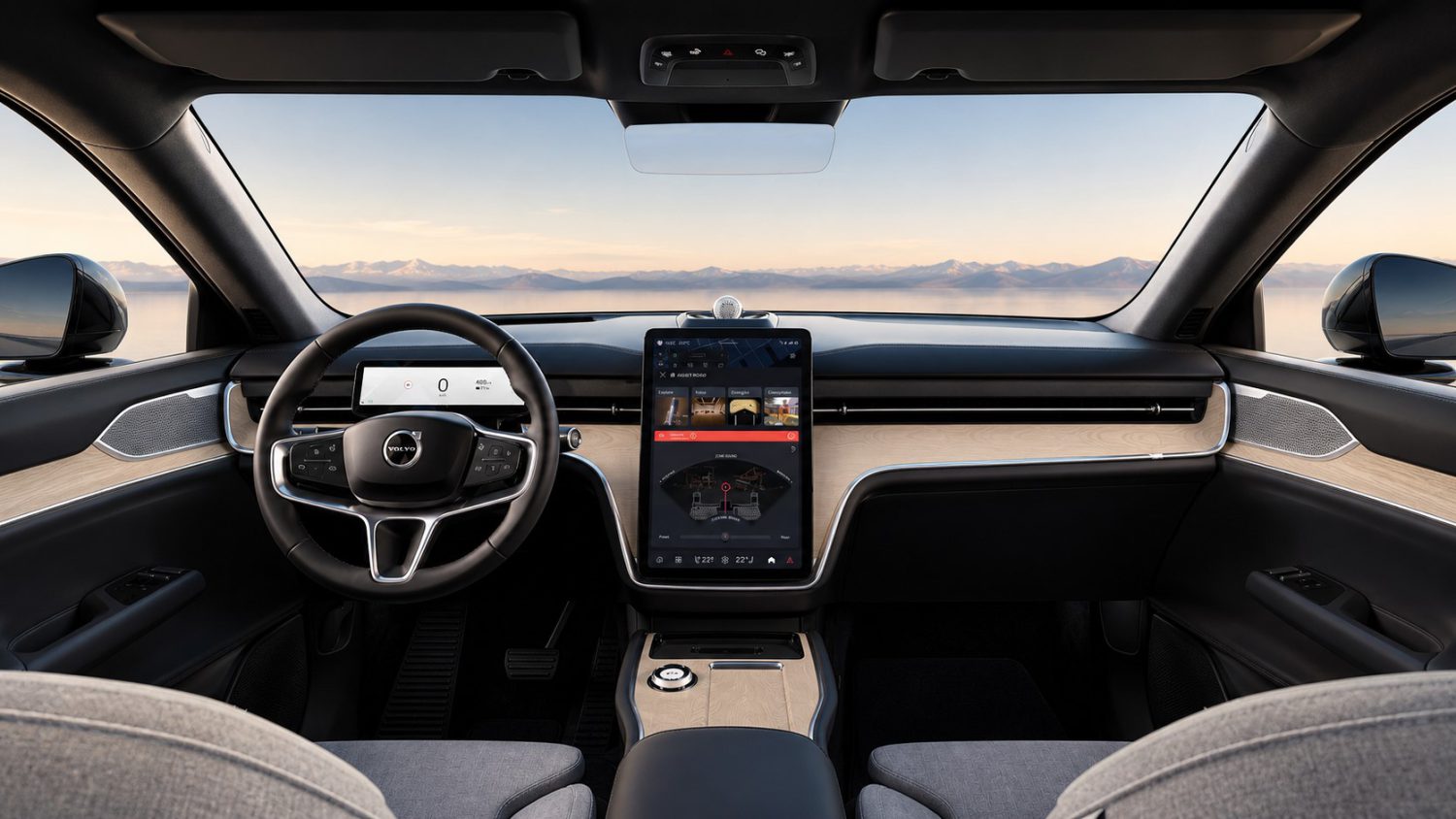
Crest a hill at 70 mph and you’re essentially flying blind into whatever’s on the other side. A moose standing in lane two. A cyclist who drifted onto the shoulder. A fender-bender that happened three minutes ago. Your headlights can’t help you yet. Now, if the Volvo that came over that hill before you detected the hazard, tagged it with GPS coordinates, and pinged Volvo’s cloud — your EX90, ES90, or EX60 already knows. No driver tapped anything. The car did it automatically. For context on how autonomous systems can still go wrong, a driverless Tesla recently made headlines after crashing through traffic barriers.
Four Alerts, One Cloud, Zero Manual Reports Required
This update turns each equipped Volvo into a silent scout for every other connected car behind it.
Volvo’s expanded Connected Safety program — rolling out via over-the-air update to its three newest EVs across Europe, the US, and Canada — adds four specific hazard categories to its existing alert network:
- Large animal alert (deer, moose, anything that totals a bumper)
- Vulnerable road user alert (pedestrians and cyclists on or near higher-speed roads)
- Roadwork alert
- Accident ahead alert
The detection is sensor-driven. Onboard cameras and radar flag the hazard automatically, log a GPS position, and send it to Volvo’s servers. Other connected Volvos traveling the same road receive the warning before they arrive. Think of it as Waze — except nobody has to tap a button, and the source is calibrated sensor data rather than a stranger’s phone.
That distinction matters. Fewer human inputs means fewer false positives. The tradeoff: the system requires an active internet connection and a road present in the vehicle’s map database. Rural tracks and dead zones fall outside its reach — a real limitation worth keeping in mind before you lean on it.
A Decade in the Making, and the Network Is Just Getting Interesting
Volvo’s Connected Safety roots stretch back to 2016, and the growing fleet is what makes the whole system more valuable over time.
Volvo has been running cloud-based hazard sharing since 2016, when Hazard Light Alert and Slippery Road Alert launched in Sweden and Norway on the 90 Series. Around one million Volvo vehicles now carry some version of Connected Safety. Crucially, Volvo shares that data beyond its own fleet — traffic management centers and select partner brands receive it too, extending the safety benefit well past Volvo drivers alone.
The same OTA update cycle also delivers native Apple Music with Dolby Atmos Spatial Audio through the optional Bowers & Witkins system on these three models. Safety update and concert-hall audio, arriving the same way your phone gets smarter overnight. No dealership required.
That’s the real signal here. As Volvo’s connected fleet grows beyond its current roughly one million vehicles, the alerts become faster and more statistically reliable. What’s a differentiator today — networked hazard awareness — follows the same arc as ABS: eventually, every premium automaker either matches it or explains why they didn’t. If you’re weighing the broader EV ownership proposition, it’s worth understanding what a car really costs across gas vs diesel vs electric before committing.