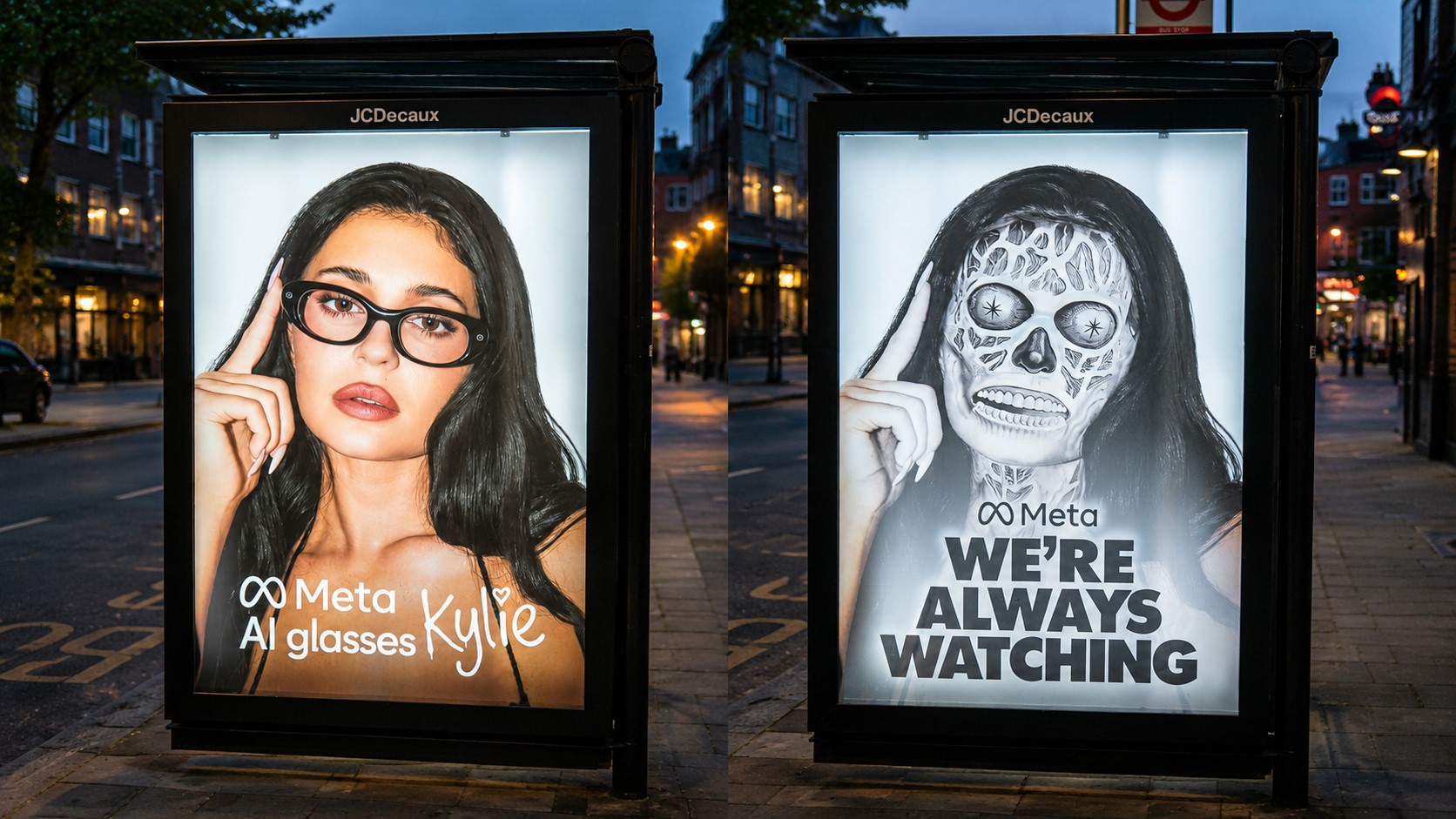
You walk past a London bus stop. Kylie Jenner stares back, modeling Ray-Ban Meta smart glasses. Take one step sideways. Her face becomes a skull, warning about AI surveillance. No magic trick — that’s a lenticular print, two interlaced images that flip depending on your viewing angle, installed covertly near Meta’s UK offices in late July 2026, according to PetaPixel. An unnamed activist group pulled it off, channeling John Carpenter’s They Live (1988), the cult film where special sunglasses reveal skeletal faces and hidden commands beneath everyday advertising. The joke lands because the parallel is uncomfortably precise.
The Ad Does What Meta’s Glasses Actually Do
Meta sells a lifestyle tool; activists sell the flip side — and both are describing the same hardware.
Meta’s official Ray-Ban campaign pitches hands-free moments, live streaming, fashion-forward AI. The spoof pitches what happens to everyone else in the frame. These glasses carry dual 12MP cameras and can record up to three minutes of continuous video. The indicator light meant to signal recording is small enough that most bystanders won’t clock it. That’s not a flaw in the activist’s argument — it’s the entire point.
The concern isn’t theoretical. In 2024, Harvard researchers ran Ray-Ban Meta footage through facial recognition systems and matched strangers’ faces to names, home addresses, and personal data from public sources, according to Hyperallergic. Meta frames the glasses as creator tools. Activists argue the same hardware enables unconsented public profiling at scale. Camera-equipped eyewear sparked social backlash well before this — bans, venue restrictions, and informal norms against wearing them in bars or sensitive spaces — but AI and facial recognition have become dramatically more capable since those earlier debates, as Engadget noted. The rise of the surveillance app ecosystem has only accelerated those concerns.
Culture-Jamming in the Format Being Critiqued
The medium mirrors the message — you think you’re seeing one thing, and reality is something else entirely.
Lenticular printing isn’t new technology — it’s been used in everything from novelty postcards to stadium advertising for decades. Using it here is deliberate. The activists didn’t just parody Meta’s ad — they reproduced the exact perceptual trick that They Live built its entire premise around, embedding critique inside the format being critiqued. The stunt also highlights how influencer-driven campaigns normalize always-on recording by wrapping the hardware in fashion and aspiration. Broader industry momentum around smart glasses from multiple tech giants suggests this debate is far from over.
The placement matters too. A bus stop near Meta’s UK headquarters forces the people who build and market these products to walk past the counter-argument every morning. The spoof’s text warns of “secret surveillance,” which isn’t hyperbole given the Harvard research. Whether or not you wear smart glasses, this stunt drops the consent question squarely in public space — where it belongs.
Regulatory frameworks haven’t caught up. GDPR covers data processing, but not the moment a stranger’s face gets recorded by someone’s glasses on the Tube. Until that gap closes, expect more culture-jamming like this. Sometimes the only way to make people look twice is to make them take a step sideways.