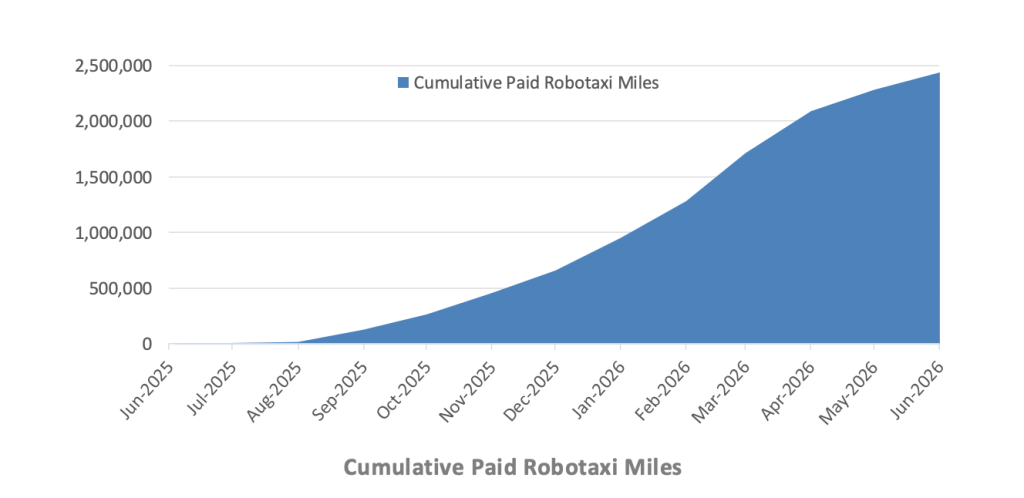
Tesla wants you to believe its Robotaxi program is accelerating. Its own data says otherwise. Buried inside the Q2 2026 shareholder deck sits a cumulative paid-miles chart climbing smoothly to roughly 2.5 million miles by the end of June. Looks great on a slide. Do the math quarter by quarter, and the story unravels fast. Independent analyses from TechCrunch, Electrek, and EVwire all land on the same conclusion: paid Robotaxi mileage growth has flatlined — or reversed.
The Chart That Tells a Different Story
Three separate analyses of Tesla’s own data agree on one thing — the Robotaxi ramp isn’t ramping.
Cumulative charts only go up. That’s the point. Tesla showed investors a smooth upward curve, but strip out the running total, and the picture changes fast. TechCrunch pegs Q1 2026 at roughly 1.1 million paid miles, dropping to about 700,000 in Q2 — a 36% quarterly decline. Electrek reads the same chart more generously at approximately 900,000 miles per quarter, but flags that April alone accounted for around 500,000 of those. May and June delivered roughly 200,000 miles each. That exit rate implies about 600,000 miles per quarter going forward — decelerating by the end of Q2.
- Cumulative paid miles: ~2.4–2.5M through June 2026 (Tesla’s own chart)
- Q1 2026 paid miles: ~1.1M (TechCrunch) or ~900k (Electrek)
- Q2 2026 paid miles: ~700k (TechCrunch/EVwire) or ~900k (Electrek) — no acceleration either way
- April alone: ~500k miles; May and June dropped to ~200k per month each
- Exit run-rate: ~600k miles per quarter — clear deceleration by late Q2
“Tesla’s Robotaxi is not scaling. It is, for now, a test program acting as a paid fare service.” — Electrek
Musk countered on the earnings call with claims of “more than 10% weekly growth.” That figure describes a narrow slice — unsupervised miles only, a small subset of total paid operations. It’s the statistical equivalent of a restaurant bragging about Tuesday night table turns while monthly covers are quietly dropping. Tesla VP of AI Ashok Elluswamy echoed the weekly growth framing, projecting that compounding rate through year-end. Neither addressed the quarterly trajectory.
The Cybercab Problem Nobody Saw Coming
Musk quietly admitted that millions of customer FSD miles can’t fully train the Robotaxi he promised.
For years, Tesla’s pitch was straightforward: data from nearly 10 million customer vehicles running Full Self-Driving would seamlessly train future Robotaxis, making regulators — not technology — the bottleneck. On the Q2 earnings call, Musk walked that back. The Cybercab needs chassis-specific driving data before it can scale. Early units will be retrofitted with steering wheels and pedals to collect it. That’s not a footnote — it’s a structural admission that the data flywheel argument had a significant gap.
Tesla has bet heavily on the concept of a large, low-cost, revenue-generating Robotaxi fleet — or going “all in for autonomy,” as CEO Elon Musk described it in 2024.
Not quite betting the company, but going balls to the wall for autonomy is a blindingly obvious move.
— Elon Musk (@elonmusk) April 16, 2024
Everything else is like variations on a horse carriage.
Then there’s the safety record, which deserves scrutiny. Elluswamy told investors the program has covered 380,000 unsupervised miles with “zero notable incidents.” He never defined “notable.” Tesla has filed 22 crash reports with NHTSA since Robotaxi trials began — including three caused by its own teleoperators moving vehicles remotely, plus multiple low-speed impacts with curbs, utility poles, and a tow truck. The word “notable” is carrying enormous weight in that claim. Tesla also counts San Francisco Bay Area rides within its Robotaxi “coverage” figures, despite those vehicles requiring mandatory safety drivers due to missing state autonomous operation permits — counting supervised rides as Robotaxi coverage is roughly as meaningful as a streaming service counting a view after someone watches the trailer.
Tesla’s stock dropped more than 13% following the earnings release, with the company missing on EPS while projecting $25 billion in capital expenditure for the year. The Cybercab data gap means a longer, costlier road to scale than any investor presentation implied. The reckoning isn’t coming from regulators. It’s coming from Tesla’s own spreadsheet.