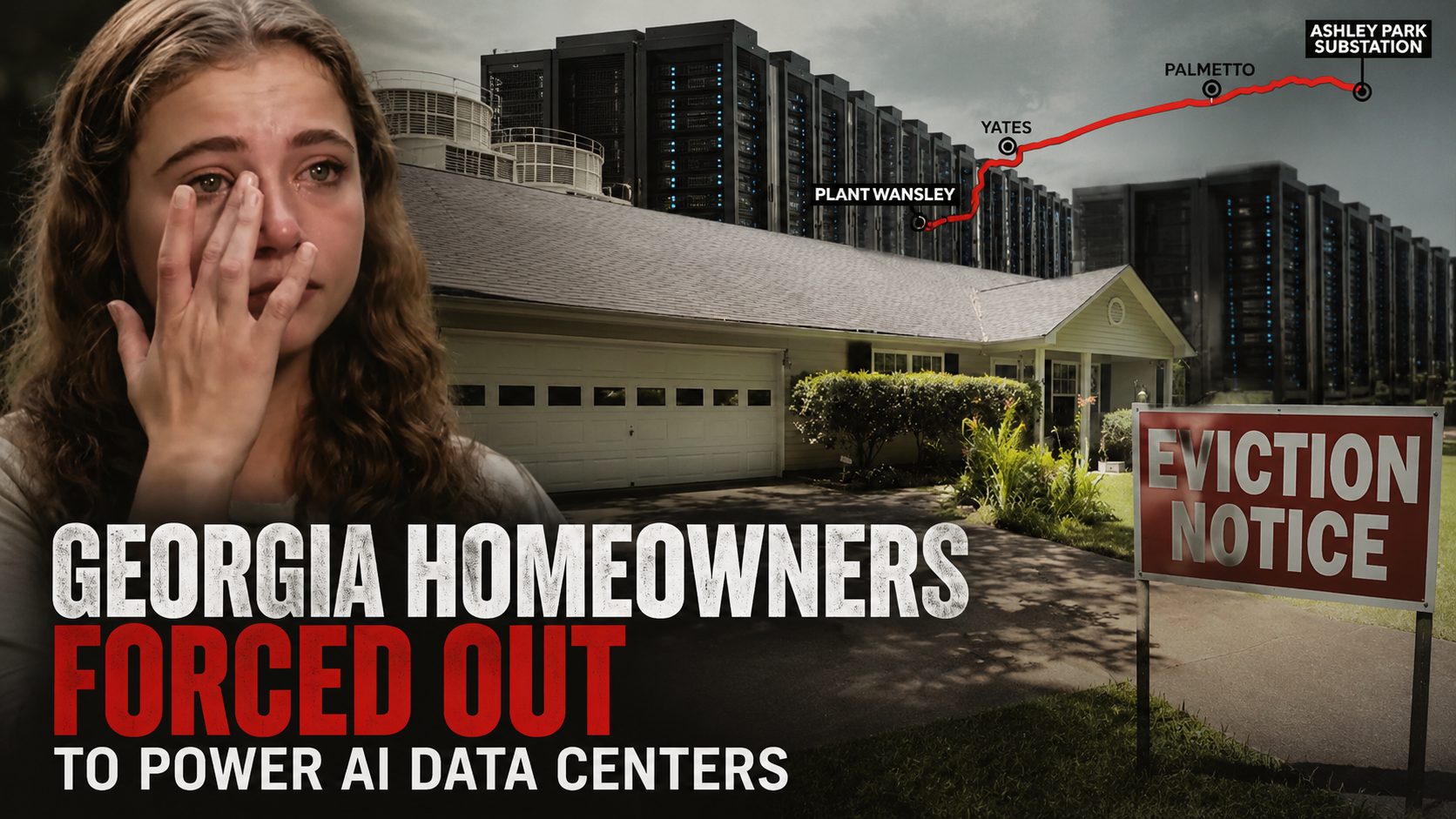
Angela Hall bought her home in 2003 through a USDA loan program designed for single mothers in rural areas. It wasn’t destroyed by a storm or lost to foreclosure. Georgia Power wants the land beneath it for high-voltage transmission lines feeding AI data centers. Her daughter Ansley Brown posted about it on TikTok. Six million people watched.
“It is being taken by force by Georgia Power,” Brown stated publicly.”Homeowners in this county do not have a choice. It is called eminent domain and they will take it.”
The Numbers Behind the Land Grab
Georgia Power says it needs 10,000 megawatts of new capacity — and roughly 80 percent of it serves data centers, not your kitchen lights.
The utility is building 230-kV and 500-kV transmission lines across Coweta and Fayette counties to support at least four AI-focused data centers, according to AP News. About 330 private properties sit in the path. Between 20 and 30 homes are expected to be demolished entirely, per legal analysis from MROD Law.
The projects carry internal names like “Project Wansley” and “Project Sail.” The actual corporate tenants? Undisclosed, citing “security concerns.” The families losing their homes don’t even know whose servers they’re making room for.
Here’s what homeowners are actually facing:
- Accept Georgia Power’s offer now, or face formal condemnation proceedings
- Hall’s family believes the offer runs roughly $100,000 below market value; Georgia Power says it offered above the official appraisal
- Transmission lines will cut through backyards, pools, and generational family land
- Eminent domain legally applies because grid infrastructure qualifies as “public use” — even when 80 percent of new load is corporate
The Law Is Clear. That Doesn’t Make It Comfortable.
Post-Kelo America is supposed to be skeptical of takings that primarily benefit private interests — but transmission lines keep getting built.
Georgia Power calls eminent domain a “last resort,” stating it has “worked hard to be transparent, negotiate in good faith, and make the process as easy as possible,” according to WSB-TV. Brown’s family disputes that characterization, calling the process “bullying.”
Legal experts note that homeowners’ real recourse is challenging the valuation — not the taking itself. That’s the shadow cast by Kelo v. City of New London, the 2005 Supreme Court decision that made Americans deeply uneasy about eminent domain serving private commercial interests. The doctrine hasn’t changed; only the beneficiary has — from a waterfront development project to a data center campus running AI workloads around the clock.
A Preview of Conflicts Coming Everywhere
Georgia officials say accept data centers or get “left behind” — but displaced families are asking who “public use” actually serves.
State energy leaders have urged residents to embrace data center growth or risk economic irrelevance, according to the Ledger-Enquirer. Data centers do bring jobs and tax revenue. Nobody serious disputes that. But when 80 percent of new capacity serves unnamed corporate clients while families lose homes their mothers bought with federal assistance, the phrase “public use” starts doing some heavy lifting.
As AI compute demand climbs nationally, Georgia won’t be the last state where this fight plays out. Compensation will be set on someone else’s terms, by someone else’s appraisal — and the central question won’t be whether the takings are legal, but whether legal has ever been the same thing as fair.