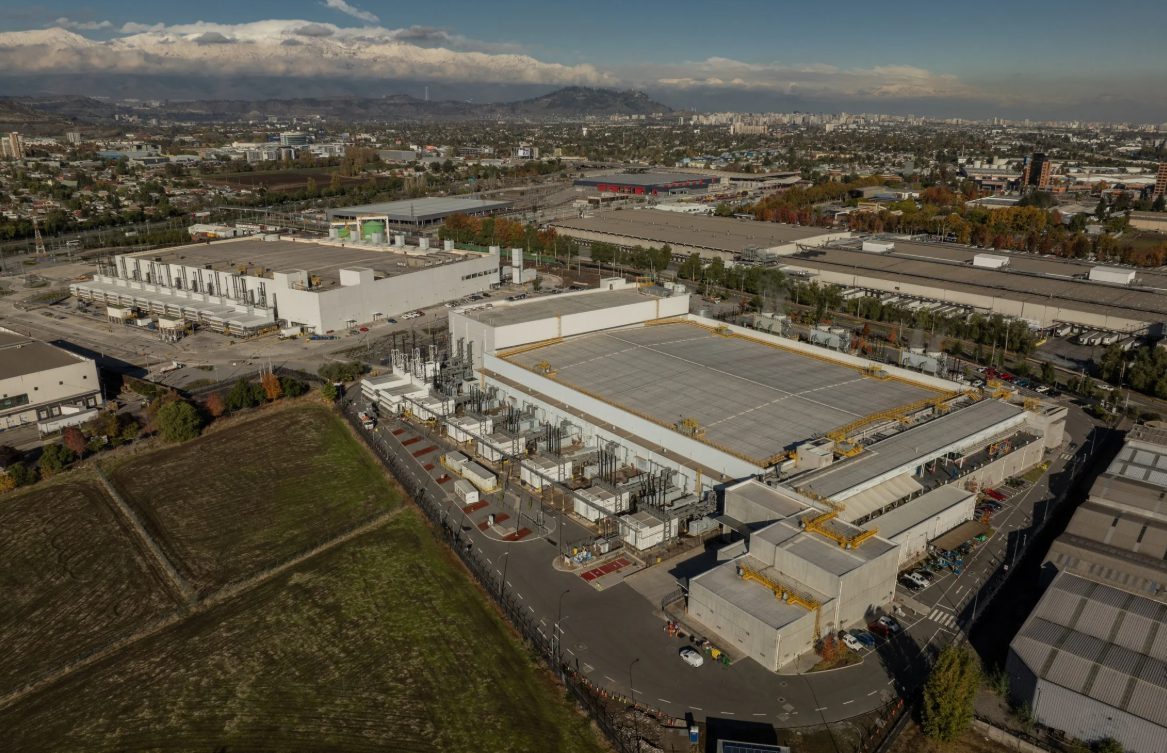
Your neighborhood’s water source disappearing so ChatGPT can generate another image of a cat wearing sunglasses? That’s essentially what’s happening in Quilicura, Chile, where activists describe a once-thriving wetland as “a wetland without water”—dried and yellowed after years of industrial pumping to cool the data centers powering your cloud storage and AI queries.
The Thirst Behind Your Thumb Swipes
Google alone consumed 461 million litres at its Chilean facility in 2024—enough for 8,500 households annually.
Chile positioned itself as Latin America’s tech hub starting around 2015, attracting Google, Microsoft, and others with political stability and renewable energy. But the hidden cost is staggering. Google’s water rights in Quilicura allow extraction of 50 litres per second. Their cancelled second facility in Cerrillos would have claimed 228 litres per second—equivalent to 40,000 households’ worth.
Nationally, data center water consumption is projected to hit 31.8 billion litres by 2030, a 19% annual growth rate that makes your Netflix addiction look quaint. This boom coincides with Chile’s 15-year mega-drought, where central regions face persistent precipitation deficits and rising temperatures.
When Silicon Valley Meets Ancient Ecosystems
Communities report visible wetland transformation while tech companies promise green solutions that keep failing.
The Quilicura wetland once regulated groundwater and buffered droughts across Santiago’s northern edge. Now residents see dried grass where marshland used to thrive, even as aquifer levels drop from combined drought and industrial extraction pressure.
Google’s main community offset—an urban park promising 1,500 native trees—has become a symbol of corporate greenwashing gone wrong. Local councillor Alexandra Arancibia reports withered vegetation and broken irrigation, describing the initiative as a failure that highlights minimal community engagement from data center operators.
AI’s Exponential Water Appetite
Every ChatGPT conversation consumes the equivalent of a water bottle when cooling and power generation are included.
Here’s where your generative AI habit gets expensive for the planet. Researcher Nicolás Jara found that AI-focused data centers consume up to ten times more water than traditional storage facilities, thanks to intensive cooling needs for GPU-heavy workloads. Those 10-50 ChatGPT responses you fire off daily? They collectively require about 500ml of water upstream—the same bottle you’d grab at a convenience store.
Corporate Cooling Claims vs. Ground Truth
Microsoft touts air-based systems while Ascenty claims minimal impact, but the wetland keeps shrinking.
Companies are scrambling to address the optics. Microsoft emphasizes air-based cooling and funds Maipo river restoration projects, while Ascenty insists its facilities only consume water equivalent to 16 households annually. Yet activist Rodrigo Vallejos estimates major operators collectively use 1.5 billion litres yearly in Quilicura alone.
The industry’s new data center association now campaigns against “myths” about water consumption—a defensive posture that suggests the criticism is landing. Climatologist Pablo Sarricolea argues the real question is whether water gets prioritized for tech companies or people. Your cloud might be invisible, but its thirst is reshaping landscapes thousands of miles away.