
Scroll through YouTube Music and you might now spot something new sitting beneath a song’s title: a small “AI” label signaling that a machine played a significant role in making what you’re about to hear. YouTube began rolling out the feature on October 14, 2026. The label applies to tracks where generative AI produced major components such as the composition, the vocals, or both.
Tapping the label opens a detail menu providing more information about how AI was used, giving you context before you decide whether to keep listening, save the track, or move on. The feature arrives as streaming catalogs receive more AI-generated uploads and listeners grow more attentive to questions of authenticity and origin.
What the Label Actually Does
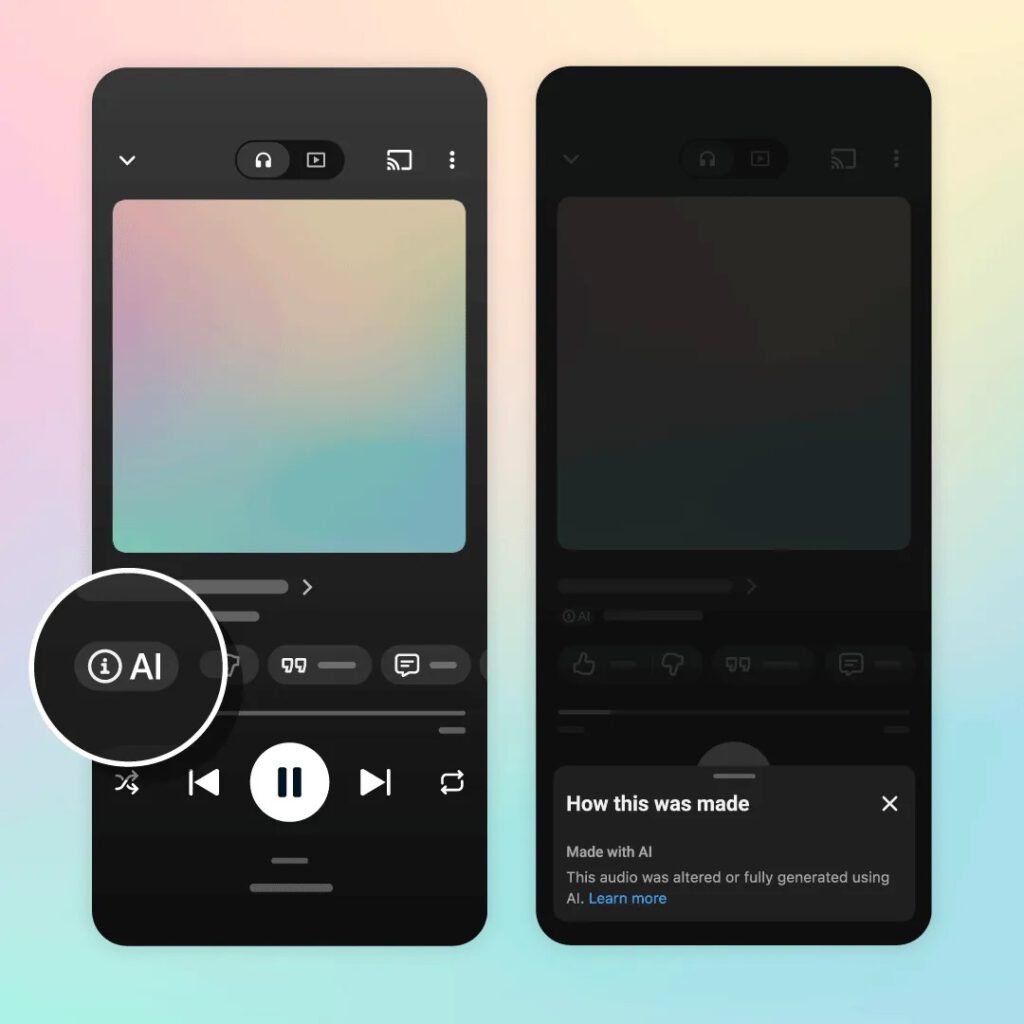
The label sits directly on the player page and taps open to reveal more about how AI shaped the track.
The label appears on the player page beneath the track information. YouTube says it determines which tracks qualify using disclosures from music partners and its own internal detection tools. It may also use signals beyond creator disclosures alone, according to The Verge.
Standard digital production tools, including pitch correction, are not classified as generative AI under this framework. The broader treatment of conventional mixing and mastering tools is not fully specified in YouTube’s announcement, so that distinction is worth noting.
The label applies when a track meets conditions such as these:
- AI generated the composition, the vocals, or both as primary elements
- The track qualifies as primarily created with generative AI tools
- YouTube’s detection system or partner disclosures identify it for classification
- The creator or distributor provides disclosure about AI’s role in production
Note that creator or distributor disclosure is one route to classification, not the only one. YouTube’s internal detection tools and additional signals may also trigger the label independently. Separately, AI involvement alone does not automatically affect a track’s eligibility for monetization, according to reporting by Yahoo Tech. The feature is designed as a transparency measure, not a content filter.
How YouTube Compares to Rivals
YouTube sits between Spotify’s voluntary credit system and Deezer’s more restrictive exclusion approach.
Spotify has tested AI-use information in song credits, but its approach depends largely on voluntary disclosures from artists, labels, or distributors. It is not a comprehensive listener-facing system in the way YouTube’s label is. Deezer takes a more interventionist position: it tags albums containing AI-generated tracks and excludes detected AI music from algorithmic recommendations and human-made playlists, according to the BBC.
YouTube’s current approach sits between those two models. It informs you about significant AI involvement without deciding whether that disqualifies a track from your queue. The labels are also expected to expand to the main YouTube app’s video player, extending the disclosure system beyond the dedicated music service.
An Honest Caveat About Consistency
The system’s accuracy depends on multiple inputs, and a missing label does not confirm a track is entirely human-made.
Reliability depends on partner disclosures, automated detection, and YouTube’s classification standards. Each of those inputs can produce gaps or disputes, so the system should be understood as informative rather than comprehensive. A label’s absence does not confirm a track is entirely human-made, and not every creator or distributor may disclose AI involvement accurately or at all. That remains a potential limitation rather than a demonstrated outcome.
The label gives you a visible, tappable signal when a song’s core elements were substantially built with generative AI tools. Whether that changes what ends up in your playlist is your call.