Remember Japan’s Henn-na Hotel? It deployed robot dinosaurs at the front desk, then quietly hired humans back when half the machines broke down. Pudu Robotics thinks it has cracked what Henn-na couldn’t — not with a single novelty bot greeting guests, but with a coordinated fleet running every operation, front-of-house and back, across a 44-room hotel on West Artificial Island of the Shenzhen–Zhongshan Link in Guangdong Province. Trial operations target late 2026. First guests arrive early 2027, according to Pudu and its partner, Shenzhen Culture & Tourism Industry Development Co. Ltd.
Every Job, No Exceptions
From luggage hauling to espresso service, robots handle the full guest journey under a shared AI brain.
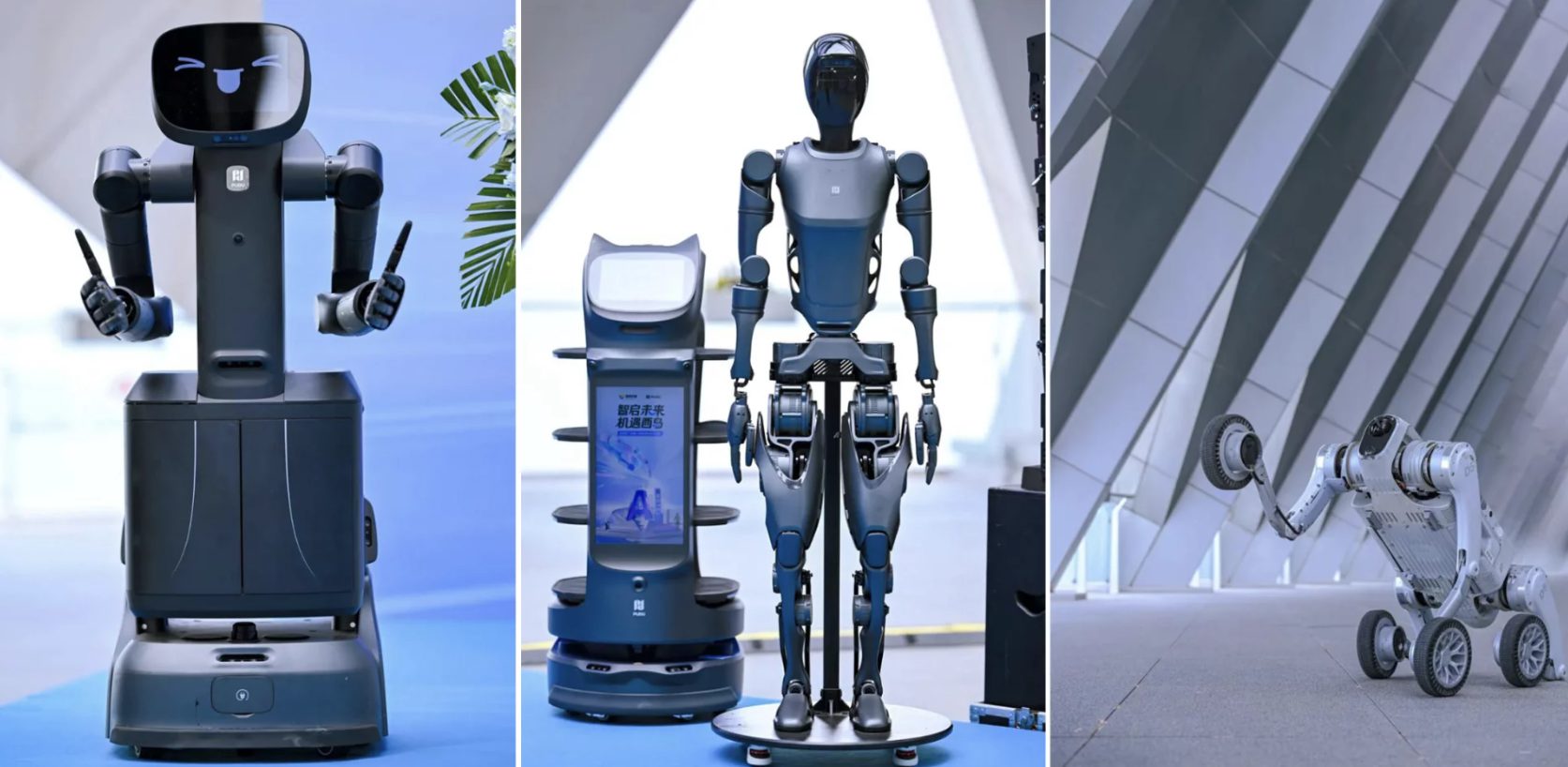
You check in via robot. A PUDU T300 — payload capacity around 300 kg (661 lb) — hauls your suitcase to your room without a bellhop in sight. BellaBot Pro delivers freshly brewed coffee, complete with expressive lighting effects. KettyBot Pro handles snack delivery and displays hotel info on its onboard screen. CC1 Pro and MT1 clean floors autonomously. FlashBot runs vending and room delivery. Guest issues route through the hotel’s AI management layer rather than a human staff member.
The backbone is PuduFM 1.0 and PuduAgent — a shared intelligence layer. Built on Vision-Language-Action models, the system lets robots with different hardware share perception and navigation improvements in real time. When one robot learns a better route, the entire fleet benefits. Pudu co-founder and CTO Cong Guo told New Atlas that robots will be “deeply involved in every part of hotel operations, with no service gaps and no human interruptions.”
Impressive Demo, Unproven Hotel
A polished signing ceremony showed what’s possible, but no booking link exists yet.
The June 2026 unveiling was also a live performance — Pudu staged a full hotel simulation, complete with the PUDU D5 robot closing the show with an “interactive performance.” Think Apple keynote energy, but for room service. That detail matters: this remains partly a signed agreement and partly a public demonstration of a model being built in real time. Real-world reliability across sustained guest operations remains unvalidated.
“Provides an opportunity to explore new service models where AI and robotics work together to deliver intelligent, end-to-end experiences in the real world.” — Pudu Robotics
For hospitality operators, this is the stress test worth watching. A 44-room showcase property with government backing, a restaurant, a gym, and Pudu’s full product lineup represents close to ideal conditions. If fully autonomous service can’t work here, the timeline for broader deployment gets pushed back significantly. If it does, hotel chains in high-wage markets will be running staffing spreadsheets well before 2030.
The question was never whether robots can carry luggage or brew espresso — Pudu’s existing restaurant deployments already prove they can. The real test is whether a coordinated fleet can handle the unpredictable, often irrational texture of actual guests, night after night. That answer arrives in early 2027.