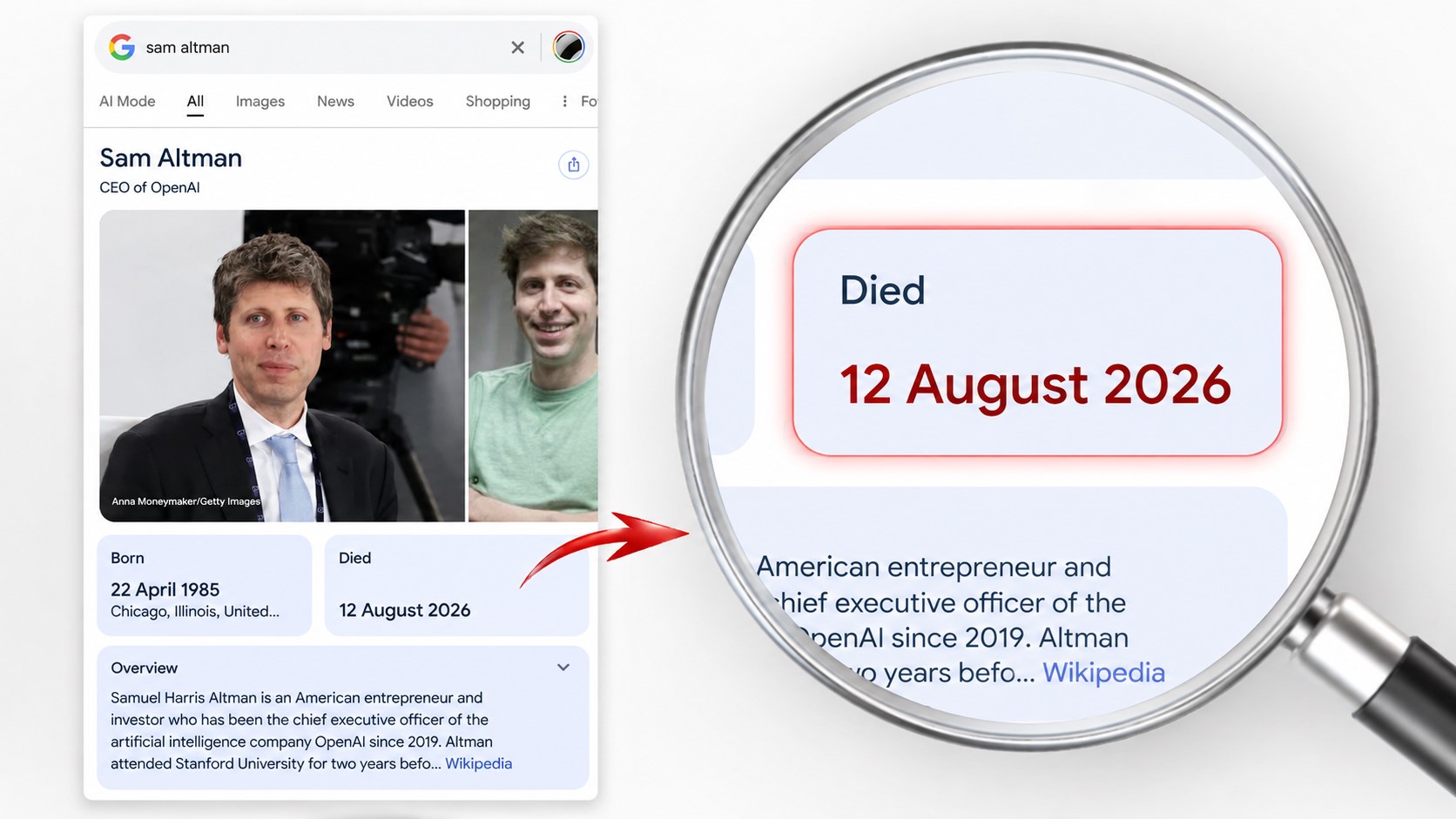
On August 12, 2026, Google Search reportedly told anyone who looked that Sam Altman — sitting CEO of the most talked-about company in tech — was dead. Killed in Seattle, according to a vandalized Wikipedia entry that apparently moved through Google’s automated pipeline faster than a human could catch it. The same panel, in the same breath, described him as OpenAI‘s current chief executive. Google’s own system couldn’t agree with itself. That contradiction isn’t just embarrassing. It’s the story.
The chain of events moved fast:
- A vandal reportedly rewrote Altman’s Wikipedia biography to include a death date of August 12, 2026, a Seattle location, an assassination framing, and a full past-tense rewrite of the opening paragraph
- Wikipedia’s automated tools flagged the edit as a potentially unreferenced addition to a living person’s biography; a human editor reverted it at 10:29 UTC — roughly 41 minutes after it appeared
- Google’s Knowledge Panel apparently ingested the false data and surfaced it under the standard “All” tab — not AI Mode, not an AI Overview, just ordinary Search
- A screenshot landed on X at 12:36 UTC; a second false edit reportedly reintroduced the death date at 12:39 UTC before being removed again
- Google responded on X: “Thanks for flagging. This is no longer appearing, and was not a manual change by Google.”
The Confidence Problem Nobody Wants to Talk About
Google’s narrow public response cleared the error but left the harder question — how the system accepted an unverified death claim in the first place — completely unanswered.
Google’s response is technically accurate. No employee manually entered a death date. That’s the easy answer. The harder question — why the automated system apparently accepted an assassination claim about a living person without corroborating a single other source — remains unanswered.
Knowledge Panels update automatically from structured public data. According to Google‘s own documentation, that’s the feature. It’s also, clearly, the vulnerability. At least once, that confidence threshold decided a 41-minute Wikipedia edit was reliable enough to broadcast to every user who searched a sitting CEO’s name. Think of it less like a fact-checker and more like autocomplete with a press credential.
Altman’s profile will recover quickly. The less famous public figure — the local politician, the academic, the journalist — with a sparse Wikipedia entry and no PR team monitoring their Knowledge Panel? That’s a different story entirely. This isn’t a one-famous-name problem; it’s a structural exposure for anyone whose biographical facts live inside Google’s Knowledge Graph. Google has not publicly addressed what protections, if any, exist for lower-profile individuals whose Knowledge Panels lack the same scrutiny.