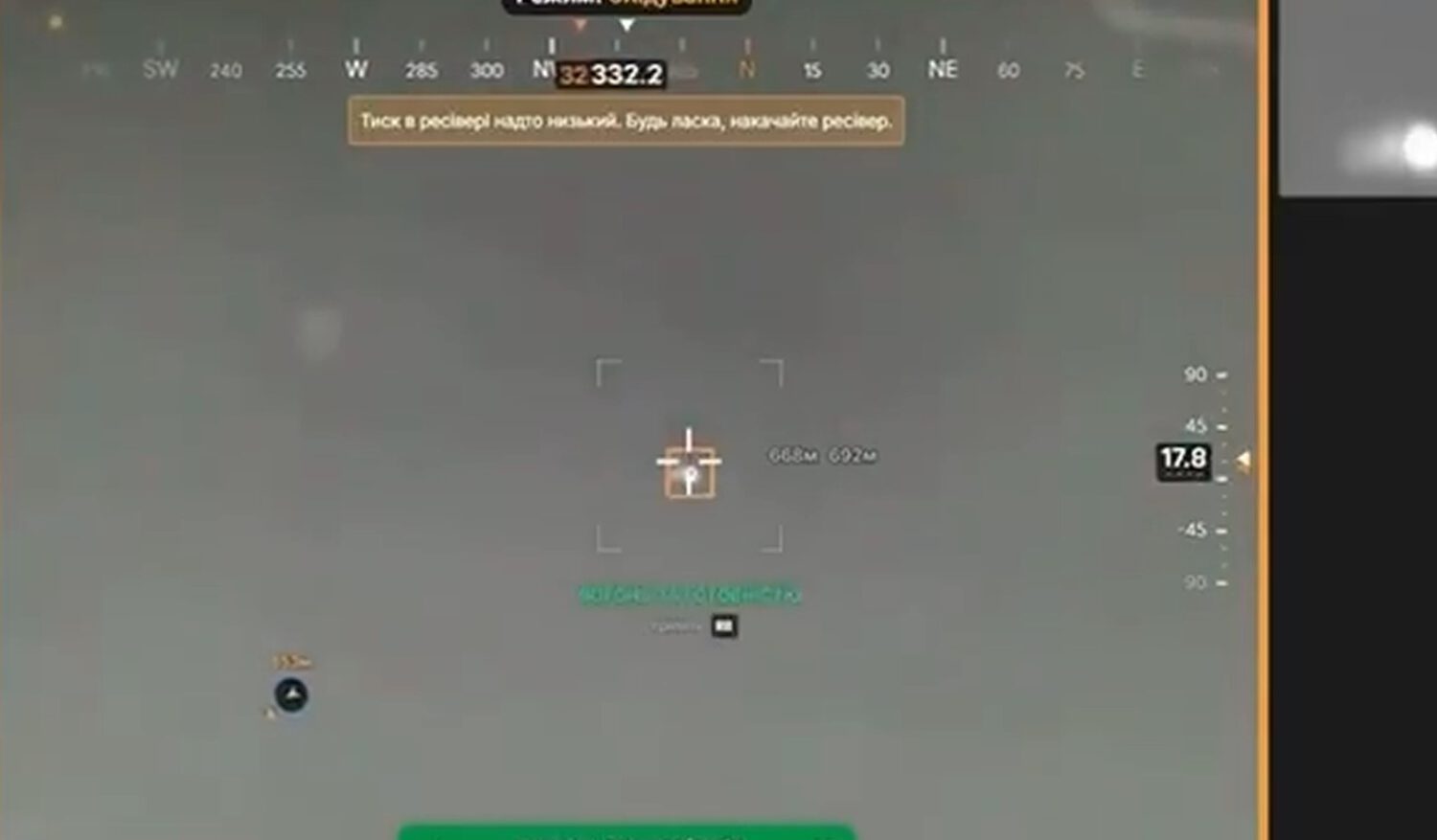
Missiles cost money. Every one fired against a cheap Shahed drone represents a lopsided exchange rate that favors Russia. Ukraine’s reported answer to that arithmetic is Blysk, a domestically built combat laser developed by Carmine Sky. It allegedly brought down a jet-powered Geran drone using electricity instead of a missile interceptor. That claim has not been independently verified.
Presidential defense-technology adviser Serhii “Flash” Beskrestnov shared a roughly 21-second video on Telegram on November 25, 2026. He asserted that Blysk had achieved the world’s first combat laser kill of a jet-powered Geran. Ukrainian media reported the claim widely, but no independent confirmation from Ukraine’s defense ministry or any outside technical body was identified in the available reporting.
What Blysk Actually Is
Carmine Sky describes Blysk as a 4-kilowatt system built to defend fixed infrastructure at close range.
Carmine Sky describes Blysk as a 4-kilowatt directed-energy weapon with an effective range of up to approximately one kilometer. The system was placed on combat duty at an unnamed critical-infrastructure site in Kyiv in early November 2026.
During its first days on combat duty, no successful engagement had been publicly reported. Carmine Sky has stated that a small FPV drone could be disabled nearly instantly, while a larger Shahed-type target would need to remain inside the beam for several seconds.
Why the Claimed Target Changes the Significance
A jet-powered Geran moves faster than a propeller-driven Shahed, leaving a short-range laser less time to work.
That speed compresses the window available for a short-range laser to acquire, track, and hold a damaging beam on the airframe. If Beskrestnov’s claim holds up to independent scrutiny, the engagement would represent a more demanding test than intercepting a slower drone.
The Economics Argument Has Real Limits
Carmine Sky suggests electricity costs less per engagement than a missile, but verified figures are not publicly available.
That marginal comparison is directionally plausible but incomplete. A full accounting would need to include the system’s acquisition price, generator and cooling requirements, optics, and maintenance. Trained operators and the vulnerability of a fixed installation to counter-targeting add further cost dimensions, and none of those figures appear in the available reporting.
Weather Is the Hard Ceiling
Cloud cover, fog, and atmospheric turbulence can degrade or block a laser beam entirely.
Earlier reporting noted that Blysk had not publicly reported a successful engagement during periods of cloud cover and fog in its opening deployment days. Rain, smoke, dust, and atmospheric turbulence can all degrade or block a laser beam, a general characteristic of directed-energy systems.
That constraint positions Blysk as a complement to missile-based defenses at fixed sites, particularly in clear-weather conditions. It is not a replacement against the full range of threats Ukraine faces.
Where Things Stand
The reported interception awaits independent confirmation, and serial production discussions remain premature.
Beskrestnov indicated it was too early to discuss serial production. The exact date, location, interception range, and specific drone variant from the claimed engagement are not publicly established, and November 25 refers to when the video was posted, not necessarily when the interception occurred.
The reported interception, if independently confirmed, would mark a meaningful operational milestone for directed-energy air defense in an active conflict. No such confirmation was identified in the available reporting.