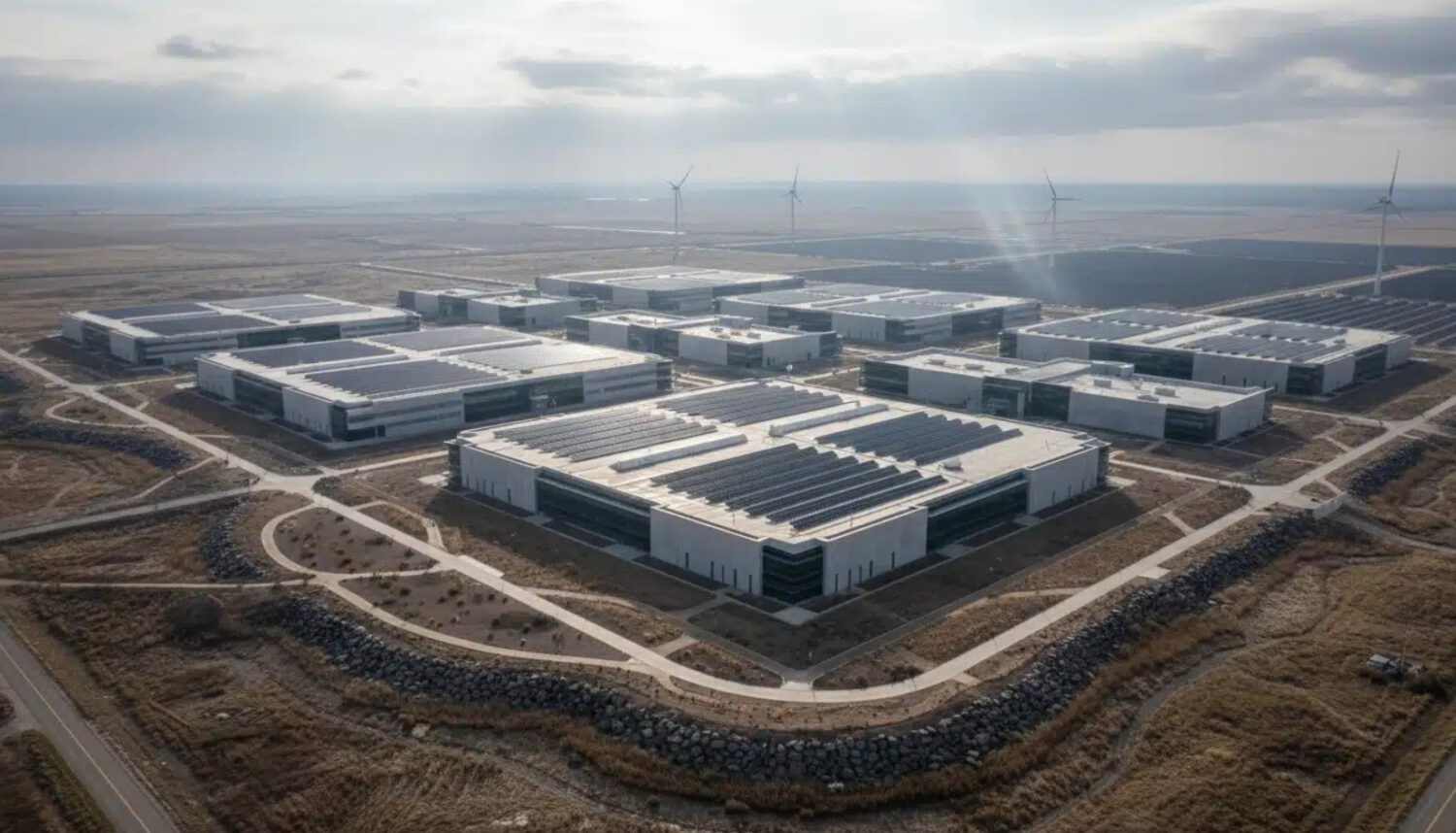
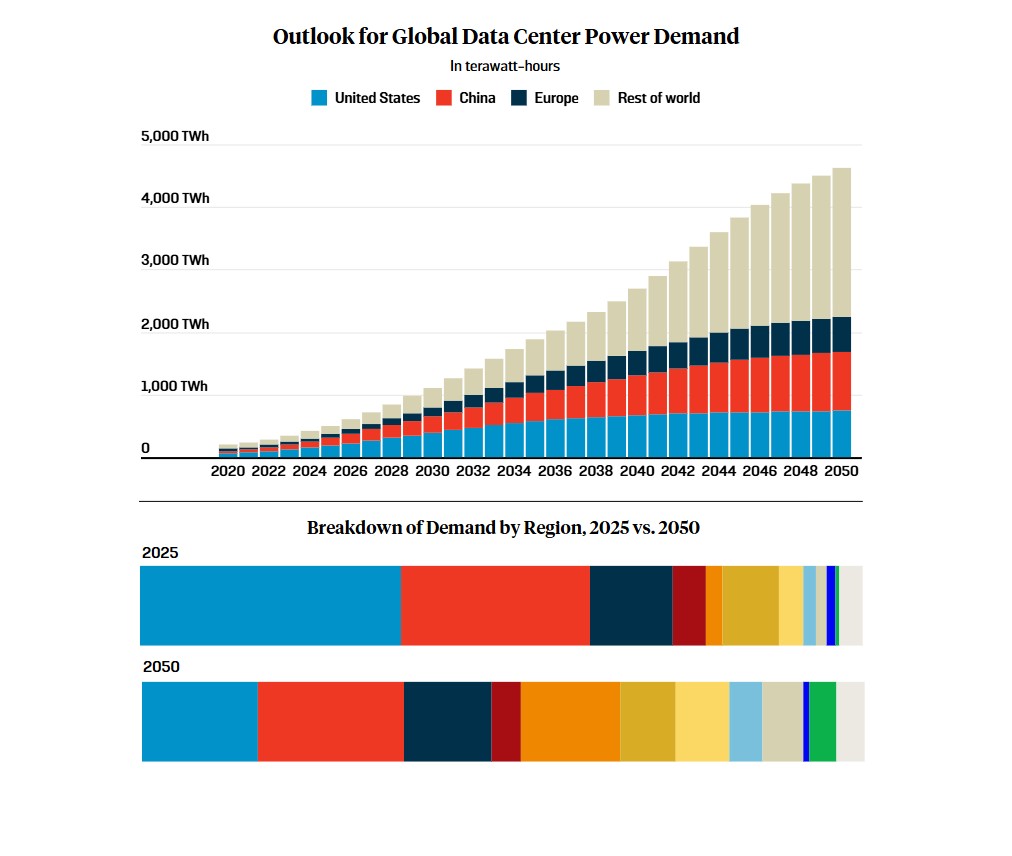
Estimates of global data-center electricity consumption vary by methodology and reference year. The United Nations University estimated 2025 consumption at approximately 448 terawatt-hours, while the International Energy Agency put the 2024 figure at around 415 TWh, equal to roughly 1.5% of all electricity used on Earth. Both figures would rank data centers among the world’s eleven largest electricity consumers if treated as a single country.
The IEA projects that figure will roughly double by 2030, reaching approximately 945 TWh. That approaches Japan’s current national electricity consumption.
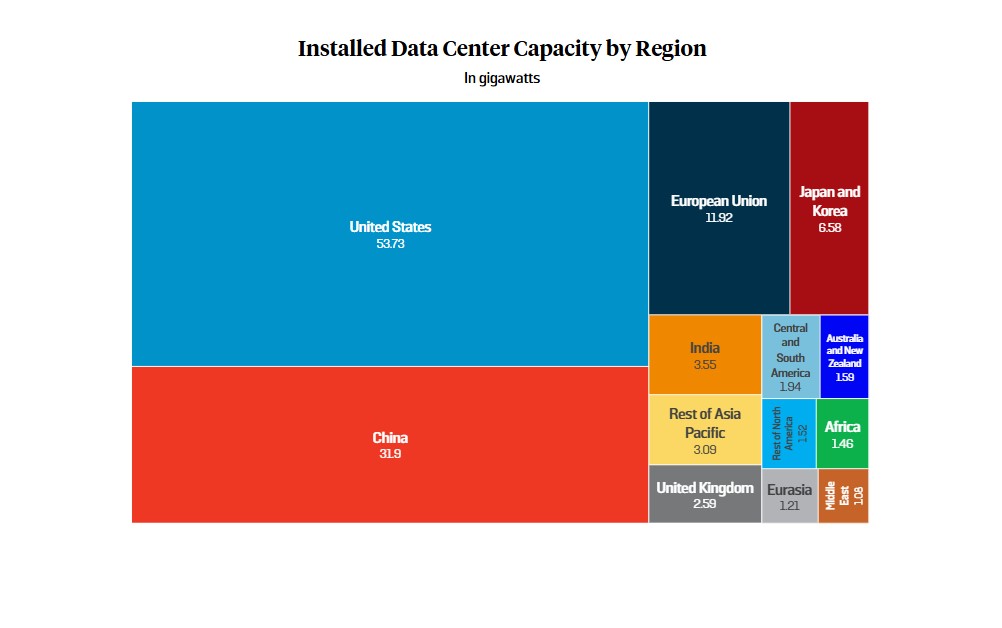
Three Regions, Three-Quarters of the World’s Capacity
The United States, China, and Europe dominate data-center electricity use, accounting for roughly 85% of global consumption between them.
According to the IEA, those three regions accounted for roughly 45%, 25%, and 15% of global data-center electricity use in 2024, respectively. Emerging markets across Asia, the Middle East, and Latin America are drawing new investment, in part because construction and associated power infrastructure can be cheaper than in more established markets.
The Strategic Calculus Governments Are Running
Nations are competing actively to attract data centers, treating them as anchors for digital economies and AI development.
Governments view data centers as strategic infrastructure tied to cloud services, AI leadership, and long-term technological competitiveness. According to reporting on BloombergNEF analysis, Saudi Arabia, the UAE, Brazil, Canada, and France rank among the most attractive markets, evaluated on energy availability, permitting conditions, tax policy, and fiber connectivity. India has reportedly offered overseas operators a tax holiday stretching two decades, though the specific program and terms have not been independently confirmed from primary government documents.
Where the Global Average Hides the Local Reality
A modest global share of electricity demand can translate into an outsized burden on individual communities and regional grids.
A 1.5% share of global electricity sounds manageable until local figures come into view. In regions with major data-center clusters, these facilities can account for 25% to 30% of total electricity consumption, according to reporting on BloombergNEF analysis. In the United States, data centers are projected to grow from 3.5% of national electricity demand in 2024 to 8.6% by 2035, according to BloombergNEF.
Ireland illustrated that pressure clearly. After data centers consumed more electricity than the country’s urban homes combined, the government restricted further construction.
The Environmental Bill Attached to Every Server Rack
Carbon emissions and water consumption both scale with electricity demand, and the local power mix determines how severe those impacts become.
The IEA estimates that data centers produced approximately 180 million metric tons of indirect carbon dioxide emissions from electricity consumption. The UNU projects a water use footprint of approximately 9.3 trillion liters associated with data-center electricity generation by 2030, reflecting the water consumed in power production itself. Environmental impact depends heavily on the local power mix and how efficiently each facility cools its hardware.
The IEA expects renewables and nuclear to supply a growing share of data-center electricity through 2030, with nuclear becoming increasingly important alongside renewables. Fossil fuels remain significant in several major markets, meaning the emissions picture varies considerably by region, with implications for grid reliability risks that extend beyond carbon accounting.
Resistance Is Already Slowing the Build-Out
Community and government opposition has already blocked or delayed billions of dollars in planned data-center construction across multiple continents.
Public resistance has delayed or canceled an estimated $42 billion in European data-center investments, according to Foreign Policy. At least 15 U.S. states are reportedly weighing moratoriums, according to the same reporting. In India, a project linked to Google faces legal challenges over its potential effects on water supply, local electricity demand, and a nearby wildlife sanctuary, though court details and project specifics have not been confirmed from primary legal filings.
The concerns driving that resistance are consistent: pressure on electricity rates, grid reliability risks, water consumption, and the gap between promised economic benefits and the number of permanent jobs these facilities create. If demand grows as projected, local disputes are likely to scale into national debates over grid planning, utility regulation, and industrial policy around AI data centers. The central question will be whether AI infrastructure can expand without transferring its costs to the communities that host it.