A UC Riverside study published in Scientific Reports indicates that wastewater-derived chemicals travel north through the Pacific Ocean and enter coastal air roughly 22 miles from the Tijuana River mouth, challenging how regulators think about pollution boundaries.
The Ocean Was Doing the Carrying All Along
The mechanism behind this finding matters as much as the distance it covers.
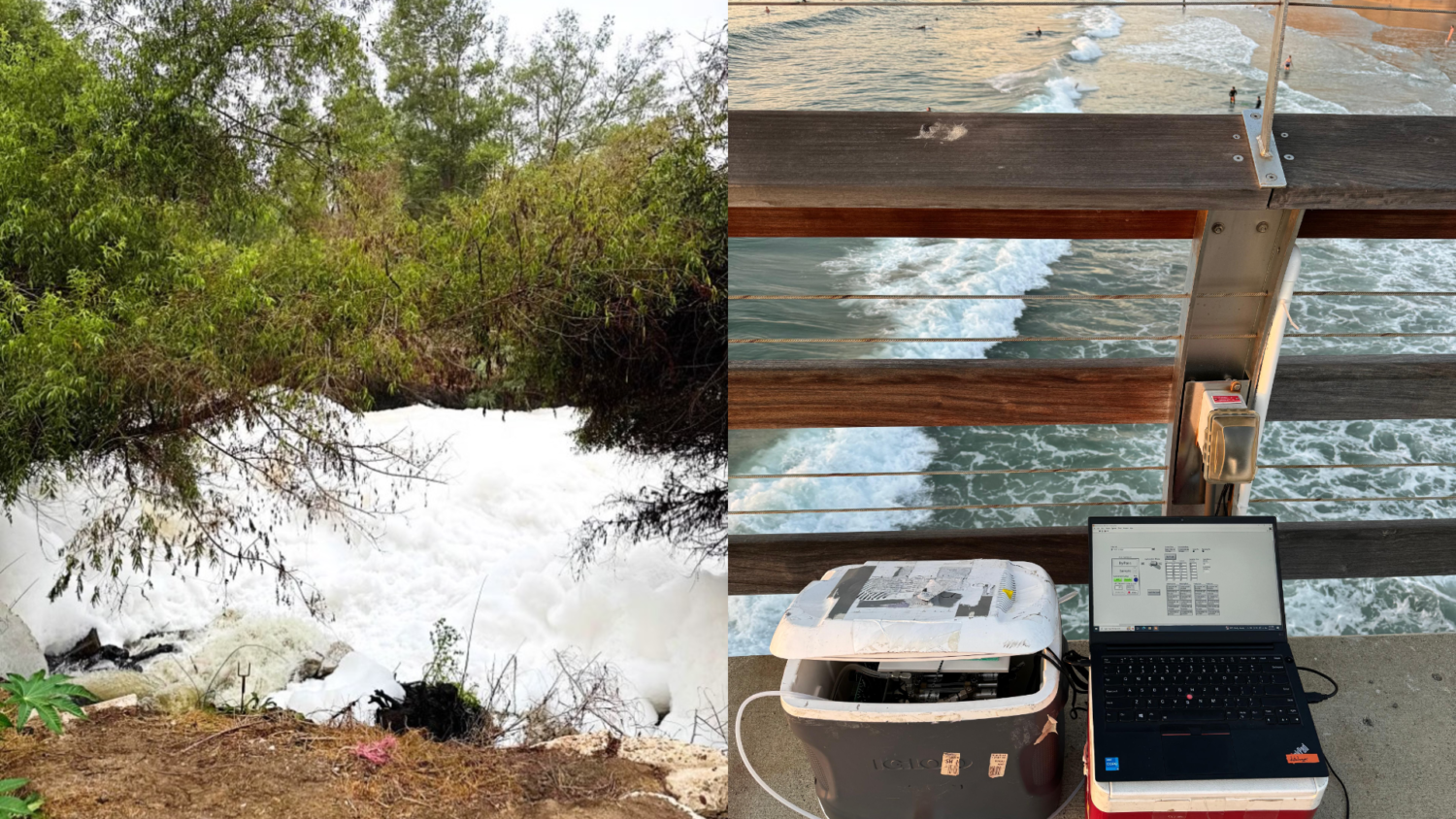
Wastewater-derived chemicals from the Tijuana River are showing up in air sampled above La Jolla, roughly 22 miles north of where the river discharges into the Pacific. UC Riverside researchers identified this pathway in a study published in Scientific Reports, and the route they traced runs through the ocean itself.
Wastewater chemicals enter the ocean near the river mouth. From there, coastal currents carry them northward and underwater, preserving a detectable fraction of the compounds until they cross the water-air boundary and enter the coastal atmosphere.
The key tracer is dimethyl trisulfide, or DMTS, a volatile sulfur compound associated with anaerobic decomposition in wastewater. It breaks down relatively quickly once airborne, which is exactly why wind alone cannot explain its presence at an air-sampling station at the Scripps Institution of Oceanography pier in La Jolla. Something else carried it there first.
The Pump Test That Confirmed It
A sharp, natural experiment in September 2024 gave researchers their most direct source-to-receptor evidence.
Researchers sampled air at four locations between August and September 2024, stretching from the Tijuana River region north to La Jolla. DMTS appeared at every site. Modeling indicated that up to 76% of the compound could survive a 35-kilometer journey at roughly 10 meters’ depth in seawater under the study conditions. That survival window closes when the chemical transfers across the water-air boundary into the atmosphere.
On September 10, 2024, a pump station began diverting wastewater southward, sharply reducing discharge into the river. DMTS levels measured in La Jolla subsequently dropped 86%, providing strong evidence linking river discharge to the distant air measurements.
One important caveat applies. This sampling occurred during an unusually sustained dry-season discharge, with flows reaching 160 to 207 million liters per day despite no rainfall. Researchers say more work is needed across seasons, wind patterns, and variable river conditions before the full picture comes into focus. The study documents a transport mechanism; it does not establish specific health risks from the measured concentrations.
The Silo Problem That Made This Invisible
The findings point to a structural failure in how environmental agencies monitor pollution across interconnected systems.
“We found pollutants far from the source that couldn’t be explained by just the wind. We wondered, how did this happen?” said William Porter, an atmospheric scientist at UC Riverside who led the research. The observations pointed to something larger than a single polluted river.
Monitoring programs have long addressed water quality and air quality as separate domains, a framework the researchers challenge directly. The ocean, as this study shows, functions as a middle stage that stores river-derived chemicals, transports them northward, and later releases them into the atmosphere.
Addressing that gap, the researchers suggest, means combining river discharge data, oceanographic sampling, atmospheric stations, chemical tracers, and meteorological analysis. Those systems need to work in coordination, not in isolation.
Separate research reported by KPBS in 2025 documented elevated hydrogen sulfide and hundreds of other gases in San Diego’s South Bay near the river. This study extends the documented pollution picture significantly farther up the coast, to a sampling point in La Jolla. Regulators now have documented evidence of a cross-domain pollution pathway. What remains is whether monitoring systems will be redesigned to reflect how pollution actually moves through air, water, and ocean together.