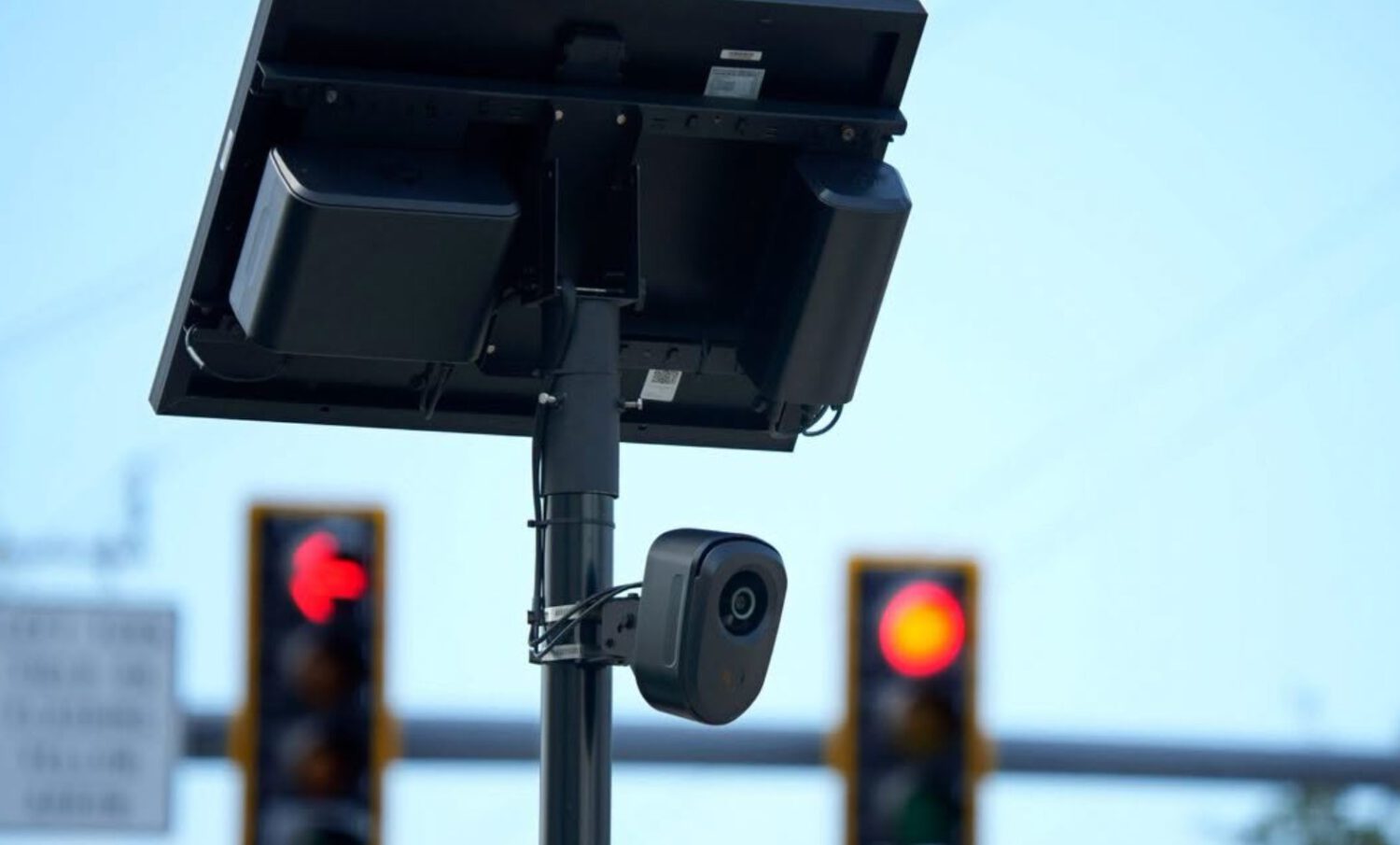
More than 3,600 automated license plate readers (ALPRs) operate across North Carolina, and roughly 80 to 85 percent are supplied by a single company: Flock Safety. Those figures come from Daily Tar Heel reporting and should be treated as reported estimates rather than a definitive statewide inventory.
In July 2026, the state made its ALPR pilot program permanent, authorizing AI-powered readers on state-maintained roads and highway rights-of-way that cover approximately 78 percent of North Carolina’s roadways.
Flock operates more than 120,000 readers across 49 states, generating over 20 billion vehicle scans per month under contracts with more than 5,000 law-enforcement agencies.
More Than a Plate Number
The cameras record far more than a license plate, and a connected network can reveal patterns that a single camera cannot.
Each camera captures a plate number, location, time and direction of travel, along with vehicle characteristics such as make, model, color, bumper stickers and bike racks. A single reader provides a moment in time; a connected network can make it possible to reconstruct recurring routes, likely home addresses, workplaces and visits to medical facilities or houses of worship.
Flock says it does not use facial recognition. Public-records requests have shown, however, that officers in some departments searched for people using descriptions that included race, gender, clothing and perceived political affiliation.
Who Can Search the Data
Law enforcement access extends well beyond the agencies that own cameras.
More than 75 percent of Flock’s law-enforcement customers opt into nationwide data sharing, according to the reporting brief. That means participating agencies can search records collected by other departments across jurisdictions.
Private entities feed into this system as well. Homeowners’ associations, businesses and retailers can own cameras whose data law enforcement may access under applicable contracts and policies. Lowe’s, for example, operates 112 ALPRs across North Carolina, according to Daily Tar Heel reporting.
North Carolina law distinguishes between operating an ALPR system and supplying data to one. That gap lets the network expand through private ownership, even where a local government has not bought every camera itself.
What State Law Requires
The statute sets a retention ceiling and use restrictions, but leaves significant standards to local discretion.
North Carolina law caps ALPR data retention at 90 days and limits use to defined law-enforcement purposes, including criminal investigations, missing persons and stolen vehicles. The 90-day limit may be extended when an active investigation, warrant or litigation requires preservation of specific records.
Agencies must maintain written policies, but the statute does not mandate identical statewide standards for audits, supervisor approval or restrictions on monitoring protests or religious gatherings. An Electronic Frontier Foundation analysis found that among 32 agencies in the SBI pilot, only Asheville and Raleigh addressed political rallies or religious gatherings in their policies.
UNC Tightened Its Own Rules
The university cut automatic data sharing and adopted stricter retention limits than state law requires.
UNC-Chapel Hill’s 23 fixed Flock cameras averaged more than 2 million plate reads per month during periods reviewed by The Daily Tar Heel. In 2026, the university ended automatic data sharing with outside law-enforcement agencies; other agencies may still request specific records, but they no longer have independent access to the university’s feed.
The UNC System adopted a systemwide ALPR regulation that takes effect December 1, 2026. Campuses already operating ALPR systems must comply by January 1, 2027.
The regulation requires 30-day data deletion, audit logs, trained administrators and an explicit prohibition on monitoring people based on protected characteristics or lawful expressive activity. That is stricter than what state law mandates.
Real Investigations, Real Errors
ALPR technology has contributed to serious criminal investigations, but documented errors and abuses raise reliability questions.
Law-enforcement agencies point to concrete results. North Carolina’s SBI reported that ALPR footage placed a victim’s vehicle and a suspect’s vehicle on the same camera 10 seconds apart before a homicide, contributing to two murder arrests. ALPR data also helped locate a former Chapel Hill officer arrested in Florida in connection with an alleged mass-shooting plot.
Documented problems run alongside those successes. The Institute for Justice has catalogued more than 200 alleged ALPR-abuse incidents, including wrongful stops and romantic stalking; the organization describes these as alleged incidents, not a verified count of substantiated misconduct.
A Brunswick County deputy was arrested on charges of misusing the system, according to the reporting brief; no court records were immediately available to confirm the case’s current status. Business Insider reported that a local police analysis found 71 percent of 1,427 stolen- or felony-vehicle alerts generated by Flock in 2023 and 2024 involved incorrectly identified plates.
Legal and Local Pushback
Several North Carolina municipalities have moved to restrict or end ALPR contracts, and a federal appeals court is weighing the constitutional question.
Atkinson adopted an ordinance banning Flock cameras within its corporate limits, according to the reporting brief; the article could not independently confirm it was the first North Carolina municipality to do so. Hillsborough and Pittsboro have also voted to end some or all ALPR vendor contracts, though official records for each action were not available at publication.
A legal dispute in Virginia is now before the Fourth Circuit, which is considering whether persistent ALPR location histories constitute a search under the Fourth Amendment. A 2024 Virginia trial court ruled they do; a federal district court sided with the city in January 2026. The constitutional question is not settled.