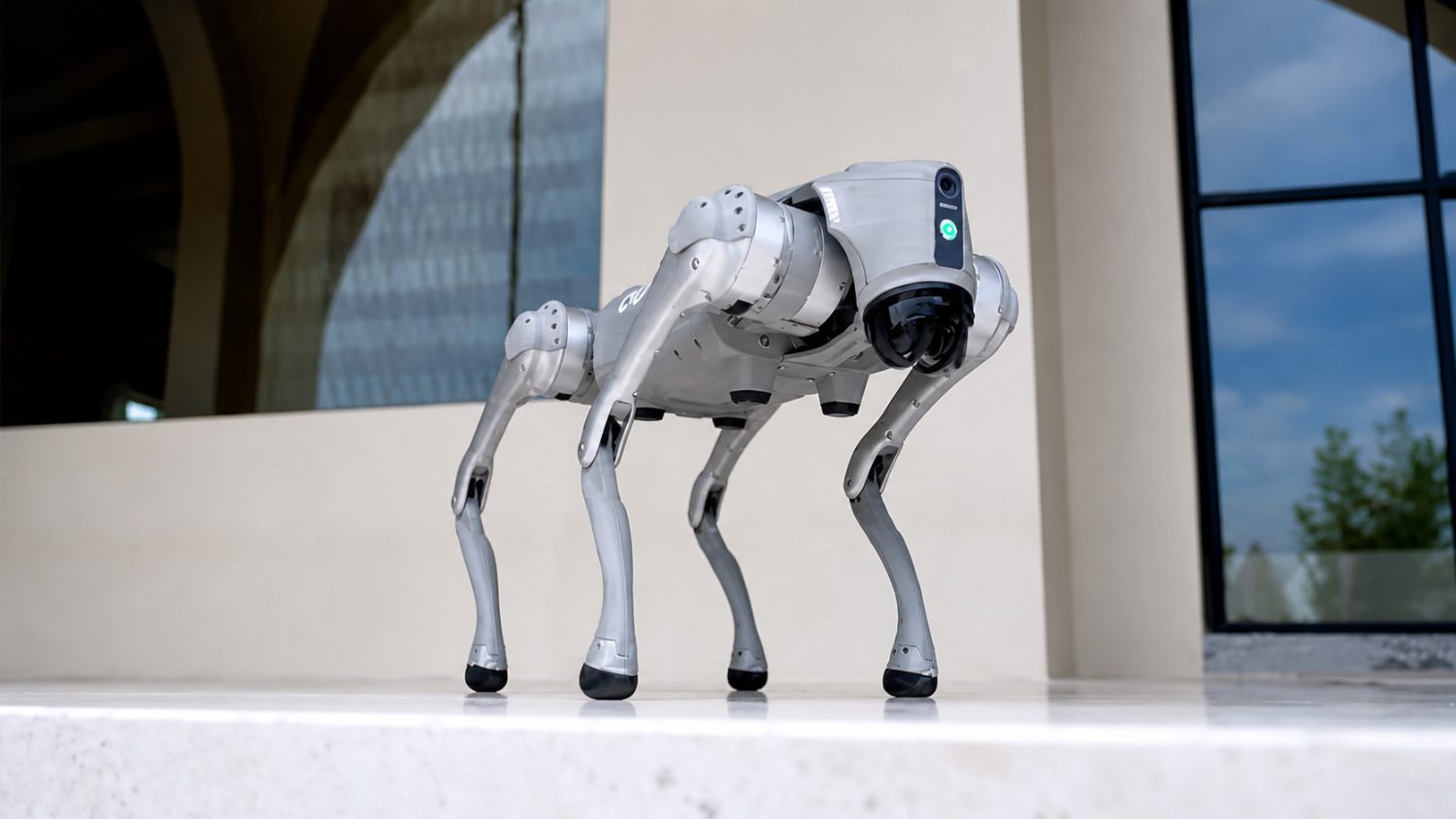
The robot reads the gap, accelerates, and launches itself through an opening barely wider than its own body. No scripted sequence told it when to leap. No engineer pre-programmed the timing. Researchers at the University of Hong Kong’s Adaptive Robotic Controls Lab (ArcLab) and the Oxford Robotics Institute built a framework called ConsJump that lets an approximately 22 kg Unitree Aliengo quadruped autonomously decide when to sprint, when to jump, and how to land — all without fixed trajectories dictating its next move. Work like this sits alongside other applied efforts, such as the robotic knee exoskeleton research coming out of U.S. institutions, in pushing the boundaries of real-world robotic deployment.
Two Brains, One Jump
ConsJump splits the problem the same way a good athlete does: instinct handles the body, judgment handles the moment.
Traditional quadruped jumping relied on pre-computed trajectories tracked by model predictive control — rigid scripts that struggle the moment conditions drift from their assumptions. ConsJump works differently. A low-level policy handles the physical vocabulary: pacing, cantering, steering, and jumping, all learned by imitating real animal motion through imitation learning. A high-level policy acts as the strategic layer — reading an Intel RealSense D435i RGB-D camera, assessing the gate’s geometry, and deciding when to accelerate and commit.
The high-level brain never touches a joint. It just decides when to go. The autonomy of that decision-making layer is reminiscent of how the Melody Humanoid Robot navigates its own environment without direct human instruction at every step.
By the Numbers
The mechanics are worth seeing plainly.
- Sprint speed before takeoff: ~2.5 m/s
- Airborne time: ~0.44 seconds
- Parallel simulation agents during training: 5,480
- Physical parameters randomized in training: motor strength, latency, joint offsets, added mass
That randomization is what bridges simulation to real hardware. The policy learns to handle a messy physical world before it ever touches one. Once the low-level skill library is locked, only the high-level planner needs retraining for new scenarios — a practical elegance that keeps the system adaptable without starting from scratch.
“Quadrupedal robots [can] achieve high-dynamic locomotion and constrained space traversal tasks.” — ConsJump research paper, ArcLab / University of Hong Kong
Lab Demo or Actual Progress?
Competing approaches each make trade-offs — and ConsJump carves out a distinct position between them.
Curriculum-based deep reinforcement learning teaches robots to jump from scratch, delivering impressive range — but typically focused on height and distance, not tight apertures comparable to the robot’s own body. Model-based MPC offers analytical guarantees yet can struggle under unexpected constraints. ConsJump lands between them: imitation-built skills paired with vision-informed high-level decisions, trading some theoretical guarantees for robust real-world adaptation.
ArcLab describes ConsJump as enabling robots to “automatically transit from walking to jumping over constrained spaces.” — HKU ArcLab
This is a research framework, not a shipping feature. The Aliengo is a commercially available platform, so a pathway toward real-world deployment exists — but nothing is confirmed, and treating it as inevitable gets well ahead of the evidence.
What is confirmed: a robot now navigates gaps that would stop most wheeled machines cold. Cluttered inspection sites, dense industrial environments, scenarios where conservative walking gaits simply fail — that is where this research points. Complementary systems like Snake Robots similarly target constrained, real-world environments where conventional mobility breaks down. Consider it a preview, not a promise.