You know the red-eye flight standoff: you want to watch something loud, your neighbor wants to sleep, and the airline’s paper-thin earbuds sit in their wrapper, untouched. Researchers at South Korea’s Pohang University of Science and Technology (POSTECH) may have built the hardware that makes that conflict disappear. Their device, MiPAL — Metamaterials-integrated Parametric Array Loudspeaker — sends a tight beam of audible sound to one specific listener while adjacent people hear next to nothing. No headphones required. The work was published in Nature Communications on May 22, 2026, led by professors Junsuk Rho and Wonkyu Moon.
How a Single Driver Does What Arrays Couldn’t
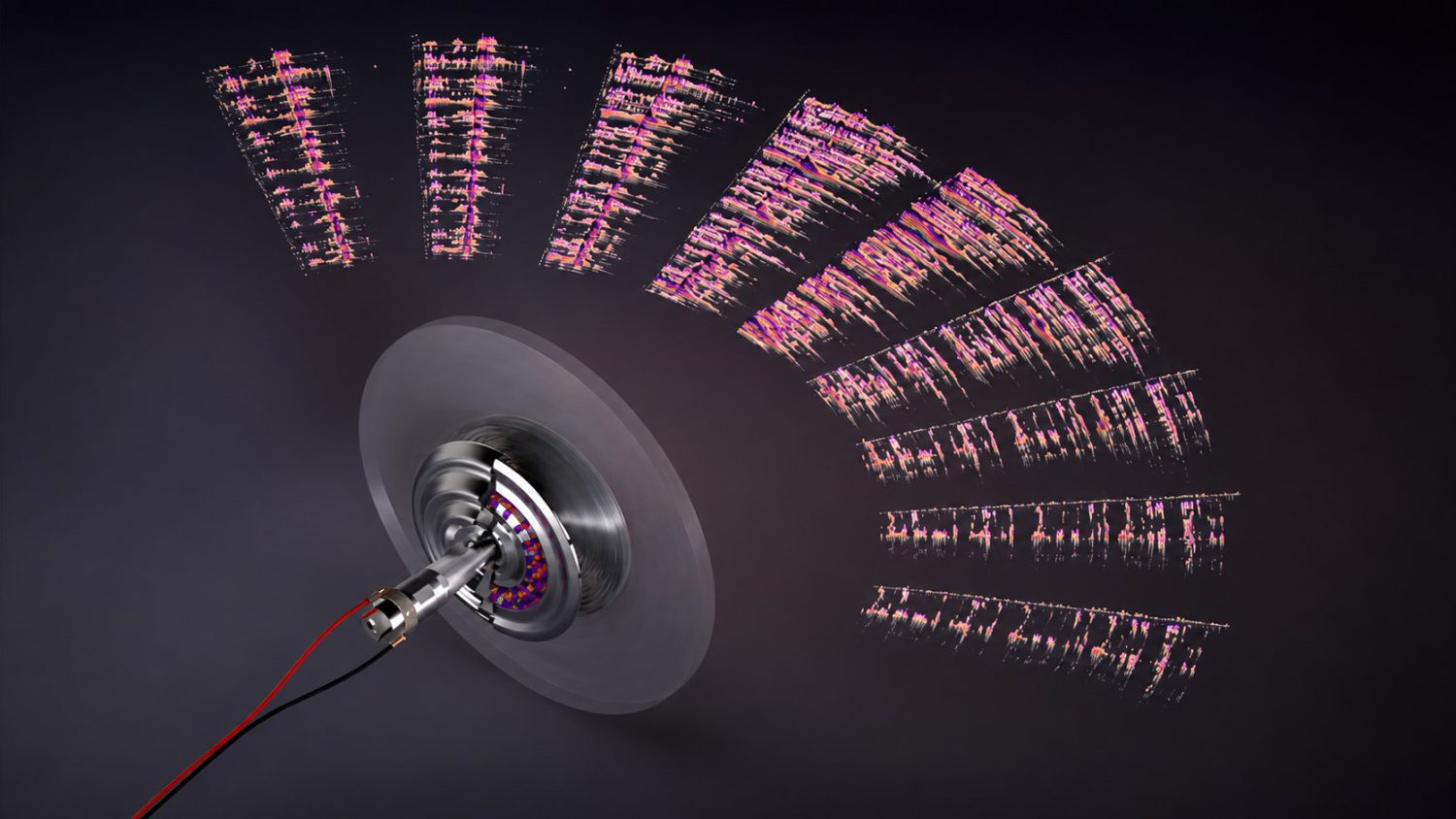
A front lens shapes the beam; a rear filter kills the leakage — and one piezoelectric driver handles all of it.
Conventional directional speakers rely on large, expensive arrays of ultrasonic emitters with complex phase-control electronics to shape their beams. MiPAL uses one piezoelectric driver — one vibrating element — paired with two engineered metamaterial structures. A front acoustic metasurface reshapes ultrasonic waves into a focused forward beam, functioning like a lens concentrating energy forward. Rear elastic meta-units act as a vibration filter, suppressing the sideways sound leakage that makes conventional systems bleed audio into neighboring spaces. The air itself converts the ultrasonic beam into audible sound through nonlinear acoustics — the physics handles the demodulation, no extra circuitry needed.
Key performance details from the Nature Communications paper:
- Frequency coverage spans 500 Hz to 10 kHz — more than four octaves, covering most speech and music
- Simulated aircraft-seating tests delivered clear audio to one “passenger” while adjacent seats experienced strongly attenuated levels
- Both metamaterial layers are 3D-printable and modular, adaptable to different seat spacings or enclosure geometries
- The single-element architecture replaces costly multi-emitter arrays without sacrificing broadband performance
Prof. Junsuk Rho described the core design advantage directly: by “co-designing the metamaterials and the ultrasonic device as a single system,” the team overcame “the limitations of cost, complexity and design flexibility at the same time,” according to Interesting Engineering.
What’s Still Between the Lab and Your Seat-Back Screen
The open questions are real, and they deserve honest answers before this technology goes anywhere near the public.
MiPAL has not been commercialized. No confirmed product roadmap exists. Testing happened in controlled environments — not reverberant train cars, turbulent aircraft cabins, or spaces with variable humidity and temperature. Ultrasound exposure safety and regulatory compliance aren’t detailed in the published materials, a gap that matters before any deployment near the public. Cost at scale, power consumption, and integration with existing audio systems remain open engineering problems.
The plausible near-term applications — per-seat airline entertainment, museum audio guides, shared living spaces where a gamer and a reader coexist without negotiating volume — are reasonable extrapolations from demonstrated lab performance. They are not scheduled releases.
What POSTECH has actually shown is a credible, simpler path toward personal audio beaming that doesn’t require a rack of hardware. That’s worth paying attention to. Whether it survives contact with a real Boeing 787 cabin is the next question nobody has answered yet.