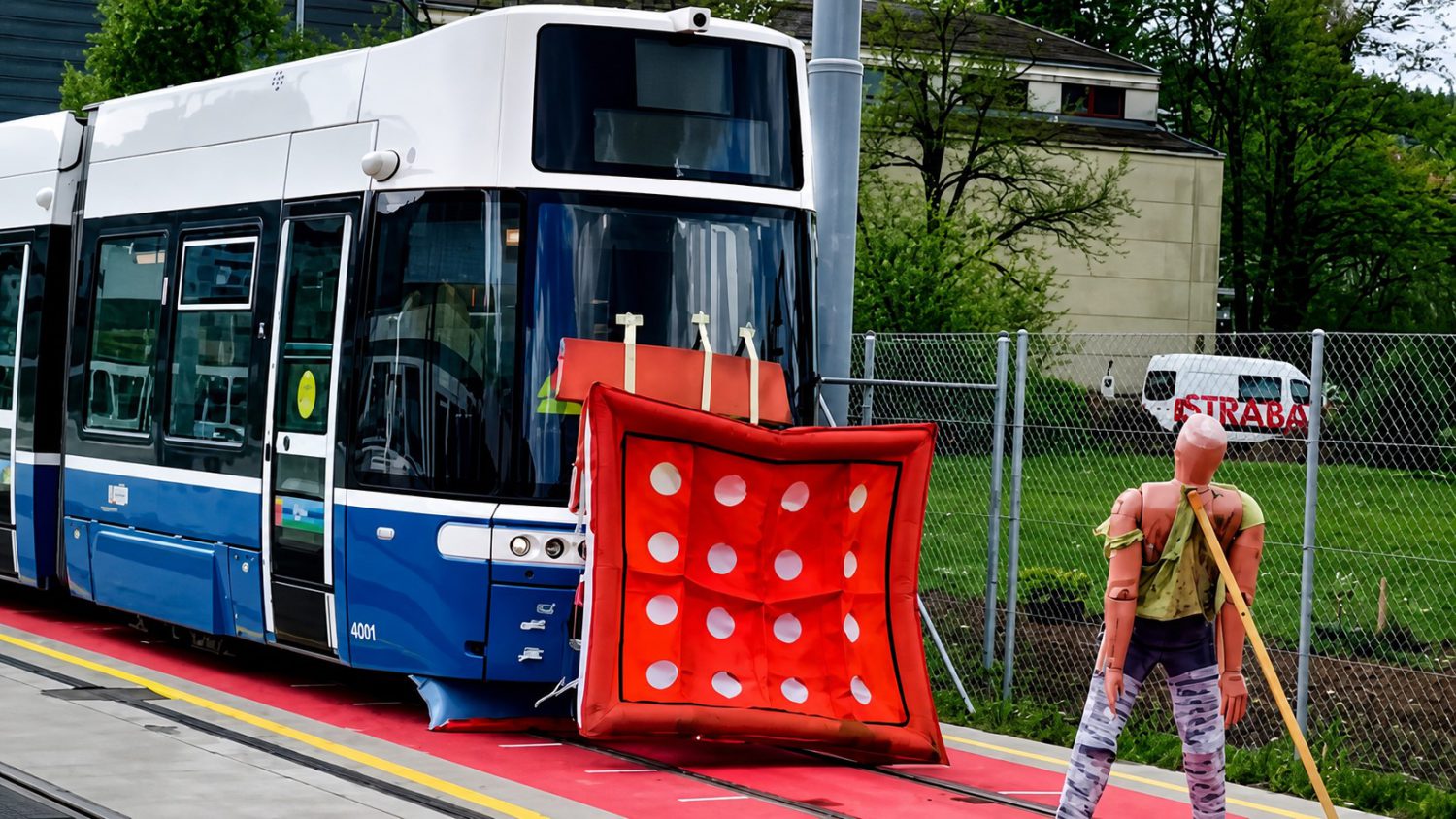
Stand on a Zurich street corner and watch a tram clear an intersection. It weighs roughly 40 tonnes. It cannot swerve. If someone steps into its path at the wrong moment, the outcome is not a matter of debate. That’s the problem Alstom and Verkehrsbetriebe Zürich (VBZ) are trying to solve — not by preventing the accident, but by surviving it better. Their answer: strap an external airbag to the front of the tram.
The system uses front-mounted sensors to detect an unavoidable collision and deploys an airbag from the lower front of the vehicle in milliseconds. The goal is to absorb impact energy and prevent a person from striking the hard front structure, the windshield, or ending up under the wheels. One Zurich tram driver, quoted by Railway Pro, described it plainly: it “pushes the person away and prevents the impact to a large extent.”
A 2024 pilot was deemed successful. Development continued into June 2026, with Alstom and VBZ focusing on reliability, performance, and stability before any wider rollout.
What’s Actually Being Built
This is the world’s first airbag-based driver-assistance system for trams — still in development, not yet in daily service.
- Developed by Alstom and VBZ; described as the world’s first airbag-based driver-assistance system for trams
- Tested on Flexity trams; VBZ has discussed equipping all 110 ordered trams if validation succeeds
- External deployment from the lower front of the tram, triggered in milliseconds by sensor detection
- Designed to protect pedestrians, cyclists, and e-scooter riders — not tram occupants
- June 2026 work targets reliability, performance, and stability ahead of any potential fleet rollout
A Cushion Is Not a Solution
The airbag addresses what happens after the accident begins — and critics argue that distinction matters enormously.
Multiple fatal tram accidents in Zurich during 2024 created real political urgency. That context matters. So does the pushback. Public debate has raised a legitimate question: does an airbag let cities off the hook for street design, traffic management, and operator training — the systemic fixes that actually reduce accidents in the first place?
VBZ doesn’t claim otherwise. The system is explicitly a last-resort device, not a prevention tool.
There’s something worth sitting with in the fact that the engineering answer here was “put an airbag on it” — the same instinct that once turned automotive safety debates toward thicker bumpers while intersection design went unchanged. Critics in transit forums make a fair point: hardware solutions are easier to announce than the slower, harder work of redesigning streets and enforcement culture.
Both things can be true simultaneously. The airbag is pragmatic engineering for genuinely unavoidable scenarios. The harder infrastructure work remains the real answer. If reliability testing clears the bar, 110 trams could carry this system into daily Zurich service — and other cities with dense pedestrian-tram interaction will be watching closely, collision statistics in hand.