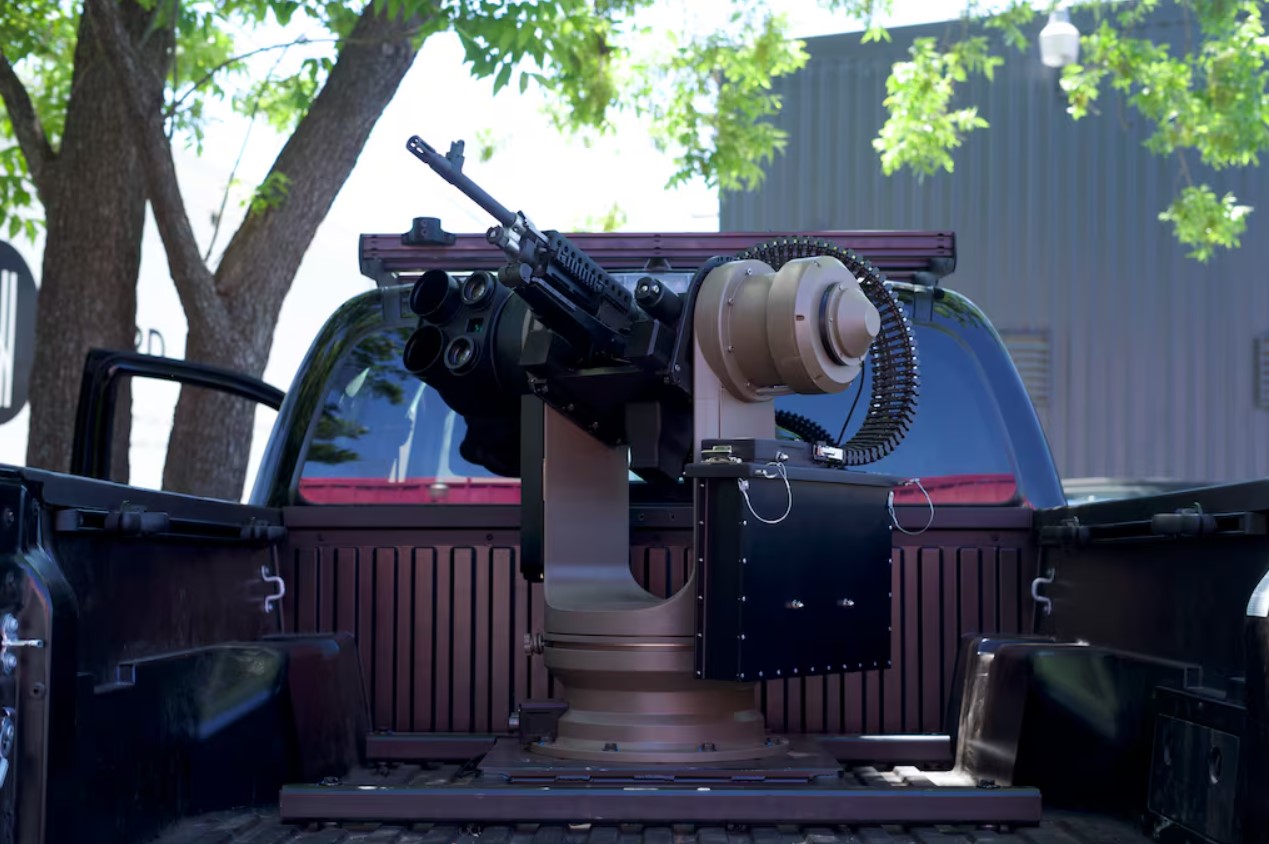
The math sounds elegant. Why fire a six-figure missile at a drone that costs less than a PS5? Allen Control Systems’ Bullfrog M240 promises engagements using standard 7.62mm ammunition. The Marines apparently liked the pitch enough to sign a $6.2 million prototype contract integrating Bullfrog into L-MADIS, their mobile counter-drone platform built on paired Polaris MRZR vehicles.
Here’s what the marketing glosses over. Company footage reportedly shows the system transitioning from tracking aerial objects to acquiring ground targets. We can’t tell from that footage, if software guardrails prevent the AI from identifying a person the same way it identifies a quadcopter.
- The Bullfrog M240 weighs roughly 300 pounds and fires up to 850 rounds per minute
- Effective range sits at approximately 800 meters against Group 1 through Group 3 drones
- Allen Control Systems states a human operator must authorize each shot
Allen Control Systems describes the system as “human in the loop” — the AI detects, identifies, tracks, and acquires targets, then presents them to an operator for a firing decision.
One Command Between Algorithm and Gunfire
Pentagon policy demands meaningful human judgment over lethal force, but Bullfrog’s authorization workflow raises hard questions about what “meaningful” actually looks like under fire.
Consider what “human authorization” means in practice. An operator — likely under pressure, in a fast-moving engagement — watches an AI flag a target. That liability architecture should feel familiar: it mirrors the same uncomfortable dynamic that made Tesla Autopilot debates so thorny. The human is technically responsible, but the machine is doing the seeing and the deciding.
This is not a single-purpose tool — it is a scalable autonomous weapon platform with a scalable policy problem attached.
DoD Directive 3000.09 requires commanders to exercise appropriate human judgment before applying lethal force. Whether a single AI-prompted button press satisfies that standard — while the weapon cycles through roughly 14 rounds per second — is a question the procurement process has so far declined to answer directly. At some point, that answer stops being optional.
Update July 27 2026: Fact checked and updated to be more accurate.