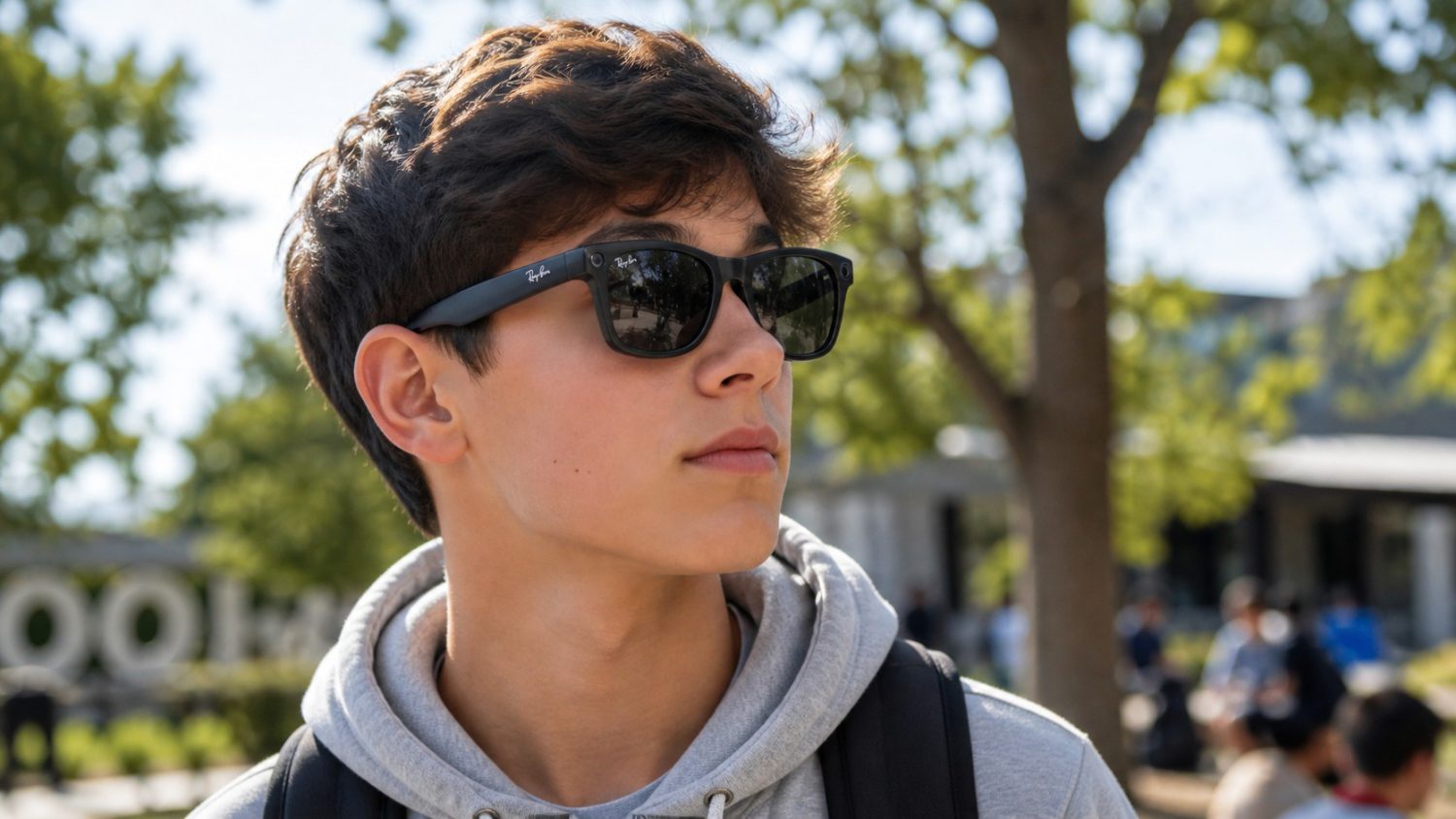
Futurism documented numerous TikTok and Instagram videos showing students using Meta’s Ray-Ban smart glasses to film classmates, teachers, and staff without their knowledge. Some clips were ordinary school-day vlogs.
Others showed boys following girls who had already asked them to stop, mocking their appearances, staging humiliating pranks, and copying the kind of pickup-artist content that’s been fermenting in dark corners of the internet for years. VICE described the pattern plainly: f harassment. At eye level. Hands-free. Looking like any other pair of glasses on any other face in any crowded hallway.
That’s the design feature that changes everything. The classic phone-camera moment — someone raises their device, you notice, you have a choice — disappears entirely when the camera is built into the frame.
Meta Has an Answer. Schools Aren’t Convinced.
Meta points to a built-in capture LED as its primary safeguard, but the gap between a blinking light and anyone actually noticing it is where the problem lives.
Meta’s position is that the device includes a front-facing capture LED that stays on during recording, cannot be disabled, and triggers a camera shutdown if physically blocked or tampered with on newer models — per the Ray-Ban Meta glasses FAQ and Meta’s own statements. The LED flashes for photos and remains on continuously during video capture. That’s a real safeguard.
It’s also a small indicator light, in a hallway full of noise and movement, on a device most students and teachers wouldn’t recognize on sight.
The gap between “the light is always on” and “anyone actually noticing” is where the problem lives.
Schools Aren’t Waiting for a Technical Fix
Districts aren’t tweaking their phone policies — they’re issuing outright bans and warning that covert recording can carry legal consequences.
When the policy response outpaces the product cycle, that’s a signal worth reading. Parker Unified School District explicitly names Ray-Ban Meta as a prohibited device during the school day. Draft policy language from The White Hatter — a digital-safety organization — states that recording functions must remain disabled unless expressly authorized for educational or accommodation purposes, and that covert recording of teachers, staff, or students is prohibited under any circumstance.
Several districts have flagged a harder edge: depending on state consent laws, covert recording can cross from a school-discipline issue into a legal one. The response pattern across districts isn’t partial restriction. It’s removal.
The Device Isn’t Really the Point
Banning one product fixes one product — the normalization of covert recording as everyday content is the larger fight.
Banning one product fixes one product. What schools and parents are actually pushing back against is something broader: the normalization of covert recording as content. The TikTok virality loop — film it, post it, spread it before anyone can respond — doesn’t require smart glasses. It just gets faster and quieter when the camera disappears into the frames on someone’s face.
Your phone’s privacy settings won’t solve that. Neither will a single district policy. That’s the part worth sitting with.