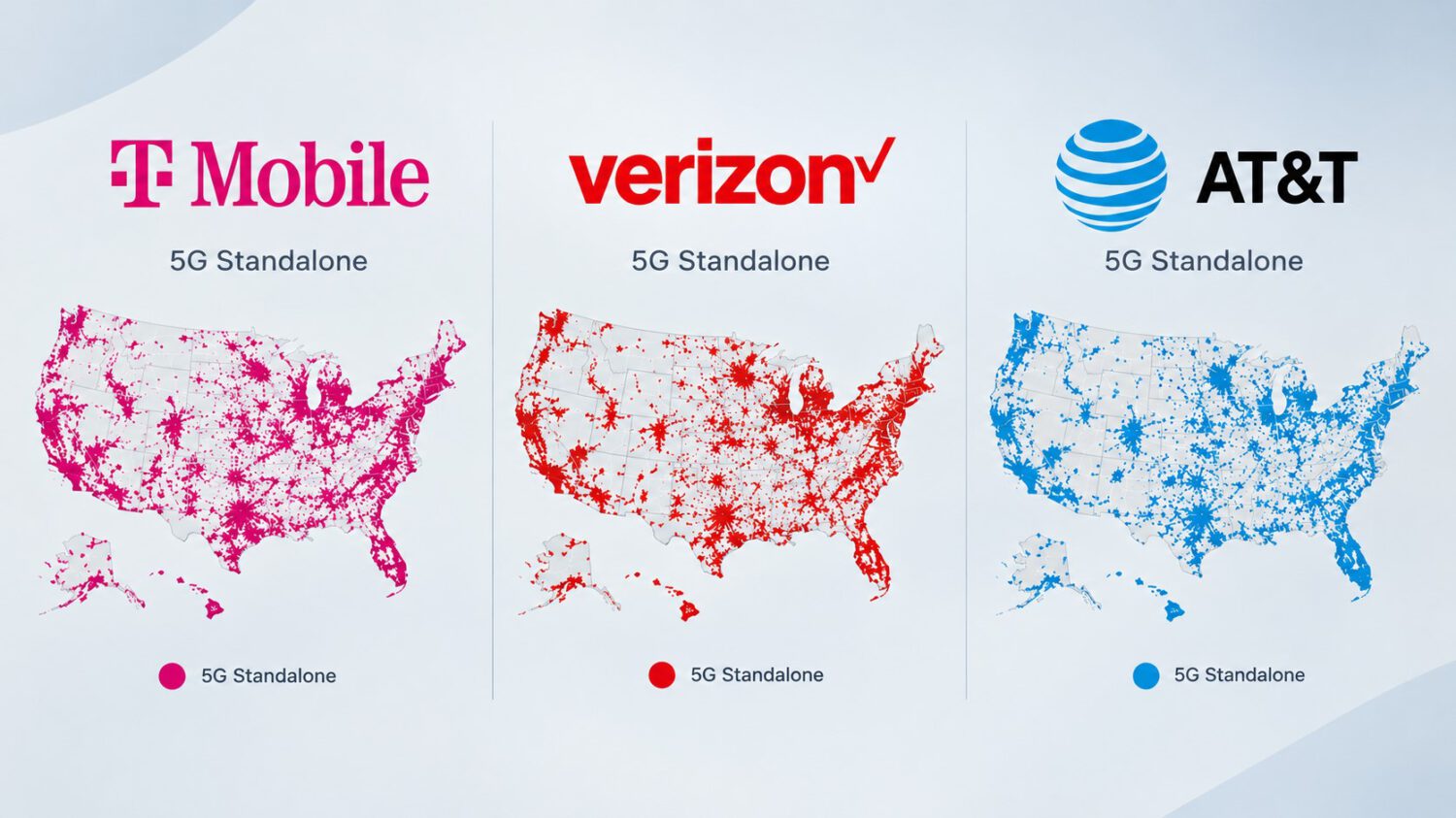
Three carriers. Three “nationwide” 5G standalone networks. Three very different realities for your phone. According to Opensignal, T-Mobile customers had access to a 5G standalone (5G SA) connection 71.2% of the time, Verizon customers 20.2% of the time, and AT&T customers just 4.4% of the time. That 5G icon on your screen and an actual 5G SA connection are not the same thing.
What “Nationwide” Actually Means for Your Phone
The word “nationwide” describes where a network exists, not how often your phone actually connects to it.
Most 5G networks in the U.S. launched as non-standalone configurations: 5G radio equipment paired with an existing 4G LTE core. It works, but it leaves the more advanced capabilities of true 5G on the table. Standalone 5G runs a complete 5G core, enabling lower latency, network slicing, and next-generation services.
All three major U.S. carriers have announced nationwide 5G SA deployments, and technically, all three are telling the truth. The gap shows up not in geography but in how often customers actually land on that architecture. During the final full measurement week in Opensignal’s data, 86% of T-Mobile users accessed 5G SA at some point, compared with 34% of Verizon users and just 13% of AT&T users.
T-Mobile’s Head Start and What It Bought
A six-year runway separates T-Mobile’s first move into 5G SA from where its competitors stand today.
T-Mobile introduced limited 5G SA service in 2019 and announced nationwide 5G Advanced availability in April 2025, according to the company. Verizon and AT&T have since made their own nationwide deployment announcements, but the consumer access numbers tell a different story.
Opensignal characterized T-Mobile’s lead explicitly as a first-mover advantage. Network reach matters, but so do device provisioning and spectrum allocation. Equally important are the policies that govern when a customer’s phone migrates to the standalone core.
Speed Numbers With an Asterisk
AT&T leads the cited performance metrics, but those results come with an important caveat about who is actually being measured.
AT&T posted the fastest reported download speed at 344.7 Mbps and led Opensignal’s consistent quality metric at 88.9%, ahead of Verizon at 86.4% and T-Mobile at 85.1%. T-Mobile recorded the lowest internet speed metric at 40.2 milliseconds latency, narrowly ahead of AT&T at 40.6 ms and Verizon at 42.9 ms.
Opensignal noted that AT&T’s smaller active 5G SA user base may reduce network load and contribute to those speed results.
What This Means Before You Switch Carriers
Your carrier choice on 5G SA access depends on which trade-off matters more to you.
If frequent access to 5G SA architecture is your priority, T-Mobile is the clear frontrunner among the three. AT&T’s peak-speed advantage is real, but it reflects the experience of a narrow group of customers measured on standalone service, not the typical AT&T subscriber. Verizon occupies the middle ground, substantially ahead of AT&T on access but well behind T-Mobile.
The 5G symbol on your phone reflects a radio connection, not confirmation that your device is attached to a 5G SA core. Location, handset compatibility, spectrum bands, and plan provisioning all factor into what you actually get. If you suspect you may be paying too much for a plan that rarely delivers true 5G SA access, it’s worth reviewing what your current tier actually provides.
The competitive question has shifted from who can claim a nationwide 5G SA network. All three major carriers measured by Opensignal can say that now. The question is how often your phone actually uses it, and on that measure, the gap between these carriers remains wide.