Your solar panel is quietly wasting most of the sun’s energy right now. About 80% of incoming sunlight converts to heat, not electricity — radiating silently into the air while the panel struggles to stay cool enough to function. Stanford’s Tarpeh Lab published a fix in Nature Water on 19 August 2025 that turns that waste heat into a second product: ammonium sulfate, the same bagged fertilizer already stacked in farm supply stores.
Two Outputs, One Copper Plate
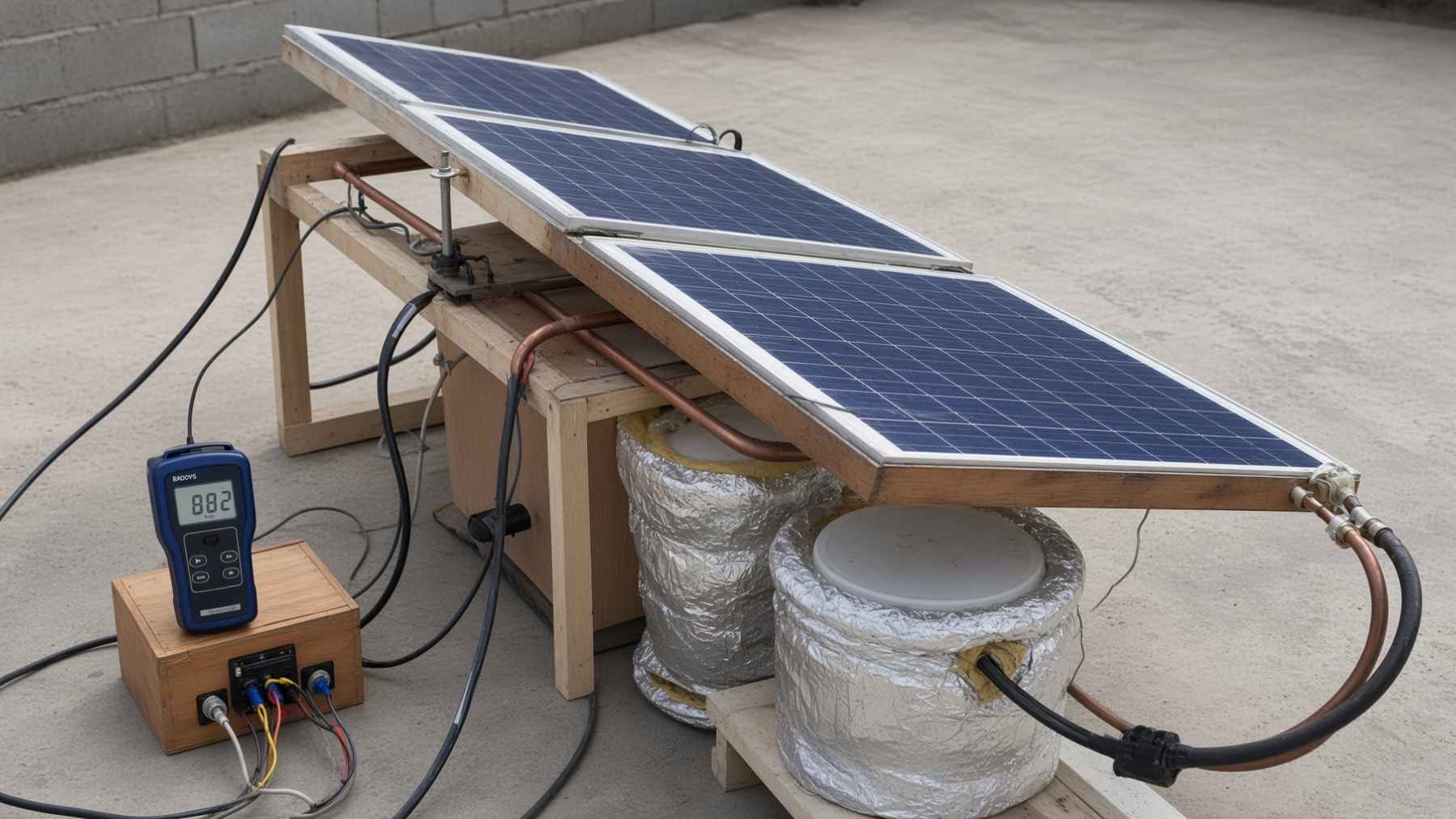
A single copper cold plate captures the heat every solar panel normally throws away, boosting both electricity output and fertilizer production in one move.
- Standard PV panels convert roughly 20% of sunlight to electricity; the remaining 80% becomes heat
- A copper tube cold plate bolted to the panel’s back extracts that heat via coolant flow
- Cooling the panel boosted power output by 59.3% ± 3.6% compared to earlier prototypes without heat transfer
- The same warm coolant fed into an electrochemical reactor improved ammonia recovery by 22.4% ± 7.4%
- Charge controllers preventing excess current cut energy use by 2.24 ± 0.25 kJ per gram of nitrogen recovered
“You don’t need a giant chemical plant or even a wall socket.” — Orisa Coombs, lead author, Stanford
Here’s how the chemistry works without the jargon: electricity moves ammonium ions across membranes in an electrochemical cell, converting them to ammonia gas. That gas gets absorbed into acid and becomes ammonium sulfate — boring, normal, already-understood fertilizer. The rate-limiting step is ammonia leaving the liquid, which is exactly what the panel’s waste heat accelerates. Think of it as the engineering equivalent of using your cast-iron skillet’s residual heat to proof bread dough: the energy was always there, someone just had to decide it was worth capturing.
The climate stakes deserve a number. Haber-Bosch ammonia production reportedly consumes roughly 2% of global final energy and emits approximately 450 million tonnes of CO₂ annually — about 2.4 tonnes per tonne of ammonia, nearly twice the carbon intensity of crude steel. Meanwhile, nitrogen already dissolved in global human urine represents roughly 14% of annual fertilizer demand. Most of it gets flushed. The modeled revenue ceiling for recovered nitrogen reaches $2.18/kg in US markets, above current urea prices of approximately $1.63/kg N per DTN retail data. These are modeled ceilings from the Nature Water paper — not realized receipts.
Slaughterhouses Before Toilets
The near-term commercial path runs through industrial wastewater, not off-grid fields.
Recovered Potential — the Menlo Park startup spun from Tarpeh’s lab — is targeting meat processing plants and anaerobic digestate streams first, where ammonia is already a compliance problem operators pay to eliminate. Fix the industrial plumbing before redesigning the house. The solar-plus-copper-plate version is the long game for genuinely off-grid settings; near-term deployments are grid-connected reactors attached to existing industrial waste pipes, where the electrochemical stripping process reportedly achieves over 95% ammonia removal across more than 600 continuous operating hours on real urine.
The persistent challenges aren’t the copper plate itself — membrane fouling, sulfuric acid management, and urine collection logistics remain formidable. The DOE’s RECOVER program and Recovered Potential’s selection into the Activate 2026 fellowship cohort suggest this isn’t vaporware. Whether it scales beyond the slaughterhouse and into off-grid fields is the only question worth asking.