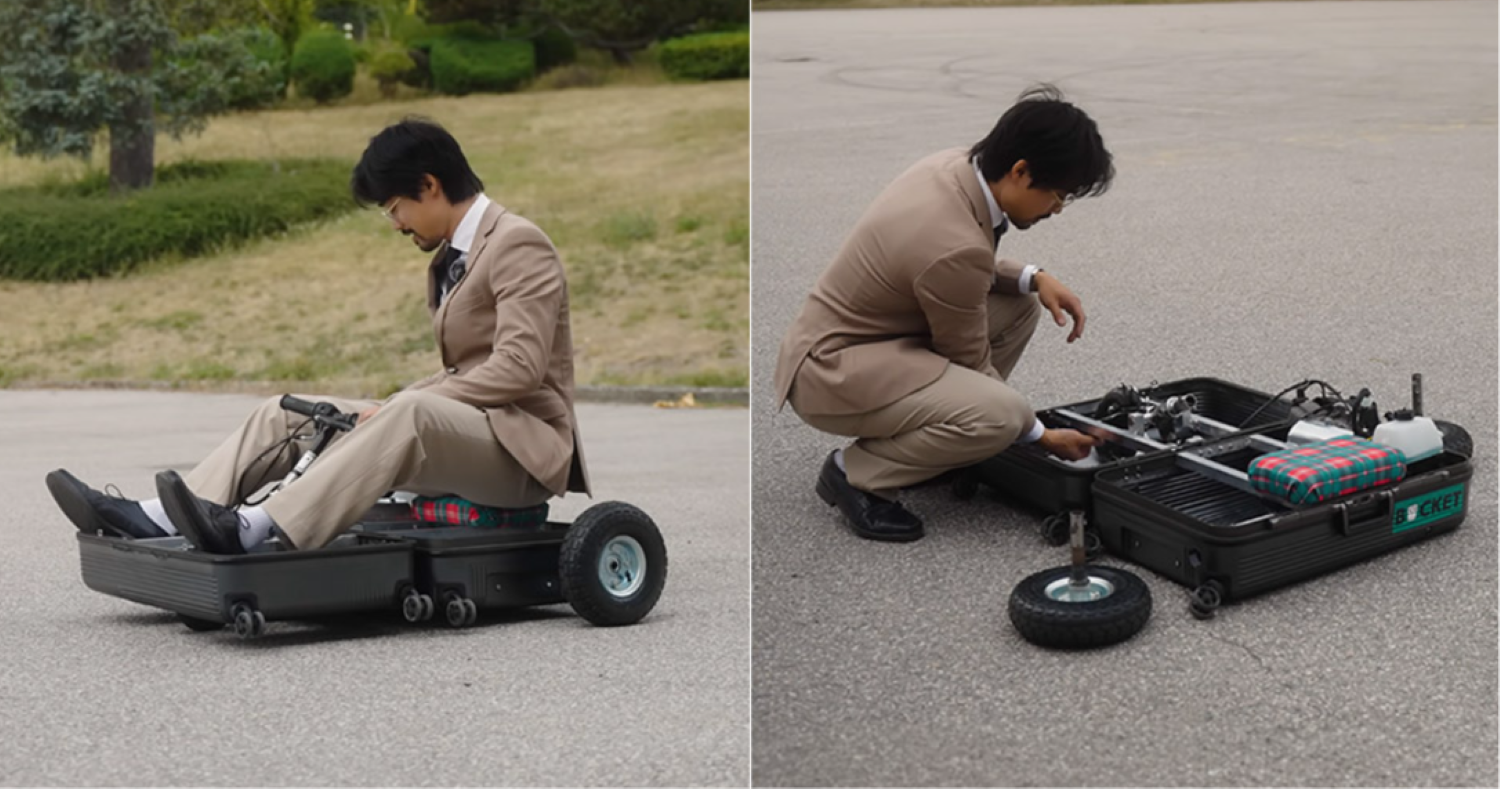
A vehicle that folds into luggage and drives under its own power sounds like a fever dream from a SkyMall catalog. In 1991, Mazda’s engineers actually built one. Now a YouTube channel called Bucket has rebuilt it from scratch — and the replica is lighter, faster, and arguably more impressive than the original.
The Original Was Weirder Than You Remember
Seven engineers turned a Samsonite suitcase into a driveable three-wheeler — then took it on Oprah.
Seven engineers from Mazda’s manual transmission R&D group entered an internal competition called the Fantasyard contest with a deceptively simple premise: stuff a three-wheeled gasoline vehicle into the largest Samsonite suitcase they could find. They sourced a pocket bike for the engine — a 33.6 cc Komatsu Zenoah two-stroke producing about 1.7 hp — built a folding chassis around it, and produced a machine weighing roughly 71 lb that assembled in under a minute and topped out near 19 mph. It appeared at auto shows across the U.S. and Europe. It was demonstrated live on The Oprah Winfrey Show. It never went into production.
Only one original is confirmed to survive today.
Replica vs. Original — Key Numbers
| Item | Value |
|---|---|
| Weight | original ~71 lb / replica ~56.8 lb |
| Top speed | original ~19 mph / replica ~20.5 mph |
| Engine | modern pit-bike two-stroke, replacing the original Komatsu Zenoah |
| Rear axle sprocket | sourced from a Razor E300 electric scooter |
| Assembly | a few minutes; fits in a standard car trunk |
Building It the Hard Way
Bucket’s build turns real-world trial and error into the engineering method.
Bucket tracked down the caretaker of the surviving original, secured permission to inspect it, and took detailed measurements before sourcing a modern hard-shell Samsonite case — slightly larger than Mazda’s, to gain more forgiving tolerances. They ground down the suitcase’s internal frame so a custom aluminum tube chassis could sit flush against the inner walls. The rear structure was TIG welded from square stock while the team was still mastering aluminum technique. Their first engine-mounting plate misaligned the crankshaft entirely; a thicker quarter-inch aluminum redesign corrected both alignment and stiffness.
The trickiest problem was physics. A solid rear axle on a short-wheelbase trike forces both wheels to spin at the same speed, which means the machine fights every turn. Bucket’s fix: a custom freewheeling axle using welded pillow-block bearings, letting one rear wheel drive while the other spins free. As described in Interesting Engineering’s coverage of the build, upgrades like this emerged from real-world testing and iterative troubleshooting rather than formal design calculations. The front end uses a Razor scooter fork — early quick-release hardware proved too soft, so the team replaced it with solid aluminum blocks and captive nuts. The seat is plywood, foam, and rice-bag upholstery, while the foot pegs are 3D-printed. Old problem, clever fix.
Consumer TIG welders, 3D printers, and scooter donor parts can now reconstruct engineering curiosities that might otherwise stay lost. The Bucket build is a tribute to a strange moment in automotive history — and a clear signal that modern maker tools have quietly lowered the barrier between “this existed once” and “this exists again.”