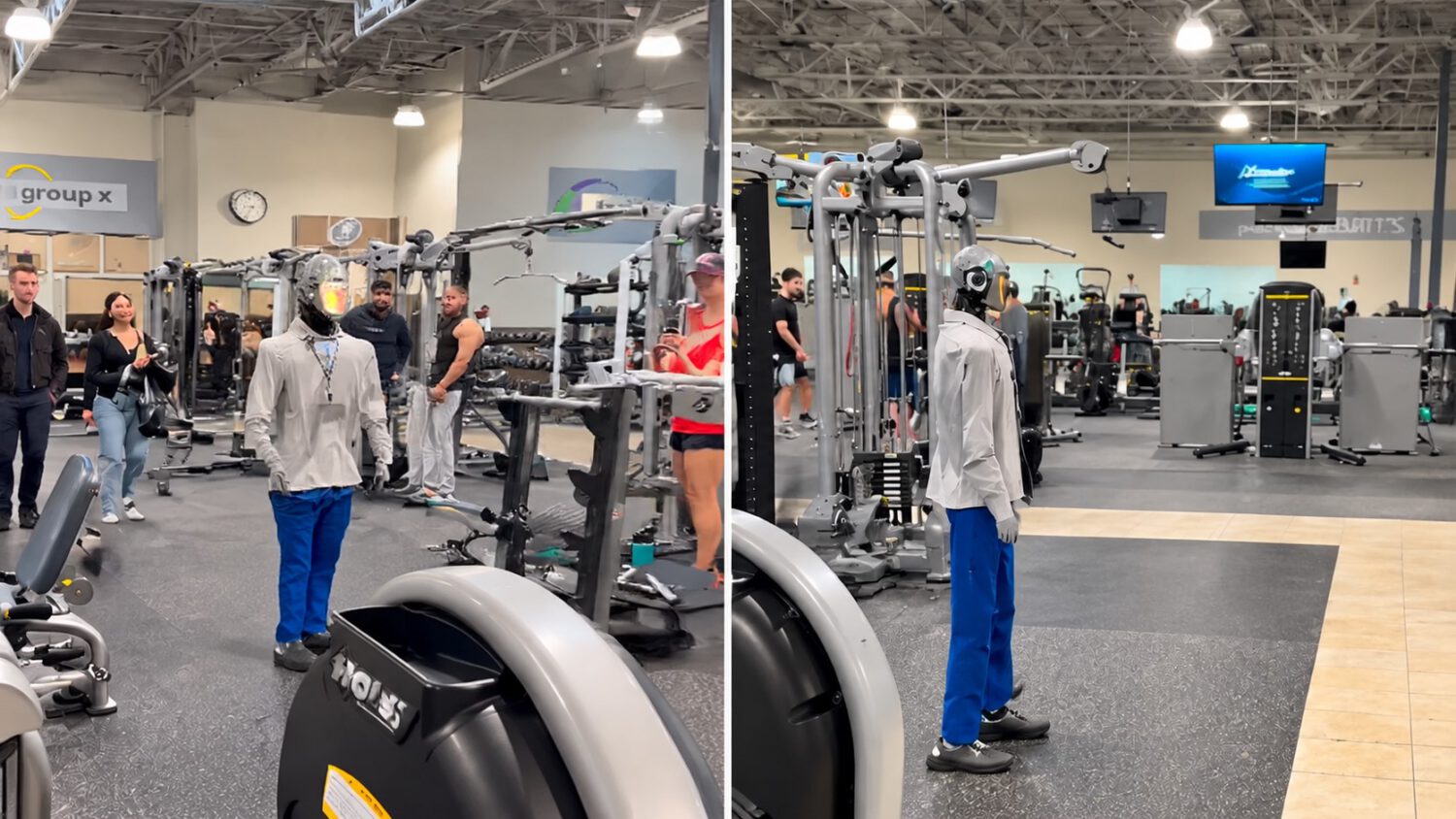
An unidentified humanoid robot reportedly entered 24 Hour Fitness‘ Carmel Mountain Ranch Super-Sport club in San Diego, walked the public exercise floor, and was filmed doing it. The robot’s manufacturer has not been identified, no verified statement from the company behind the test exists, and the gap between what the machine visibly did and what it would need to do to function as a trainer is significant.
What the Robot Actually Did
Reported social-media footage shows the robot navigating the gym floor, but no independently verified original post has been located.
According to reported social-media clips, the robot moved through the gym at 14331 Penasquitos Drive, appeared to survey its surroundings, and was seen near fitness equipment. It wore athletic clothing and sneakers. Clips reportedly circulated on platforms including TikTok, though no independently verifiable original post was located in available sources.
Confirmed and reported details include:
- Location: 24 Hour Fitness Carmel Mountain Ranch Super-Sport, San Diego
- Reported activity: floor navigation, environmental surveying, proximity to fitness equipment
- Appearance: athletic gear and sneakers
- Footage: reported social-media clips; no verified original post confirmed
- Affiliation: the available official listings reviewed here do not identify the robot as part of the gym’s training staff or technology program, and no verified partnership or endorsement role has been established
The gym’s official listings confirm human personal trainers at this location.
What Remains Unverified, and Why That Matters
The robot’s manufacturer, technical capabilities, and relationship to 24 Hour Fitness are all unconfirmed by available sources.
The robot’s manufacturer, model, sensor array, and software were not identified in available sources. Navigating a gym floor is a spatial task. Coaching a person through a workout is something else entirely.
A credible AI personal trainer would require reliable perception, exercise-recognition systems, individualized programming, conversational interaction, safety controls, and privacy protections. It would also need a verified ability to respond when a user reports pain or an emergency. None of those capabilities was demonstrated by the available evidence.
Walking through a room confirms that a robot can walk through a room. It does not confirm that the machine can read your form on a Romanian deadlift or know when to tell you to stop.
Where This Fits in the AI Fitness Landscape
Technology-assisted fitness already exists in software form, well before humanoid robots entered the picture.
AI fitness tools already exist without a humanoid body in the building. FitMachine, for example, creates personalized and adaptive workouts and adjusts sessions based on user performance. San Diego’s Smart Fit Method has described an AI-powered, data-driven training approach, suggesting local interest in technology-assisted fitness predates this reported experiment.
The reported gym visit fits that broader trend. Whether it meaningfully advances it depends on verified technical evidence that is not yet available.
The Real Distance Between Navigation and Coaching
A robot that walks a gym floor still faces a long list of unresolved requirements before it could coach paying members.
Safety certification, product liability, member consent, biometric data privacy, equipment compatibility, and emergency response protocols would all need verified solutions before a machine coaches paying members. A machine cannot responsibly guide someone through anything more demanding than a warm-up until those are in place. What the reported experiment appears to demonstrate, a robot navigating a gym, is a plausible starting point. Treat broader capability claims as aspirational until a verified source says otherwise.