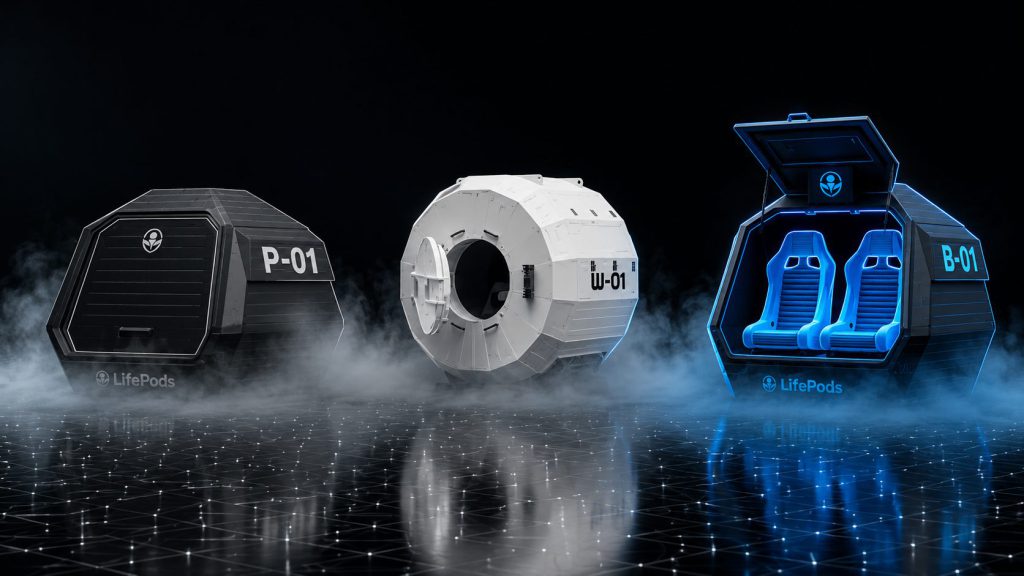
Ten seconds. That’s how long it takes to seal yourself inside a LifePod — roughly the same time you’d spend unlocking your phone to check a tsunami warning. French deep-tech firm Momentum Technologies has built a lineup of portable survival capsules designed for the moment when evacuation stops being an option. Three models cover three nightmares: the W-01 for floods, the B-01 for bullets and blasts, and the Q-01 for earthquakes. Prices start around £25,000 for the capsule alone. The engineering looks serious. The question is whether your postcode justifies the spend.
Three Pods, Three Threats
Each capsule targets a specific disaster scenario — and none of them tries to do everything.
Every model shares a 10-second seal mechanism and CO₂ scrubbers providing around 72 hours of breathable air, according to Momentum Technologies. Optional add-ons include GPS beacons and approximately two weeks of water rations. Beyond that shared foundation, specialisation takes over:
- W-01 (flood/tsunami): Marine-grade aluminium 5083 hull that floats and reportedly self-rights. Holds up to four adults and four children at maximum — though realistic comfort sits closer to 2–4 people. Priced approximately £29,870–£34,140. Expected availability: September 2026.
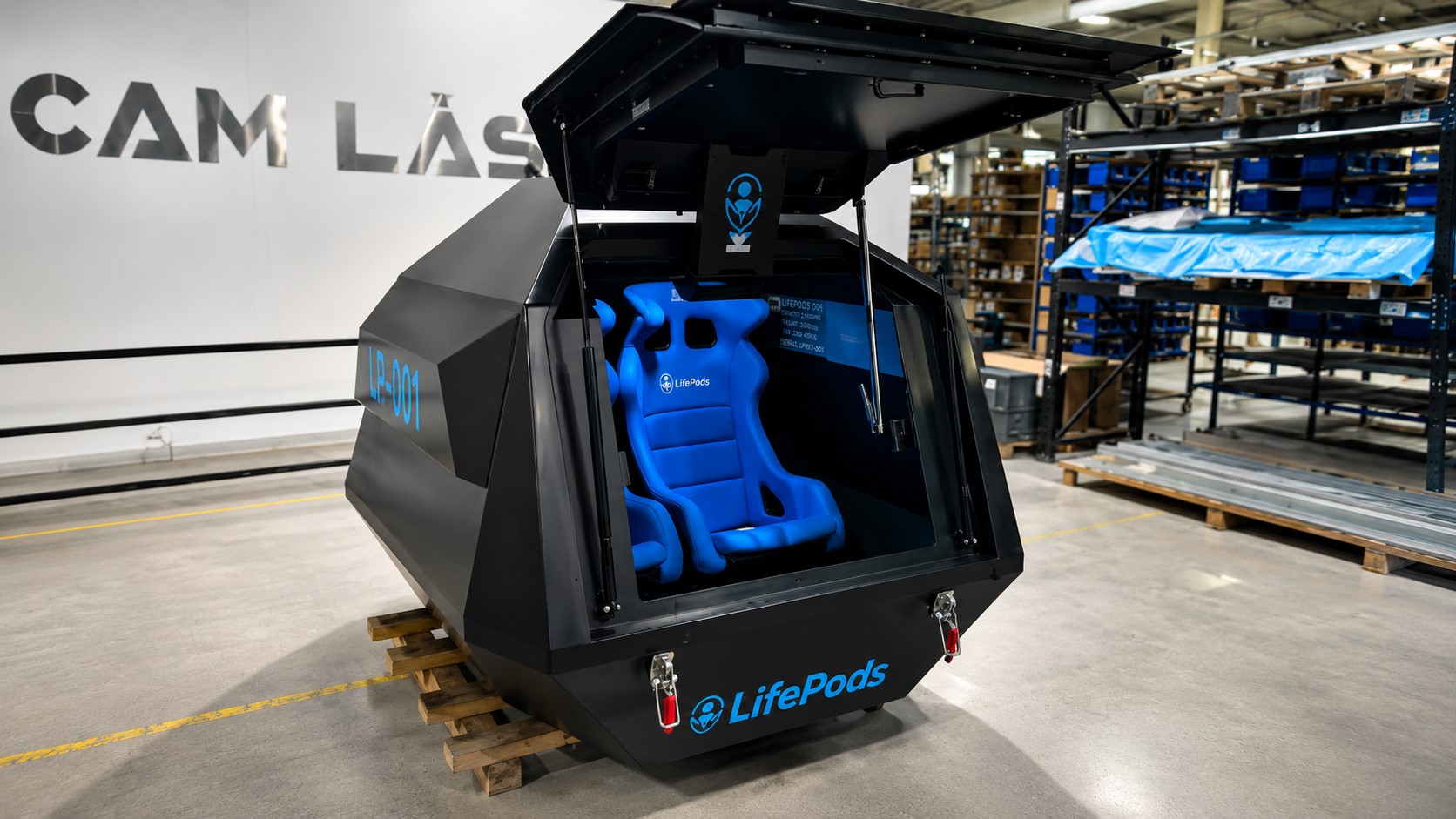
- B-01 (ballistic/blast): Technical steel with VPAM PM7-rated panels resisting 5.56×45mm and 7.62×51mm rifle rounds, as reported by New Atlas. Fits 1–2 occupants. Around £24,750. Entering production circa April 2026.
- Q-01 (earthquake/collapse): A lighter capsule designed for apartments in buildings up to six floors, seating 2–3 people. Price TBC; targeted release Q3 2027.
What Makes LifePods Genuinely Different
Portability and credible threat-specific engineering set these apart from conventional fixed bunkers.
Unlike fixed bunkers requiring excavation and permanent site commitment, LifePods can be containerised, helicopter-transported, and stacked — pre-positioned near coastal homes, industrial facilities, or remote infrastructure. Think emergency equipment, not architecture. The B-01’s VPAM PM7 rating means rifle-grade ballistic protection. Combined with optional GPS beacons, the pods become locatable survival bubbles rather than sealed tombs — a meaningful distinction when rescue teams need to find you in floodwater or rubble.
Honest caveats matter here, though. Each pod covers one threat category; the W-01 won’t help during a wildfire, and the B-01 won’t float. The 72-hour autonomy window assumes rescue actually arrives in time. That “four adults plus four children” W-01 capacity involves children sitting on laps. Independent real-world performance data doesn’t yet exist — these products are simply too new, as CBS News coverage of prototype testing acknowledges. Long-term maintenance requirements, including seal integrity and scrubber replacement cycles, remain publicly undocumented.
£35,000: Who Actually Buys This?
Government guidance still recommends emergency kits over personal capsules, making the realistic buyer profile relatively narrow.
Standard emergency planning centres on generators, water supplies, and evacuation routes — not personal capsules priced above most people’s annual salary. LifePods occupy the extreme end of preparedness hardware, most rational for buyers facing specific, identifiable threats: coastal tsunami zones, high-seismic-risk properties, or proximity to critical infrastructure. Momentum Technologies is pitching to institutional and industrial clients as much as to households, which makes sense given the deployment complexity involved. Layering in home security remains a more accessible first step for most people evaluating risk-management options.
At roughly £35,000 for the flood capsule alone — before delivery and installation — the W-01 costs more than most people’s emergency fund. Living through an era of atmospheric rivers and conflict escalation makes survival hardware feel less like doomsday cosplay and more like risk management. The question isn’t whether a portable survival pod sounds absurd. It’s whether your specific threat profile makes one rational.