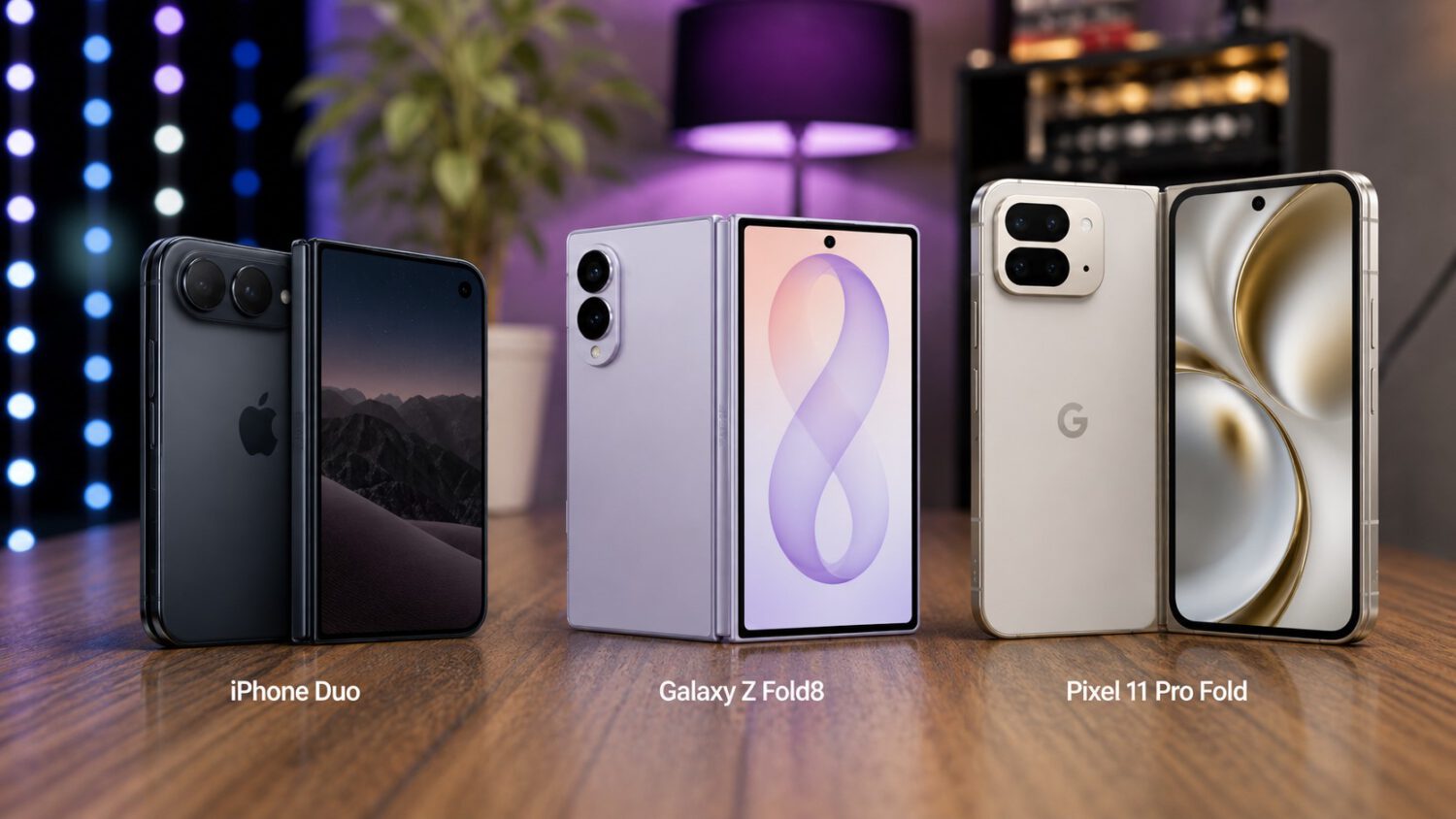
Three foldables, all premium, all arriving in 2026 at roughly $2,000 each (Apple’s price comes from a hands-on review brief and awaits official confirmation). Open them up, and the choices each company made become impossible to ignore.
Apple’s entrance into the foldable market is not simply a larger iPhone. It represents a specific set of trade-offs, and understanding them starts with the numbers.
Folded and Open: The Numbers That Matter
Getting the dimensions right matters more than any marketing claim when you’re deciding what goes in your pocket.
Hands-on review observations describe the iPhone Duo as having the smallest folded footprint of the three, though Apple has not published official folded dimensions to confirm this. Samsung’s Galaxy Z Fold8 folds to 123.9 × 81.9 × 9.7 mm, per Samsung’s official specification page. Google’s Pixel 11 Pro Fold folds to 155.2 × 76 × 10.1 mm, according to Google’s official listing.
Weight tells a different story for your wrist and pocket. Samsung’s Galaxy Z Fold8 comes in at 201 grams and the Pixel 11 Pro Fold at 239 grams, both per their respective official specifications. The iPhone Duo reportedly weighs 254 grams according to the hands-on review brief, making it the heaviest of the three despite its smaller reported footprint; that figure requires confirmation from Apple’s official specification sheet.
The Pixel 11 Pro Fold leads on inner display size at 8 inches, per Google’s official listing, while the Duo and the Z Fold8 both list 7.6-inch inner displays per Apple’s and Samsung’s official sources. The more consequential difference is shape, not size.
Samsung’s inner screen uses a 4:3-oriented format that reads as tablet-like, suited to split-screen productivity. Apple’s inner display reportedly uses a 1.4:1 aspect ratio (unconfirmed against Apple’s official sheet, per the review brief), which is narrower and closer to a widescreen video format.
Cover screens diverge more sharply. Samsung officially lists a 5.4-inch outer display, and Google lists 6.5 inches. Apple’s outer display is described as 5.4 inches in the review brief, reportedly covering roughly 90% of the screen area of the iPhone 18 Pro, though that comparison requires verification against Apple’s official display-area measurements. Reviewers describe Apple’s outer display as using an asymmetric layout, a departure from the more conventional cover-screen designs on both Android devices; treat this as a hands-on observation rather than a specification.
Display Quality and Software Layout
What the spec sheet can’t tell you is how the screen actually behaves in your hands.
Apple’s defining display feature is its nano-texture inner finish, designed to reduce reflections: that’s Apple’s own marketing language. Hands-on observers add that the coating also makes the fold crease less visible than on the Samsung and Google models, though this is a reviewer observation rather than a measured result.
Samsung’s inner panel is a Dynamic AMOLED 2X display with a 120Hz refresh rate, per the official spec page. Google’s inner screen is an 8-inch OLED panel with 2076 × 2152 resolution, per Google’s official listing. Apple’s technical page confirms a 7.6-inch OLED folding display for the Duo, though full panel specifications were not available at the time of writing.
Software layout differs structurally across all three. The review brief describes Apple moving the dock to the right side and repositioning menus and controls for foldable-adapted apps, while Samsung’s cover screen behaves like a standard Android phone. Samsung runs Android 17 with One UI 9, Google runs Android 17, and the Duo runs Apple’s foldable-adapted iOS.
Much remains unresolved before you can declare a clear winner. Samsung lists a 4,800mAh battery with up to 26 hours of wireless video playback. Google lists 4,806mAh with 24-plus hours of claimed battery life. Apple’s battery specification was not available from official sources at the time of writing, and independent camera and durability comparisons across all three devices are still pending. The size and design choices are clear enough; whether Apple’s trade-offs justify your investment is a question that needs more than a tape measure to answer.