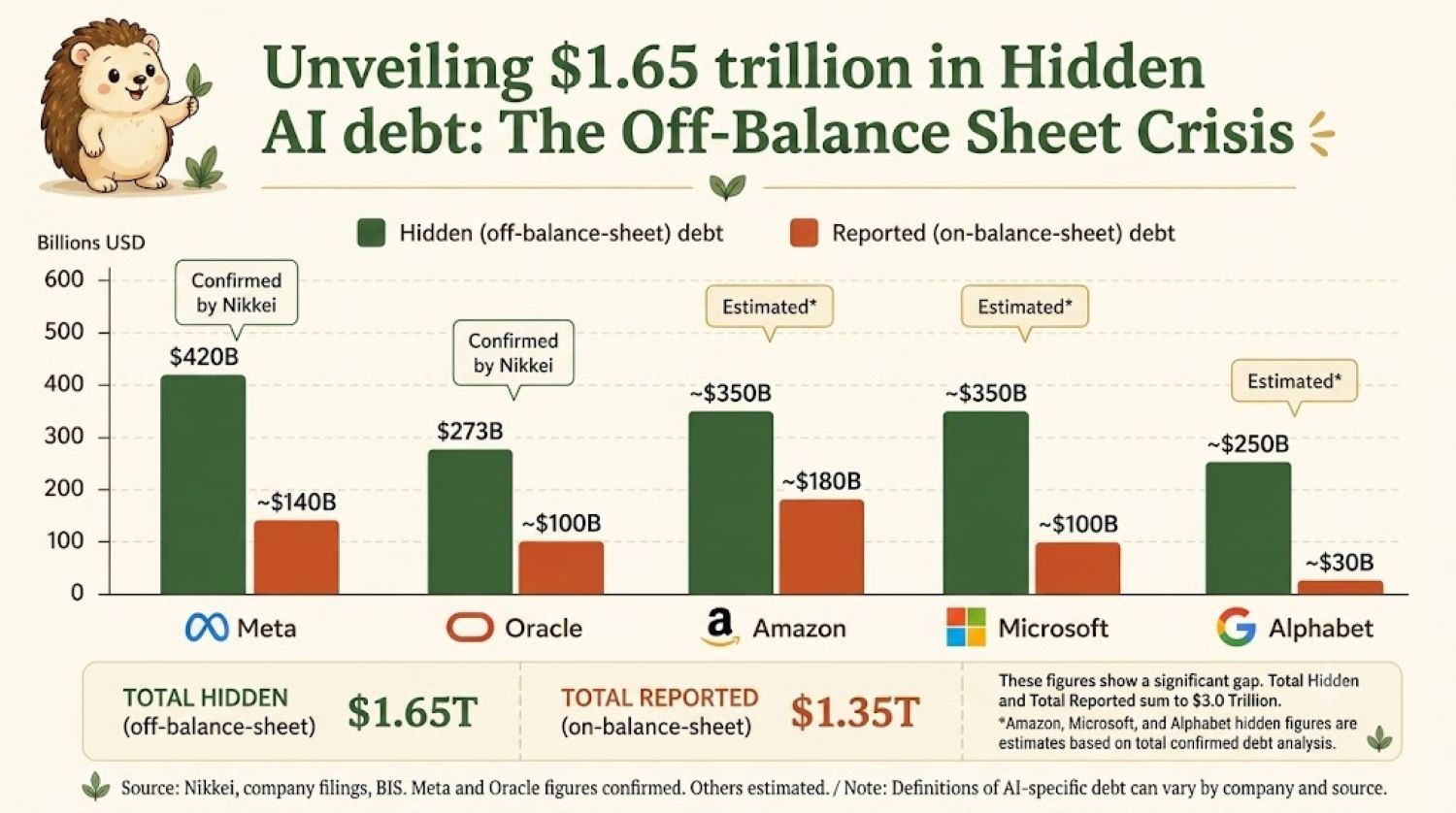
Five companies owe more money than their balance sheets admit. A Nikkei analysis of financial footnotes at Alphabet, Microsoft, Amazon, Meta, and Oracle found $1.65 trillion in off-balance-sheet obligations tied to AI infrastructure — binding, must-pay commitments parked in the fine print.
That figure exceeds the $1.35 trillion these firms report as formal debt. Quarterly earnings season is here, and anyone reading only headline leverage numbers is seeing less than half the picture. The structures involved are legal. They also happen to be the same tools Enron once used to blow up.
The Footnote Is Where the Story Lives
Off-balance-sheet financing keeps real obligations invisible to anyone who doesn’t read fine print for fun.
Buried inside supplemental tables, off-balance-sheet financing works like this: a company creates or partners with a separate legal entity — a special-purpose vehicle (SPV) — that borrows the money and owns the assets. The tech company signs long-term leases or capacity contracts but doesn’t record the SPV’s debt on its own books.
Meta’s Hyperion data center in Louisiana is the poster child. Meta and Blue Owl Capital co-funded a separate entity that took on $27 billion in debt to build the facility. Meta is the sole tenant but argues it needn’t record that debt because the entity — not Meta — bears the risk. Meta’s total off-balance-sheet obligations sit at roughly $420 billion, nearly three times its reported debt — and if you think obscured liabilities only matter to Wall Street insiders, consider how often consumers are paying too much without realizing it.
By the numbers:
- Nikkei’s $1.65 trillion in hidden obligations surpasses the group’s $1.35 trillion in reported formal debt
- Off-balance-sheet commitments have grown roughly eightfold in four years
- Moody’s estimates $662 billion of total commitments are data-center leases not yet commenced — still off the books
- In 2025, the five companies issued approximately $121 billion in new bonds, up from roughly $40 billion in 2020
The Enron comparison is inevitable, but the distinction matters. “Enron’s crime wasn’t having special purpose vehicles. Enron’s crime was hiding them,” Gil Luria noted, according to Bloomberg Law coverage. Today’s structures comply with GAAP and IFRS. The obligations are disclosed — think terms-and-conditions that nobody reads but everyone technically agrees to. Oracle is already feeling real consequences: S&P downgraded its credit rating, explicitly citing stretched leverage from AI commitments including roughly $260 billion in future lease obligations.
What Happens If AI Demand Doesn’t Show Up
The moment data centers go live, the hidden debt becomes very visible, very fast.
As facilities become operational, leases roll onto balance sheets simultaneously — recorded debt and lease liabilities spike together overnight. If AI monetization underperforms, those assets face write-downs, with losses flowing directly to the lenders, insurers, and bond investors who funded the structures. Industry estimates put total AI data-center spending through 2028 above $3 trillion, much of it deployed ahead of proven demand. Morgan Stanley and Moody’s have both flagged the rising leverage as a risk worth watching.
Analysts evaluating these companies should treat large operating leases and take-or-pay contracts — agreements obligating payment regardless of whether the underlying service is actually used — as debt equivalents when assessing true leverage. The “fortress balance sheet” narrative looks considerably different once $1.65 trillion gets added back. If AI revenue matches the ambition, this was bold financing that rational markets will applaud. If it doesn’t, the footnotes will have been the most important document nobody read.