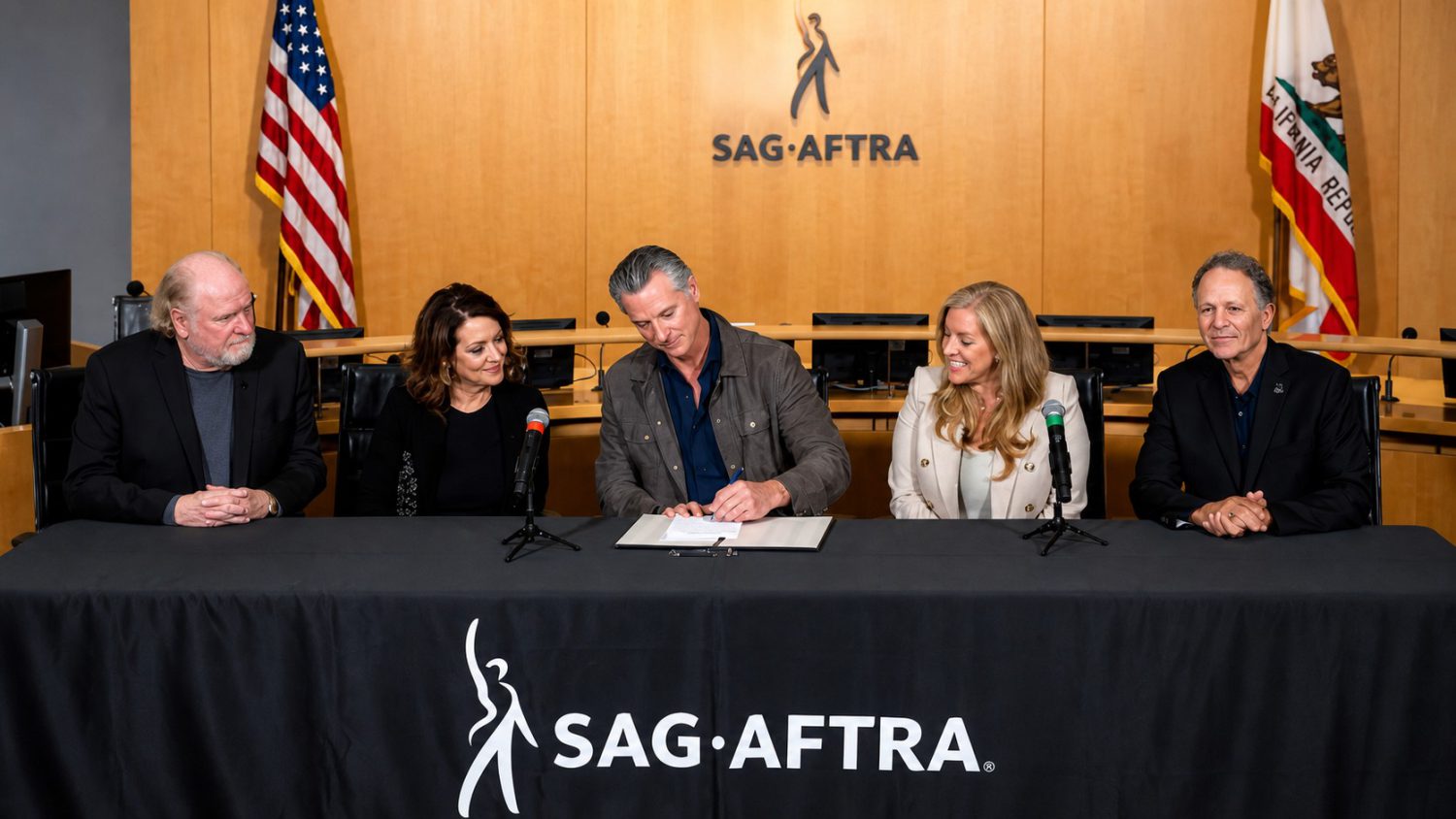
That confident spokesperson walking you through a new blender’s features, or explaining why this insurance plan is “right for your family,” might not be a person at all. Starting January 1, 2027, California advertisers will have to tell you that upfront. Governor Gavin Newsom signed SB 1050 on September 16, 2026, adding a targeted disclosure requirement to the state’s existing false advertising framework.
What the Law Actually Requires
Any audio, video, or audiovisual advertisement that features a “synthetic performer” in a prominent role must include a clear and conspicuous disclosure. Acceptable language includes “This performance features a synthetic performer” or “No human performer is depicted.” The law defines a AI-generated figure, voice, or representation. It creates a realistic impression of a human performance but depicts no identifiable real person.
The prominent-role threshold is where the law gets specific. A synthetic performer triggers the requirement when appearing in the foreground to demonstrate a product, delivering the primary commercial message, or reacting to a pitch in a way that functions as a testimonial. Background or incidental AI figures do not trigger disclosure. Lawmakers made that narrowing deliberately, after business and tech groups raised concerns about compliance burden and definition breadth.
What It Does Not Cover, and How Enforcement Works
Unauthorized AI replicas of real, identifiable people are already handled under separate state laws covering digital replicas and publicity rights. This law targets the opposite scenario: realistic but entirely fictional AI humans, the kind that look like they could be your neighbor but exist only inside a server somewhere.
Platforms carry real obligations once a violation is adjudicated. After a court of competent jurisdiction finds an ad unlawful and issues an order, streaming services, broadcasters, and online ad networks that receive that order must stop distributing the ad in California as soon as commercially and technically feasible. They must also stop accepting payment to run it, and pre-screening every ad is not required, but ignoring a court order is not an option.
New York moved first. Its synthetic performer disclosure law, signed December 11, 2025 and effective June 9, 2026, carries civil penalties of $1,000 for a first violation and $5,000 for each subsequent one. California’s SB 1050, sponsored by SAG-AFTRA, integrates into existing false advertising law rather than establishing new penalties, meaning enforcement runs through the state’s Unfair Competition Law framework. The two approaches differ in mechanics but land in the same place for advertisers.
What This Means Going Forward
Because California and New York together represent two of the largest advertising markets in the country, the industry may treat compliance as a practical national standard.
AI avatar vendors and synthetic voice platforms will likely build disclosure templates directly into their tools, positioning compliance as a product feature. If you see a disclosure reading “No human performer is depicted,” that language satisfies the law’s requirement and reflects exactly the plain, direct wording regulators expect. Advertisers who decide the friction of disclosure outweighs the cost savings may quietly move certain campaigns back to human talent, which is, at least in part, what SAG-AFTRA was counting on.