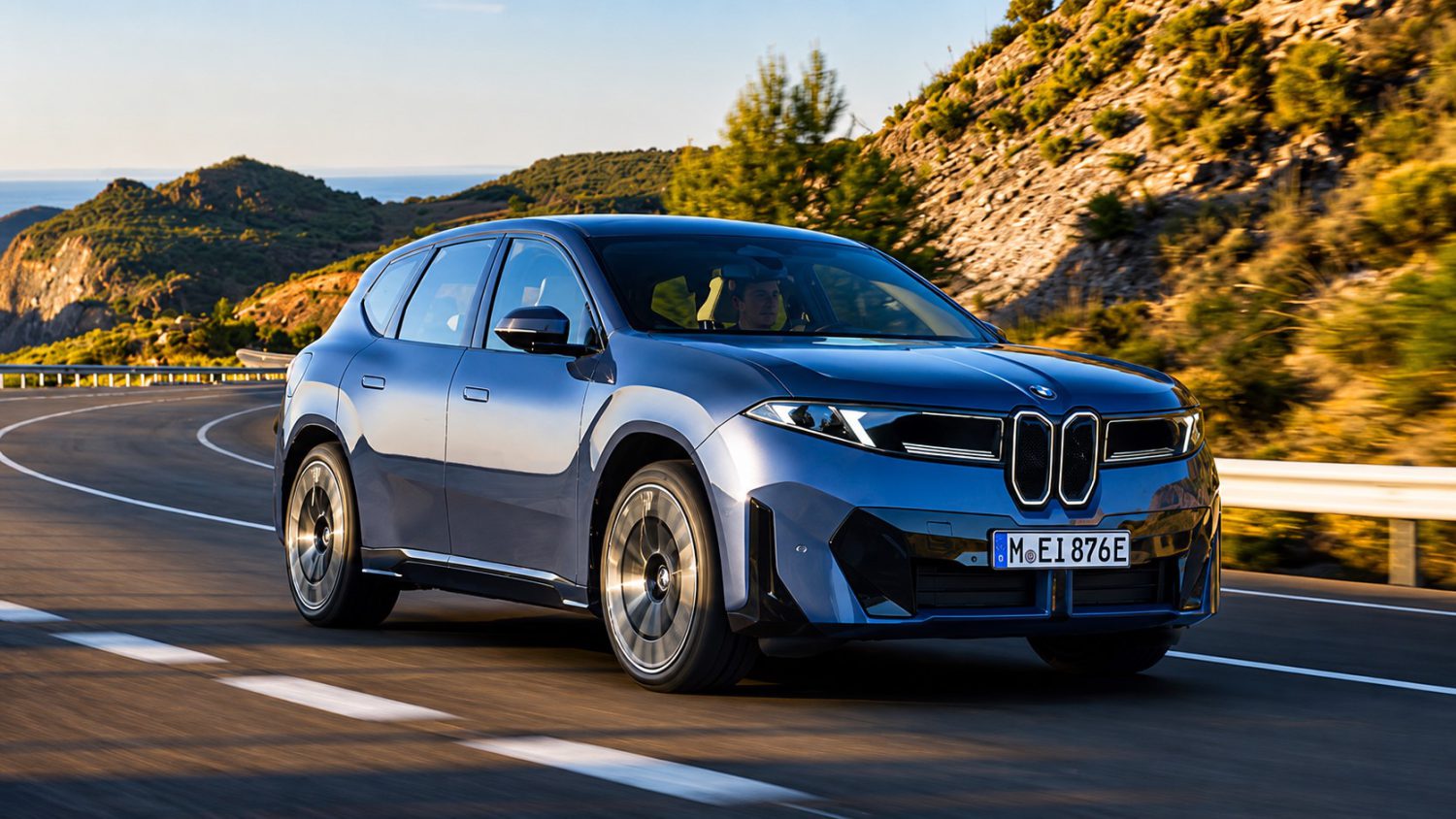
The handle moves. The door doesn’t. Nothing is broken — the car has already decided the moment isn’t safe, because a cyclist is closing in from behind and the iX3 spotted them first. That’s not a warning chime. That’s the latch physically holding. Announced in late August 2026, the 2027 iX3 is the first production Neue Klasse model to ship with this upgraded Exit Warning system. It represents something worth paying attention to: a car that briefly treats your own decisions as overridable. The safety stakes here echo what happened when a driverless Tesla demonstrated the real-world consequences of autonomous vehicle failures.
How the Door Lock Actually Works
Side radar detects the threat; your handle pull is ignored until the hazard clears.
Side-mounted radar sensors continuously track cyclists, e-scooters, vehicles, and pedestrians approaching the parked car. When the system calculates that opening the door creates a high collision risk, the lock control unit holds the latch closed. The car releases only once the road user has cleared the danger zone. BMW frames this as a direct response to dooring accidents — where a car door swings open directly into a cyclist’s path. According to BMW-cited German insurance statistics, around 8% of Berlin bicycle accidents in 2024 involved dooring. The stakes are real.
The iX3’s broader active safety suite extends well beyond door control:
- Emergency steering intervention automatically guides the car around a sudden obstacle — a pedestrian stepping from between parked cars, an unseen cyclist in low light — while staying within the vehicle’s own lane. BMW claims rivals currently lack an equivalent lane-confined evasion function.
- Pedal misapplication override: below roughly 1.2 mph with an obstacle within one meter, an unusually hard accelerator press gets ignored — the car brakes instead.
- Attentiveness Assistant: if the driver becomes incapacitated, the system takes control, brings the car to a stop, activates hazard lights, and places an emergency call.
Not Revolutionary – But More Committed Than the Competition
Lexus and Audi got here first; BMW is betting on scale and raw compute power.
Lexus’s e-Latch Safe Exit Assist and Audi’s exit-warning systems already use sensors to prevent door opening when traffic approaches. BMW is not first. What’s different is the commitment: active door-delay becomes standard across the entire Neue Klasse platform, with confirmed rollout to the i3, X5, and 7 Series. If you’re weighing the broader purchase decision, understanding gas vs electric running costs remains a key part of the iX3 equation. Underpinning all of it is a water-cooled centralized driver-assistance computer delivering roughly 20 times the processing power of BMW’s previous generation — part of what the company calls its “superbrain” architecture. That raw compute headroom is what makes real-time sensor fusion fast enough to act, not just alert.
BMW’s framing positions the Exit Warning upgrade as tackling dooring “at the hardware and software level, rather than relying solely on driver awareness.” That’s an honest acknowledgment: human attention fails. The car, reportedly, shouldn’t.
The tension worth sitting with is this. A car acting like a bouncer holding the velvet rope — not yet, the cyclist hasn’t passed — is well-intentioned. It’s also the automotive equivalent of Screen Time blocking an app at an inconvenient moment. Sensor glitches happen. Emergency exits exist. And who controls the override thresholds in future software updates is a question BMW hasn’t answered yet — much like the way dealers keep recommending services your car probably doesn’t need, raising the same question of who really holds the decision-making power. That conversation is coming.