Two companies that spent years fighting over privacy just announced they’re working together. Apple and Meta have collaborated to run Meta’s Muse Spark Open, an 816-billion-parameter AI model, locally on Mac Studio computers, allowing prompts, files, and outputs to be processed on the local hardware rather than sent to a hosted inference service. For developers who’ve wanted large-scale AI without a cloud subscription, this is one route, provided your budget can handle what comes next.
What Muse Spark Open Actually Is
Meta describes Muse Spark Open as its most capable U.S. open-weight model to date, built for complex developer work rather than casual users.
Muse Spark Open uses a mixture-of-experts architecture, meaning only roughly 42 billion of its 816 billion total parameters activate per token, though all model weights remain in memory and represent a substantial hardware requirement. The model targets coding, extended agentic workflows, multimodal tasks, and multi-step reasoning, and carries a reported one-million-token context window. Muse Spark Open is the version developers can actually download and run themselves, with weights available on Hugging Face, while Meta’s proprietary Muse Wonder model is positioned as more capable overall.
What Running It Locally Requires
The hardware bill is serious, and $10,799 is just where the math starts.
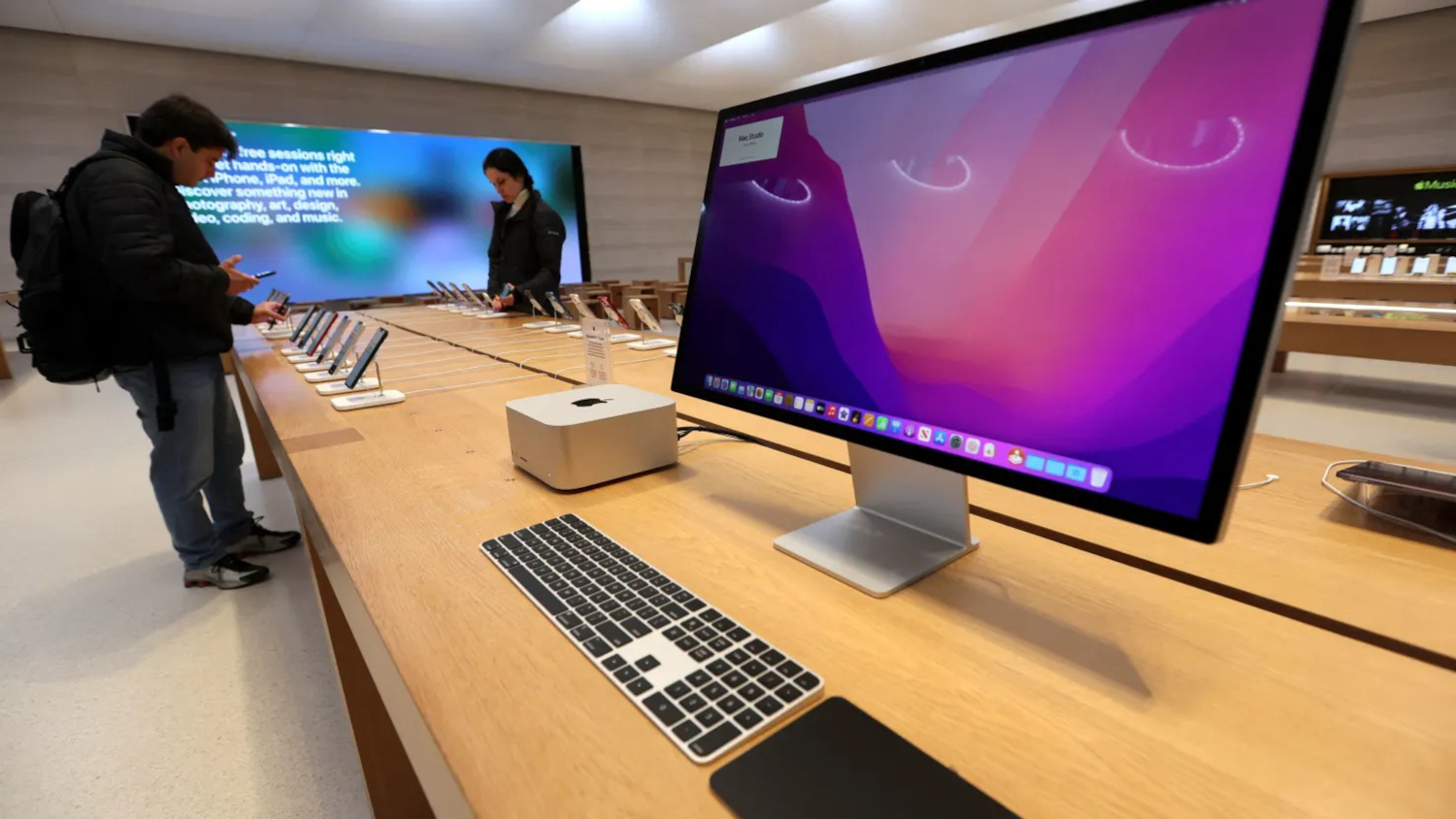
Effective operation relies on Apple’s MLX machine-learning framework distributing the model across two to four M5 Ultra Mac Studios. The cited configuration carries a 36-core CPU, 80-core GPU, 32-core Neural Engine, and 256GB of unified memory, where compute and memory share a single chip, reducing the transfer bottleneck found in traditional workstations with discrete GPUs.
Apple lists that entry configuration at $10,799, with a 16TB storage variant at $18,299. Two machines at the base price push real system costs past $20,000, and higher-memory configurations can exceed $40,000 before displays, networking, or storage. Reports differ on exact minimum requirements depending on quantization settings and context length, so treat those floor figures as starting points rather than firm guarantees.
Why Both Companies Benefit
Apple gets a high-profile hardware showcase; Meta gains a desktop platform for developers building local AI agents.
For Apple, this is a demanding real-world stress test of MLX, its unified-memory architecture, and the M5 Ultra. Meta AI chief Alexandr Wang said the companies “worked with Apple to bring leading Agent capabilities to your desktop for the first time on the Apple M5 Ultra Mac Studios,” according to CNBC. Meta gains a platform for developers experimenting with local agents, and the company has reportedly already purchased hundreds of Mac computers for its internal Superintelligence team.
A History of Public Criticism and a Reported Collaboration
The two companies arrive at this partnership after years of pointed public disputes over privacy and platform control.
Apple’s App Tracking Transparency changes in 2021 cost Meta an estimated $10 billion in 2022 revenue, according to CNBC. Tim Cook publicly criticized Meta’s approach to user data; Mark Zuckerberg publicly criticized Apple’s product control and pace of innovation. The collaboration reportedly came together with involvement from Daniel Gross, a former Apple director who later joined Meta’s AI organization, according to Axios.
Where This Fits Apple’s Broader AI Strategy
This is one piece of a multi-provider approach, not a platform merger.
Apple already integrates ChatGPT through Siri and has an arrangement involving Google’s Gemini through Apple Intelligence. The Meta collaboration adds another option for developers rather than replacing either. Neither company confirmed any Siri or Apple Intelligence integration, and both declined to characterize the project as the beginning of a deeper relationship, according to Quartz.
Developers with the budget now have a path to running a large-scale model on their own hardware, with prompts and outputs staying local during inference. The privacy and cost-control benefits are real, though electricity, maintenance, and security costs shift to the user. So is the $20,000-plus entry ticket, calculated on two base-configuration Mac Studios, to get there.