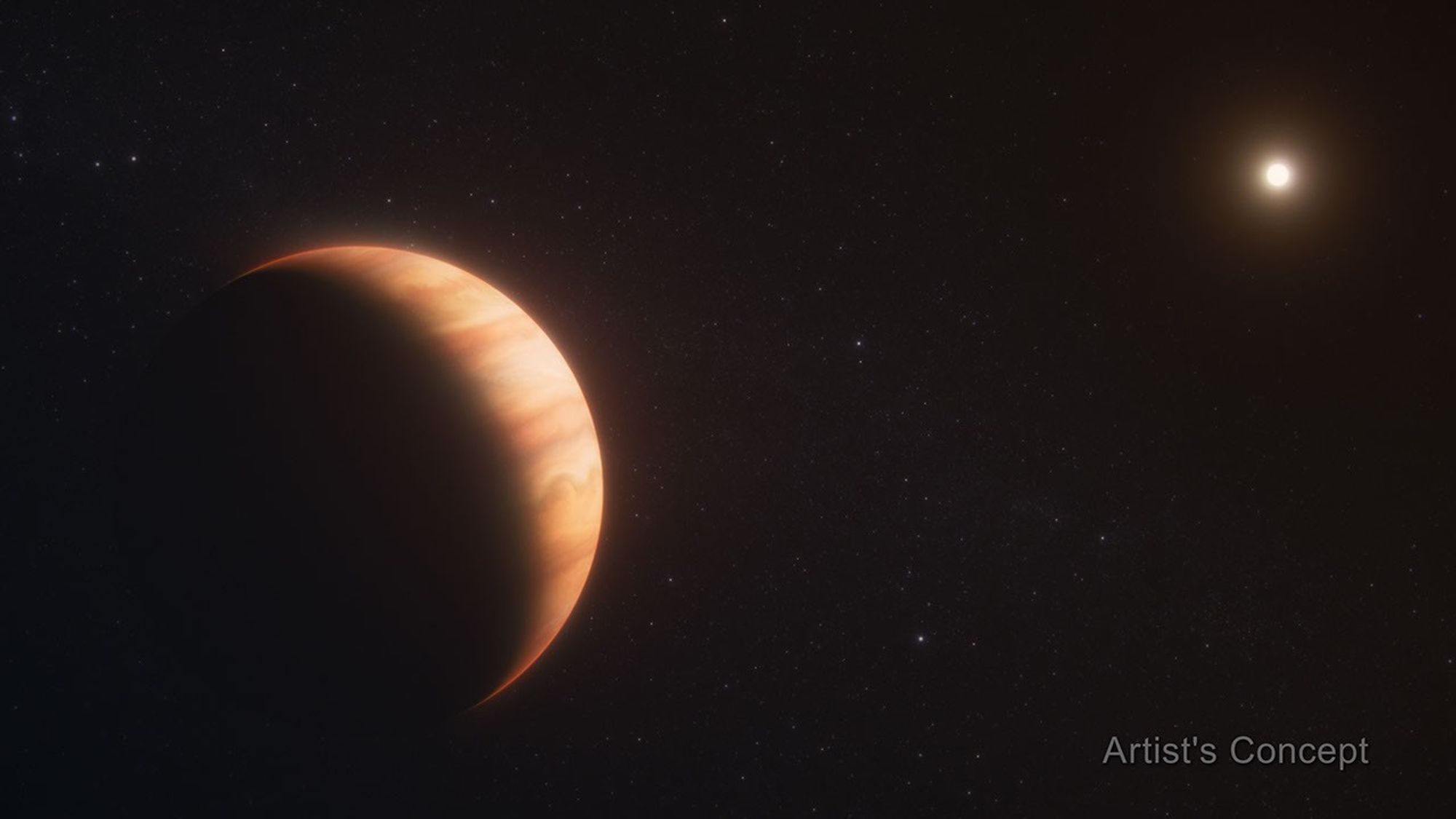
Eighty light-years away, a gas giant the size of Jupiter whips around a stellar corpse every 1.4 days. That orbit sits roughly 50 times closer to its star than Earth is to the Sun. By every reasonable expectation, WD 1856b should not exist where it does.
The host star, WD 1856+534, followed the standard playbook for Sun-like stars: burn through hydrogen, balloon into a red giant more than 100 times its original size, shed the outer layers, then collapse into a white dwarf roughly the size of Earth. Anything orbiting too close during that expansion got vaporized. JWST’s new data confirms WD 1856b wasn’t anywhere near the blast radius. The planet started far out in a safe region, then migrated inward over 3 to 5.5 billion years — a slow gravitational shove from two red dwarf companions in the triple-star system. Billions of years of cosmic patience, and it paid off.
What did the telescope actually find?
- Methane makes up about 7% of the planet’s atmosphere
- Temperatures run hotter than the white dwarf alone can explain
- This marks the first time any planet transiting a white dwarf has had its atmosphere characterized in detail
Those thermal fingerprints point squarely to a history of long, grinding orbital migration. An early competing theory suggested the planet survived inside the red giant’s envelope. JWST’s atmospheric data rules that out.
“The surviving planets around the sun will initially move further away when the sun dies… However, the giant planet we have studied, WD 1856b, has moved in closer to the white dwarf… most likely caused by the gravitational influence of two nearby red dwarf stars,” said Ryan J. MacDonald of the University of St Andrews.
Earth’s Fate Isn’t Negotiable
The Sun’s red giant phase will erase the inner solar system — though the outer planets may get a second act.
In about five billion years, the Sun expands enough to engulf Mercury and Venus. Earth either gets swallowed or loses its oceans and atmosphere to intense heat long before the white dwarf stage arrives. WD 1856b’s strategy — start far out, migrate later — simply doesn’t apply to a planet already sitting in the kill zone.
The actual survivors are Jupiter, Saturn, Uranus, and Neptune. These outer giants could eventually drift inward toward the Sun’s remnant, gravitationally nudged by mutual interactions or a distant stellar flyby, reshaping the solar system into something unrecognizable. WD 1856b is essentially a preview of that far-future scenario.
“The fact that planets can survive into that final stage of the stellar life cycle really widens the range of possibilities for where and when habitable planets might exist in the universe,” said Christopher O’Connor of Northwestern University.
Planetary systems don’t die with their stars — they restructure. The next question researchers are pressing is whether rocky worlds could migrate into white dwarf habitable zones entirely. Earth’s story ends in fire. The solar system’s doesn’t.