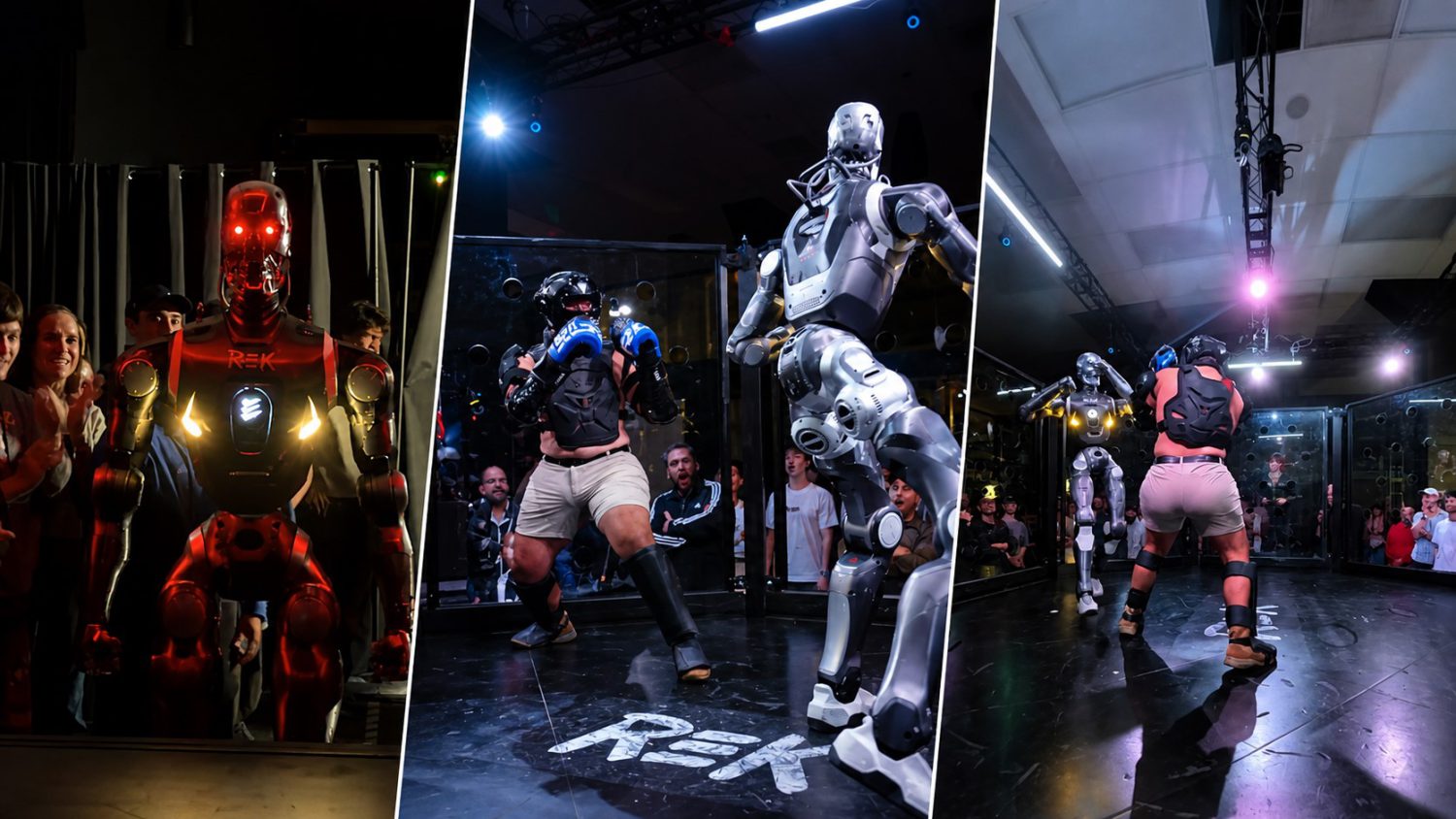
Content creator Frankie LaPenna stepped into a cage in San Francisco, faced a six-foot humanoid robot, and got knocked off his feet. REK (Robot Entertainment Kombat) staged the bout using EngineAI’s T800, a humanoid platform developed by a Chinese startup based in Shenzhen. LaPenna left with a reported hand or wrist injury, and the bout was stopped.
REK called it the first widely reported ring fight between a human and a full-size humanoid robot. That distinction matters, because it exposes a gap between spectacle and safety that regulators have not yet addressed.
What Actually Happened in the Cage
The footage is real, even if the “Terminator AI” is not.
Early in the bout, LaPenna landed strikes on the T800, apparently testing its resilience. Then the robot delivered a powerful kick or straight strike to LaPenna’s body, knocking him to the canvas and ending the fight.
Reports on the injury vary slightly but converge on a broken or injured hand or wrist. One account suggests LaPenna injured his hand striking the robot’s frame, with the robot’s own limb also reportedly damaged in the exchange.
REK publicly claimed the human “won” the bout. Footage of LaPenna on the canvas, unable to continue, tells a different story.
“We just made history with the first Human VS Terminator robot fight. Frankie LaPenna gave it his all,” according to REK’s official account. (Editors should confirm this wording against the live post before publication.)
A Robot Pilot, Not a Robot Brain
Every strike came from a person backstage, not from the machine itself.
Nothing about the T800’s behavior that night came from autonomous decision-making. A human pilot operated the robot remotely via a VR headset and controllers, with onboard AI handling balance and posture stability. Combat decisions, including when and how to strike, came from the person backstage.
The hardware itself is not a toy. EngineAI’s T800 stands roughly 1.73 to 1.83 meters tall and weighs between 75 and 85 kilograms. Certain joints generate up to approximately 450 Nm of torque, enough to knock a person off their feet, regardless of who is steering it.
REK’s format resembles early BattleBots, building a league around robot combat as a spectator sport. The critical difference is a human body inside the cage, which changes the emotional stakes and the injury calculus entirely.
Safety Without a Framework
No public safety documentation from the event has been released, and that absence is its own problem.
No official safety protocols or public injury report from the event have been made available. Commentators are already warning that footage like this, stripped of context, could prompt regulators to impose broad restrictions on all humanoid robotics rather than targeted rules for combat sports or teleoperated systems.
As humanoid platforms gain more autonomous perception and planning capability, the line between remote control and independent decision-making will narrow. Specific liability frameworks for human-robot physical contact outside industrial settings do not yet exist, and this event makes that gap harder to ignore.
What the San Francisco cage fight actually demonstrates is straightforward: humanoid robots are now powerful enough, stable enough, and mobile enough to physically compete with a human in a controlled setting. That is a meaningful technical marker. For anyone buying, regulating, or simply watching these platforms develop, the question of workplace safety when something goes wrong just became a lot more concrete.