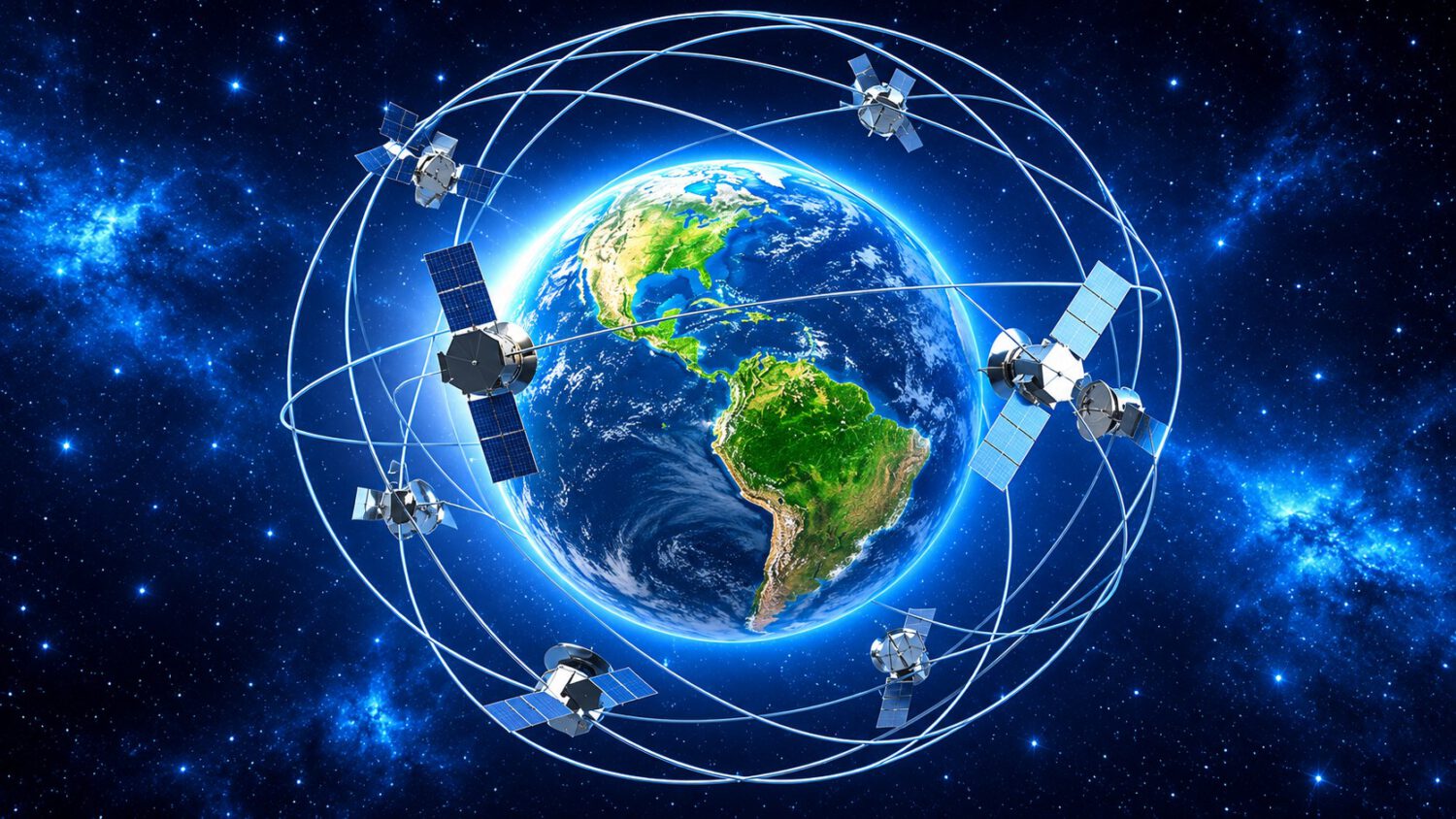
Somewhere over Norway on July 27, 2026, a satellite received a human voice, recognized it, and acted on it without anyone touching a keyboard.
The Oslo Group of the Norwegian Radio Relay League transmitted spoken audio over the 23-centimeter amateur-radio band to ESA’s OPS-SAT PRETTY spacecraft, asked it to run Doom, and received a downlinked image confirming the game had launched.
No Telecommand. Just Voice.
The transmission was ordinary spoken audio, not a preformatted digital instruction packet of the kind ground operators typically use.
PRETTY’s onboard processing chain received the signal and filtered out noise. It then ran a speech-to-text model, matched the transcription against a command trigger phrase, launched the game, and transmitted a postcard image back to Earth as confirmation.
Two Passes, One Proof
The team conducted two sessions on the same day, moving from a synthesized voice to a live human operator.
During a morning pass, the team looped a synthesized voice transmission. That evening, a human operator spoke directly into a microphone.
Radio noise made the transcription imperfect, but the recognition system identified enough of the trigger phrase to execute the command.
Attributing the “First”
Tanagra Space calls it the first known instance of its kind, a claim that merits careful attribution.
Tanagra Space, one of the experiment’s organizers alongside ESA and Graz University of Technology, characterized this as the first known instance of a satellite autonomously receiving, recognizing, and executing a spoken command in orbit. Establishing a clean historical record across all satellite experiments is difficult, so that claim should be understood as Tanagra Space’s assessment, not an independently verified universal record.
The available experiment records show that the complete sequence, from audio input to onboard inference to autonomous action, worked. OPS-SAT PRETTY launched in 2023 as an experimental ESA platform designed for testing advanced onboard processing. It is not an operational mission, and its experimental design made this kind of test possible.
What Was Actually Demonstrated
The satellite matched degraded speech against a constrained vocabulary; it did not demonstrate open-ended natural-language understanding.
The demonstration did not establish open-ended natural-language understanding. The system matched degraded speech against a constrained vocabulary and succeeded at that narrower task.
The significance is the unbroken chain: a human spoke, a satellite received the signal, a machine recognized the trigger, and no human intervened between command and result.
The Serious Part
The research team identified distress monitoring and onboard scientific observation as potential directions, though neither represents a confirmed roadmap.
Georges Labrèche, Tanagra Space’s founder and principal investigator, pointed to distress monitoring as one possible direction. He suggested that future systems could recognize emergency phrases and initiate a response. That response could arrive faster than a process requiring a Coast Guard relay or another intermediary to act first.
A related potential application involves onboard scientific observation. Models trained on the signatures of transient astronomical events could trigger data collection without waiting for ground analysts to review a signal and issue instructions. Both scenarios are stated possibilities from the research team, not confirmed plans.
The Distance Between Demo and Deployment
The gap between a successful technology demonstration and operational readiness remains substantial.
This was a technology demonstration. Authentication, replay-attack prevention, and false-command filtering would each require rigorous validation before any real-world deployment. So would radiation tolerance and mission safety constraints.
What July 27 established is narrower and more durable than the headlines suggest. Limited machine-learning inference can run on a spacecraft’s constrained hardware, interpret a noisy real-world signal, and produce a verifiable autonomous result. That is worth knowing.