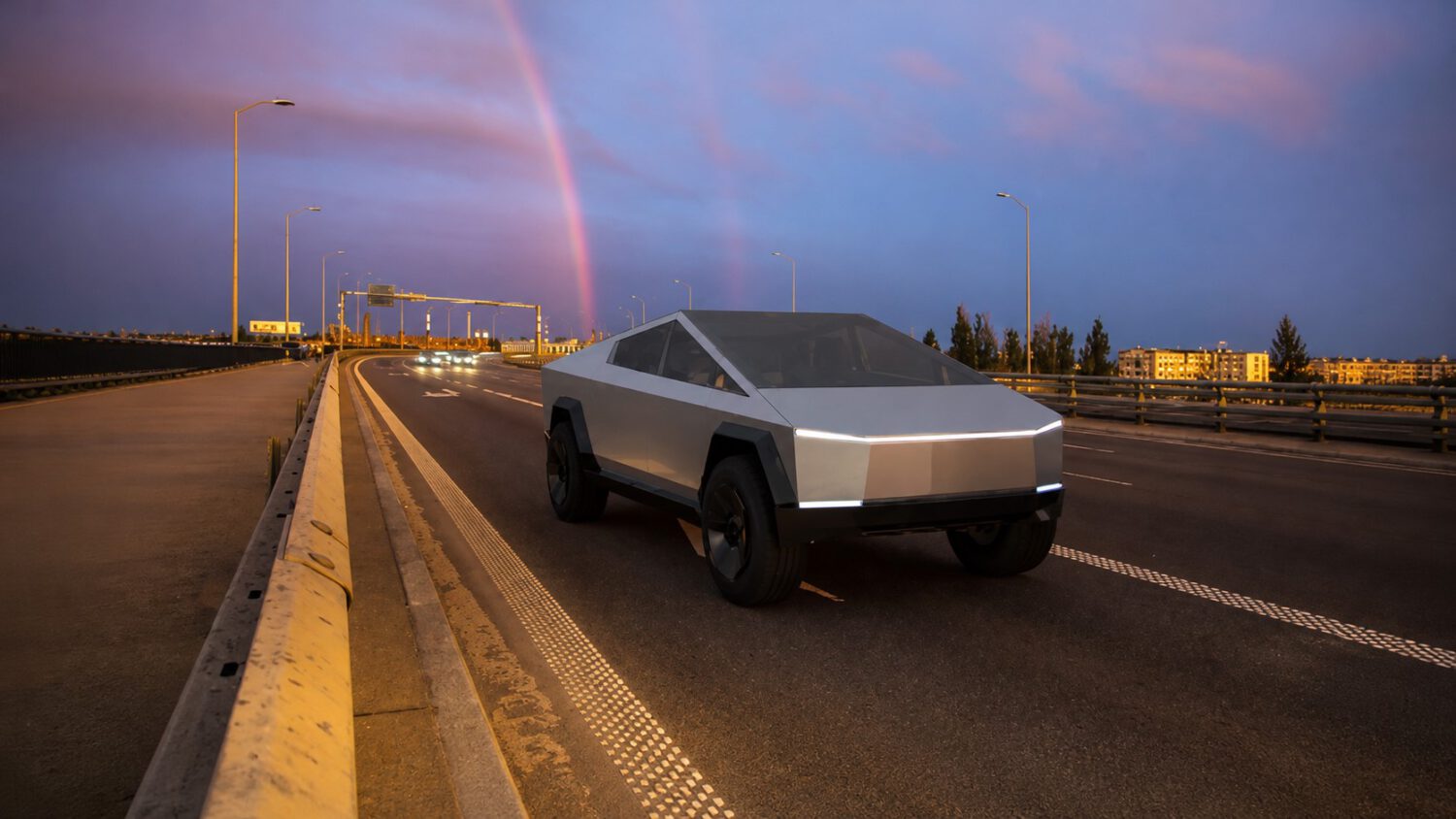
Most vehicles carry a protective layer of clear coat, sitting atop paint to absorb the minor surface damage of daily use. The Cybertruck skips that layer entirely, according to Tesla’s service documentation.
Tesla confirms that the exterior body panels have no clear coat. Any scratch occurs directly in the stainless-steel panels themselves.
Durable, but Not Invisible to Damage
Tesla’s durability claims address dent resistance, but surface damage is a separate concern.
Tesla markets the bare-steel body as more resistant to dents and dings than conventional automotive materials. Resistance to impact, however, is not the same as resistance to surface damage.
Tesla’s owner guidance instructs owners to remove corrosive or non-neutral substances promptly, because those substances can damage or corrode the exterior.
What Fixing It Actually Requires
Tesla’s own service manual describes a refinishing process that is neither quick nor cosmetically neutral.
Scratch removal on the Cybertruck requires a random-orbital sander, and Tesla’s service manual warns that sanding can alter the appearance of the repaired area. That repair scope can extend well beyond the original damage.
Technicians may need to refinish an entire flat panel plane, and the corresponding planes on the same side of the vehicle, to maintain visual consistency across the surface. When weighing long-term ownership costs, a Gas vs Electric comparison can reveal tradeoffs that go well beyond the sticker price.
Three Distinct Things the Surface Attracts
The attention the Cybertruck draws in public space falls into categories that are worth distinguishing.
Criminal vandalism is one category: opportunistic damage with no defined message. Political protest is a second, given the truck’s strong association with Elon Musk and the legibility that association creates as a proxy for public displeasure. The third is commissioned or participatory customization, where owners or artists approach the vehicle’s uninterrupted steel geometry as a deliberate aesthetic surface.
None of these categories has been documented in verified incident reports sufficient to establish a national pattern.
A Vehicle That Reads as a Statement
The Cybertruck’s silhouette and its maker’s public profile give it an unusual legibility in shared space.
The Cybertruck’s angular geometry is identifiable at a distance, and its surface reflects light differently than painted vehicles nearby. Its connection to one of the most publicly debated figures in American business adds a layer of cultural visibility that most production vehicles do not carry.
That combination makes the truck legible as a cultural object as well as a vehicle, and objects that carry that kind of visibility tend to attract responses.
What Remains Unverified
Isolated incidents have been reported, but the evidence does not yet support a broader claim.
Reports of Cybertruck vandalism and customization have surfaced across multiple cities, but no publicly available police records, owner documentation, or municipal data confirms a coordinated pattern or statistically unusual defacement rate compared to other vehicles.
Whether the attention the Cybertruck attracts reflects a genuine trend or simply the truck’s unusual visibility in public space remains an open question. What Tesla’s own documentation does establish clearly is that when something happens to the surface, the repair process is neither straightforward nor visually seamless.