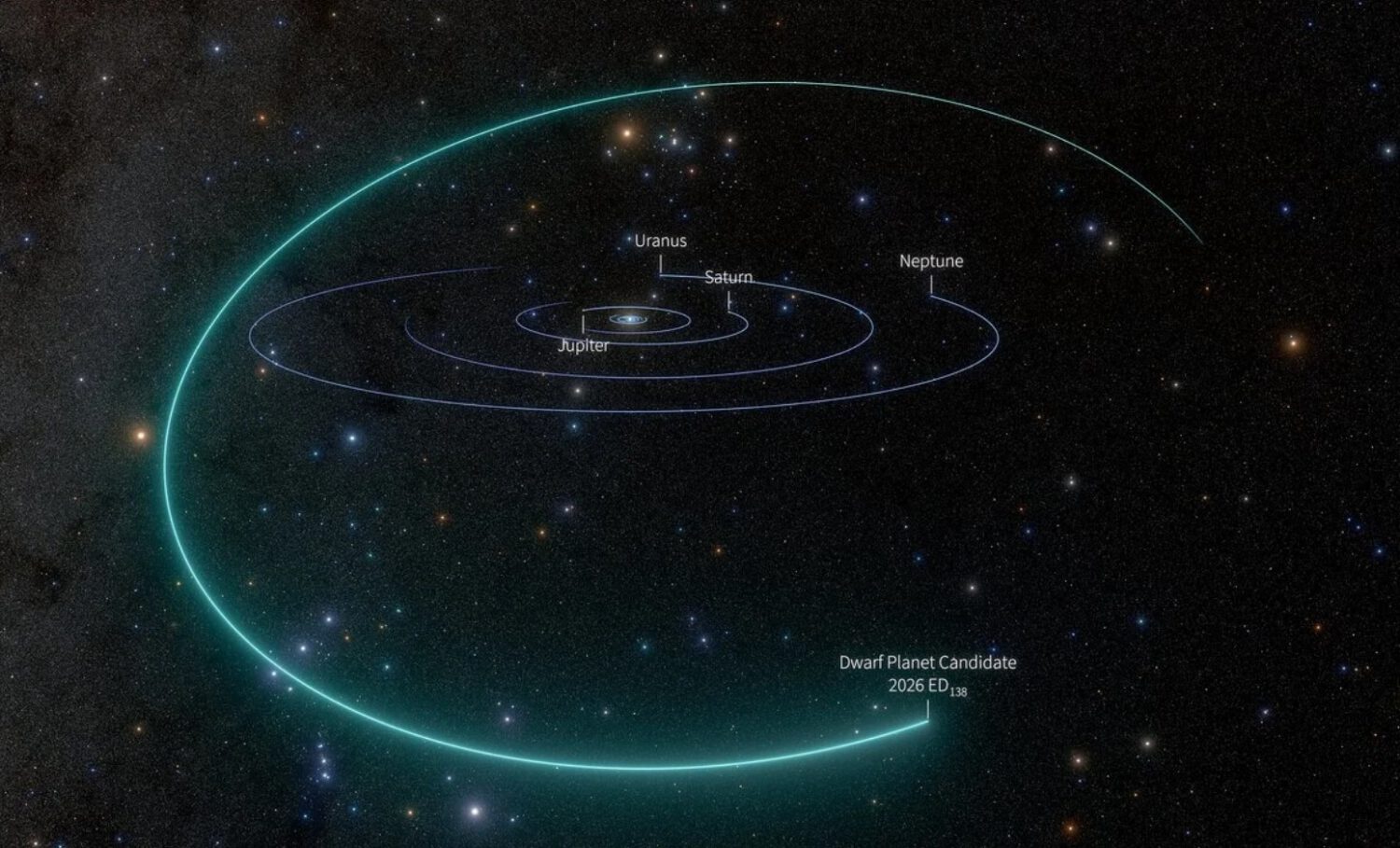
Something big has been orbiting quietly beyond Pluto for hundreds of years. The NSF-DOE Vera C. Rubin Observatory has identified it as 2026 ED138, a trans-Neptunian object large enough to be a dwarf-planet candidate. It escaped detection not because it is unusually faint, but because it spent years blending into a dense field of background stars and required repeated monitoring before its motion could be confirmed. Much like how airborne LiDAR has uncovered hidden worlds on Earth, systematic detection technology is reshaping what we know about our cosmic neighborhood.
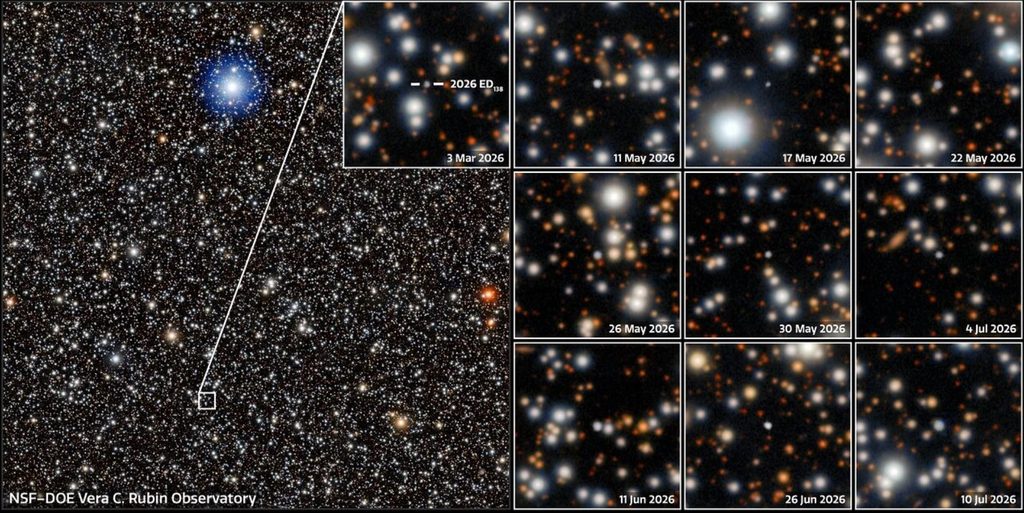
NSFDOE Vera C. Rubin Observatory/NOIRLab/SLAC/AURA Image Processing: M. Juri¿ (UW), D. de Martin & M. Zamani (NSF NOIRLab)
What Exactly Is 2026 ED138?
A provisional designation tracks the object officially, but formal dwarf-planet status requires additional evidence.
The International Astronomical Union’s Minor Planet Center assigned 2026 ED138 its provisional designation, a label that tracks the object formally but does not itself establish any planetary classification. Preliminary size estimates place its diameter between 600 and 1,500 kilometers. That range puts it in the same general tier as some recognized dwarf planets, though the estimate remains uncertain and should not be treated as a confirmed measurement.
Whether ED138 earns formal dwarf-planet status depends on several unresolved questions about its size, shape, and composition. The most important physical question is whether its own gravity has pulled it into an approximately round shape, a condition scientists call hydrostatic equilibrium. Under the IAU’s definition, a dwarf planet must orbit the Sun, have sufficient mass for a nearly round shape, and not have cleared the neighborhood around its orbit. Follow-up observations will determine whether ED138 meets those criteria.
Its Orbit Explains the Long Invisibility
A steeply tilted path kept the object outside the sky regions most surveys routinely covered.
ED138 sits roughly 46 astronomical units from the Sun, with one astronomical unit equal to the average Earth-Sun distance. Its orbit takes approximately 281 years to complete, and its path is inclined about 24.5 degrees relative to the ecliptic, the flat plane where most planets travel. Many traditional sky surveys concentrated their coverage near that plane, so an object spending significant time above or below it could go unnoticed for decades.
That orbital geometry is part of the explanation, though not the whole story. NSF reporting also highlights that ED138 appeared against a field containing millions of stars, making it nearly indistinguishable without repeated observations. Both factors, the inclined orbit and the crowded stellar background, contributed to its long absence from the catalog.
How Rubin’s Camera Changes the Search
Repeated wide-field imaging across broad sky regions revealed what single exposures could not.
Rubin Observatory sits atop Cerro Pachón in Chile and operates the largest digital camera ever built for astronomical imaging. Its design prioritizes repeated scans of broad sky regions, allowing it to track slowly moving objects that would be invisible in any single exposure. A slow-moving body looks like a fixed star in one image, but enough comparisons over time reveal its motion.
Matthew Holman of the Center for Astrophysics at Harvard and Smithsonian identified ED138 while analyzing Rubin data, using software developed with Kevin Napier. Detections accumulated between March 4 and July 11, 2026. Researchers then located archival images from other instruments, extending the observational record and sharpening the orbital calculation.
The Outer Solar System Still Has Surprises Left
ED138 is a reminder that systematic, wide-field surveys can find what targeted searches leave behind.
Confirming ED138’s size and shape will require infrared measurements, thermal modeling, occultation observations, and light-curve analysis, all dependent on follow-up work from other observatories. Detailed physical measurements do not yet exist, so the classification remains open. Rubin’s survey approach could continue to uncover additional objects in regions that earlier programs examined less thoroughly.
ED138 does not prove any specific theory about unseen massive planets or unknown orbital forces. What the discovery does establish is more straightforward: a world potentially comparable in size to recognized dwarf planets was circling the Sun undetected, and the gap was observational rather than inevitable.