Alchemists spent centuries chasing mercury-to-gold conversion. A San Francisco startup says fusion neutrons accomplished it. Marathon Fusion announced on October 21, 2026, that it had transmuted mercury into stable gold using high-energy fusion neutrons, claiming a production rate 10 times CERN’s 2025 benchmark. No independent verification was publicly available at the time of reporting, and the company has not disclosed how much gold it actually made.
How the Reaction Works
The nuclear physics behind Marathon’s claim is established science; the experimental data is not yet public.
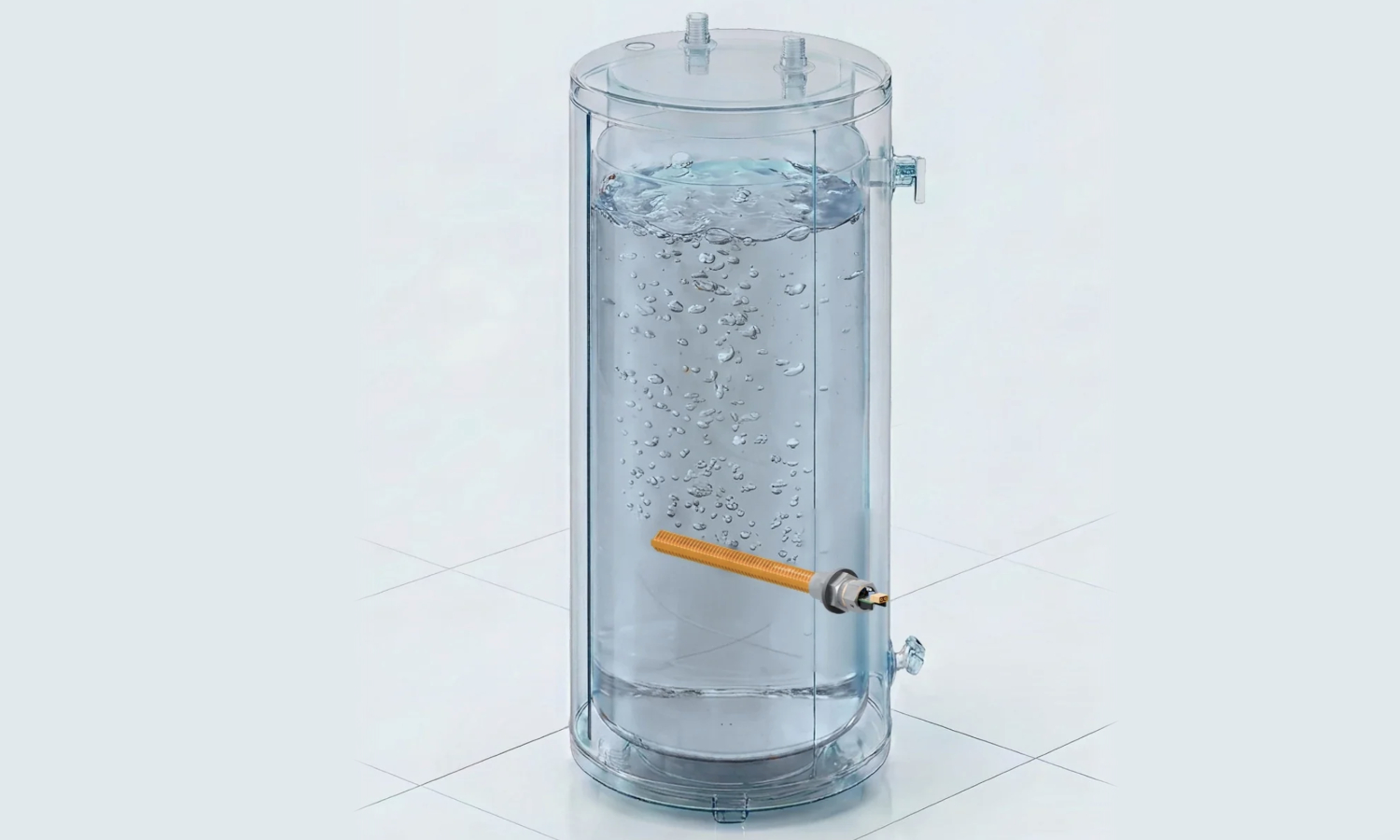
A 14-MeV neutron from deuterium-tritium fusion strikes mercury-198, producing mercury-197, a radioactive isotope with a reported half-life of roughly 64 hours. Mercury-197 then decays into gold-197, the only stable isotope of gold. In Marathon’s proposed design, mercury sits inside the reactor’s fusion blanket, which simultaneously breeds tritium to fuel continued fusion reactions. The concept appeared in a 2025 Marathon preprint that has not undergone peer review.
What Marathon Claims vs. What It Has Actually Shown
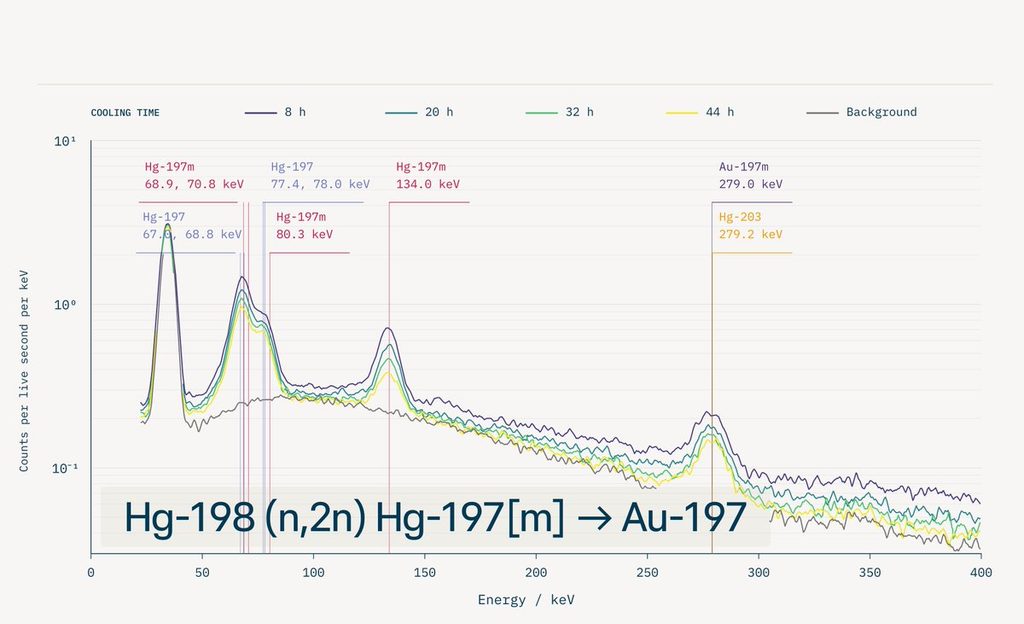
The company posted gamma-ray spectra on X; it has not posted yield figures, purity data, or a methodology outside researchers can replicate.
CERN’s ALICE experiment produced roughly 29 picograms of gold over four years of Large Hadron Collider operation, with those nuclei generated in lead-ion collisions. Marathon says its production rate is 10 times that benchmark. The company has not clarified whether that comparison measures total mass, nuclei per second, irradiation duration, or another metric entirely.
The two processes also differ fundamentally in mechanism, making the comparison difficult to interpret without complete data. According to Marathon Fusion’s October 21 post on X, the company posted gamma-ray spectra showing signatures associated with mercury-197 and gold-197. What it has not disclosed publicly is the quantity of gold produced, its purity, recovery efficiency, or production cost.
That gap prevents independent verification of the claimed yield and commercial significance. Marathon’s current reactor reportedly operates at approximately 1 kilowatt of fusion power, roughly one-millionth of a gigawatt. Its modeled projections of up to two tonnes of gold annually assume future gigawatt-scale plants that do not yet exist.
Freshly produced material would also carry radioactive isotopes requiring decay storage and processing before any gold could be sold. Marathon’s own modeling reportedly contemplated years of storage in some scenarios, with reported estimates ranging from roughly 7 to 18 years depending on assumptions.
The Broader Business Case
Medical isotopes, not gold, may be Marathon’s most credible near-term revenue opportunity.
Marathon also says it produced copper-64 and copper-67 by irradiating zinc with fusion neutrons, though that claim also requires a direct first-party source for full confirmation. Those isotopes are used in cancer imaging and targeted radiotherapy, markets where small quantities command high prices and demand exists today.
Marathon was founded in 2023 and reportedly raised a $5.9 million seed round in 2024 from the 1517 Fund and Anglo American, though those funding details have not been independently confirmed in the sources reviewed. The company is building a compact fusion reactor in San Francisco focused on record power density, and its stated activities span fusion hardware, neutron utilization, isotope production, and eventually grid-scale fusion electricity.
Even if gold production scales significantly, world mine output runs to thousands of tonnes annually. This is not a commodity disruption scenario; it is a startup demonstrating a neutron-utilization concept with commercial applications still to be proven.
The physics Marathon describes is plausible in principle. Nuclear transmutation is scientifically established, and fusion-neutron irradiation of mercury-198 is a known pathway to gold-197. What is missing is the experimental data required for independent verification of the claimed yield and production rate. Marathon’s credible next step is publishing those results in a form that outside researchers can scrutinize. Until then, this remains a company-reported demonstration, not a confirmed scientific or commercial breakthrough.