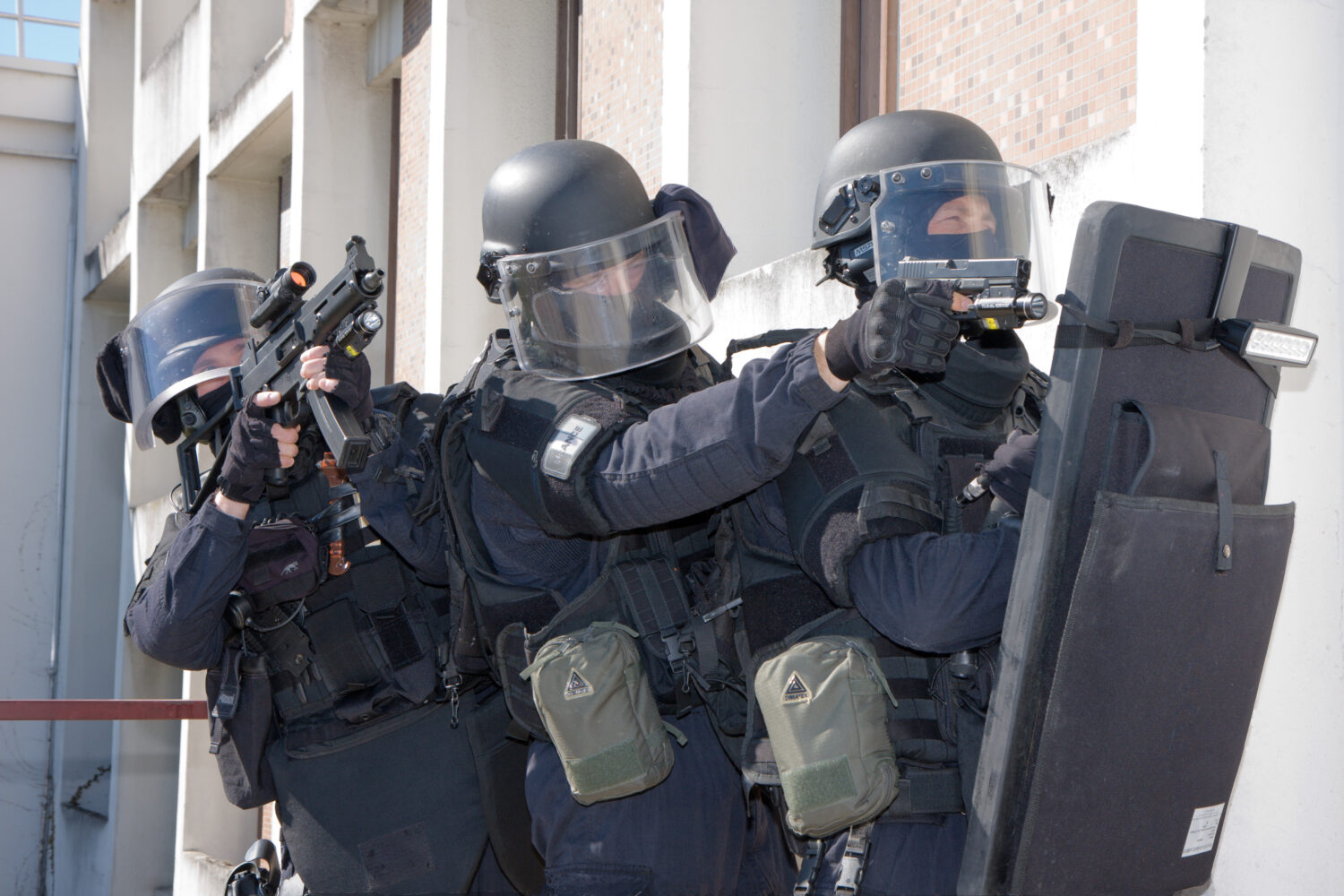
A French Senate mission has recommended that police use coded chemical-marking devices to help identify suspected offenders after demonstrations disperse. The proposal is a recommendation, not a deployment order, and the shorthand “DNA gun” circulating in coverage needs immediate correction: these devices tag people with a synthetic chemical marker, not biological sample capable of building a genetic profile. Civil-liberties questions about surveillance app technology targeting protesters have surfaced in comparable contexts elsewhere.
How the Device Works
The Senate’s proposal centers on a coded liquid marker designed to connect a person to a specific police operation, not to establish genetic identity.
The described system uses small marking devices that apply a liquid marker to skin and clothing. According to the available Senate material, vaporization can reach approximately 5 to 7 meters, though the precise delivery mechanism for the French proposal requires confirmation from product-specific documentation.
Each batch of marker is reportedly tied to a unique code assigned to a particular police operation. The stated purpose is delayed accountability: mark a person during a disorderly demonstration, then attempt to locate and question them after the situation has settled.
What the Senate Actually Said
The French Senate’s 30-recommendation report positions coded marking as one tool in a broader evidence-gathering strategy.
The French Senate mission on the future of maintaining public order issued 30 recommendations after examining protest-related violence. Coded marking products, referred to in the report as “produits de marquage,” were proposed alongside drones and body-worn cameras. Whether algorithmic video surveillance appeared in the same recommendation set should be confirmed against the report’s complete text.
Senator David Margueritte, co-rapporteur of the mission, was quoted in Sud Ouest as saying identification should be “facilitated through technological means, such as coded marking or paint sprays.” That translation of the original French requires confirmation against the Senate proceedings before it is treated as definitive.
No confirmed procurement decision, deployment date, or courtroom admissibility standard has been established in France.
What a Positive Marker Actually Proves
A positive marker result would indicate contact with a coded substance, not commission of a crime.
If you were marked during an operation, that result would show contact with a specific coded liquid at a particular event. It would not establish that you threw anything, vandalized property, or committed any offense.
Transfer risk adds another layer of uncertainty. Before the liquid dries, contact with another person could deposit the marker on someone entirely uninvolved. That includes bystanders, medics, and journalists, any of whom could later test positive through no fault of their own.
Impact safety is also an open question, particularly for any application near the face or eyes. No independently verified injury profile for the specific system under discussion appears in the reporting reviewed here.
Treated as one investigative lead among several, coded marking has a plausible role in complex cases. Treated as standalone proof of guilt, it raises serious evidentiary concerns that courts and legal advocates would be expected to challenge.
The Proportionality Question
The gap between presence at a demonstration and proven criminal conduct is the central legal question the Senate’s proposal has yet to answer.
If you attended a demonstration, a positive marker result would not prove you committed any offense. That gap, between being present and being guilty, is the foundation of due process, not a technicality.
Any deployment should address clear targeting rules, chain-of-custody procedures, and data-retention limits. Concerns about secretly tracking users through covert technology underscore how data-retention and proportionality questions can remain unresolved long after a tool is deployed. Judicial standards governing how a positive result may be used in prosecution have not been established. For now, the Senate has put a debated tool on the table; whether it reaches operational use, and under what constraints, remains an open question.