The United States and the Philippines are planning a 4,000-acre “economic security zone” in New Clark City, Tarlac, designed to anchor allied semiconductor and AI supply chains. Negotiations toward a framework agreement were ongoing as of mid-2026, and technical assessments had begun while communities living on that land were still waiting to be heard.
The Promise on Paper
Official projections are substantial, but they represent government estimates, not realized outcomes.
The Bases Conversion and Development Authority has projected that the Pax Silica hub could attract $40 billion to $70 billion in investment and generate 130,000 to 190,000 jobs. Philippine law reportedly permits foreign businesses to lease commercial and industrial land for up to 99 years, a detail that rarely appears in the promotional materials.
What the Numbers Don’t Say
The hub’s projected resource demands raise serious questions that have not yet received independent answers.
The estimated electricity demand is approximately 3 gigawatts, according to BCDA officials. Officials initially described the project as solar-powered, though later reporting indicated a proposed mix of solar and liquefied natural gas, leaving the energy plan unsettled.
Describing that mix as “green” is a characterization, not an engineering verdict. Solar generation still requires land, storage capacity, transmission infrastructure, and materials whose environmental costs need independent assessment.
Water demand is projected at 65 million to 90 million liters per day, according to the BCDA. Officials say that figure could scale to 300 million liters as technology expands, with harvested rainwater stored in impounding facilities serving as the primary source.
Critics question whether that system can reliably meet industrial demand during the Philippines’ dry season, when farmers in Central Luzon also need irrigation water. No independent feasibility study confirming the rainwater system’s reliability had been completed as of the date of this reporting.
Whose Land, Whose Consent
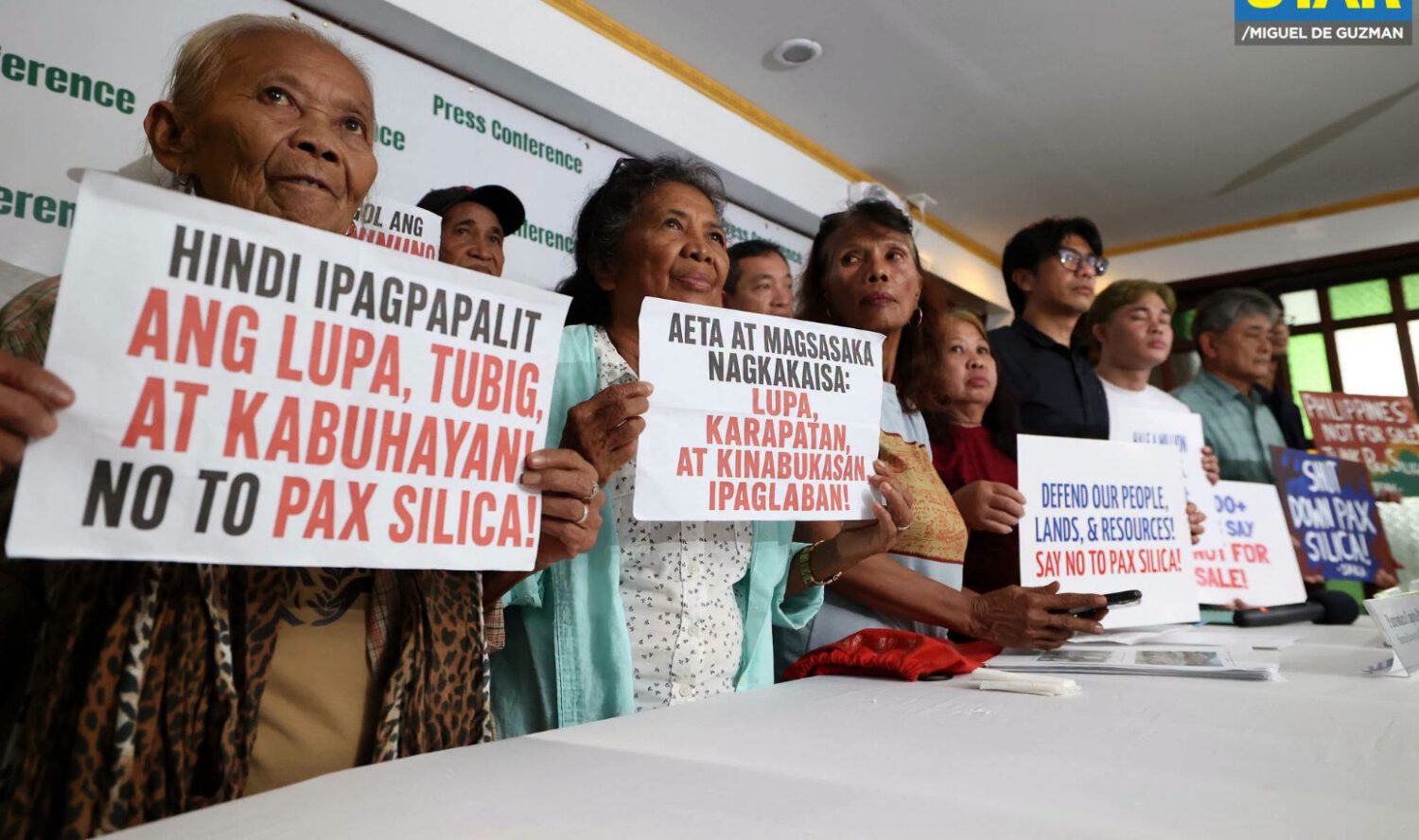
Aeta communities dispute the government’s account of who lives on the proposed site and what will happen to them.
The proposed site sits within the former Clark U.S. military complex, territory where Aeta communities have lived for generations, predating the base itself according to Mongabay’s reporting. Mapping work cited by Mongabay indicates that planned construction could affect at least three Aeta villages.
President Ferdinand Marcos Jr. has said no Indigenous communities or burial grounds will be displaced. Community testimony reported by Mongabay presents a different account: residents say they have already been told to leave.
The BCDA maintains the project sits on public land with no formal ancestral-domain title covering the site. That framing requires context. Obtaining formal ancestral-domain recognition in the Philippines requires submitting detailed maps, genealogies, census data, and testimony. Aeta communities have reportedly pursued that certification process for decades without resolution.
The absence of a formal title reflects a demanding administrative process, not necessarily the absence of historical occupation or legitimate customary rights. Those are distinct propositions, and conflating them shapes the entire accountability debate.
Activist-scientist Jona Yang of AGHAM, cited by Mongabay as speaking after a police confrontation at a Manila investors’ forum, was quoted as saying: “We want the Marcos government and investors to see the outrage all of this has caused. They’re taking away our resources and our lands.” Mongabay reported that environmental advocates, scientists, and affected residents participated in the protest. Police reported officer injuries; activists alleged their own injuries and arrests.
What Accountability Actually Looks Like
Specific, enforceable steps exist that would meaningfully improve how this project proceeds.
Independent environmental review should be completed before construction commitments lock in, not applied after the project’s main parameters are settled. Genuine Free, Prior, and Informed Consent with Aeta communities cannot be substituted by a government denial issued on their behalf. Public feasibility studies on water and power demand are overdue, and accountability structures must carry real consequences after foreign capital arrives.
The Pax Silica hub could become a template for AI-era industrial zones across allied nations. Whether that template includes the communities bearing its costs is still an open question, and the answer depends on whether scrutiny arrives before the concrete does.