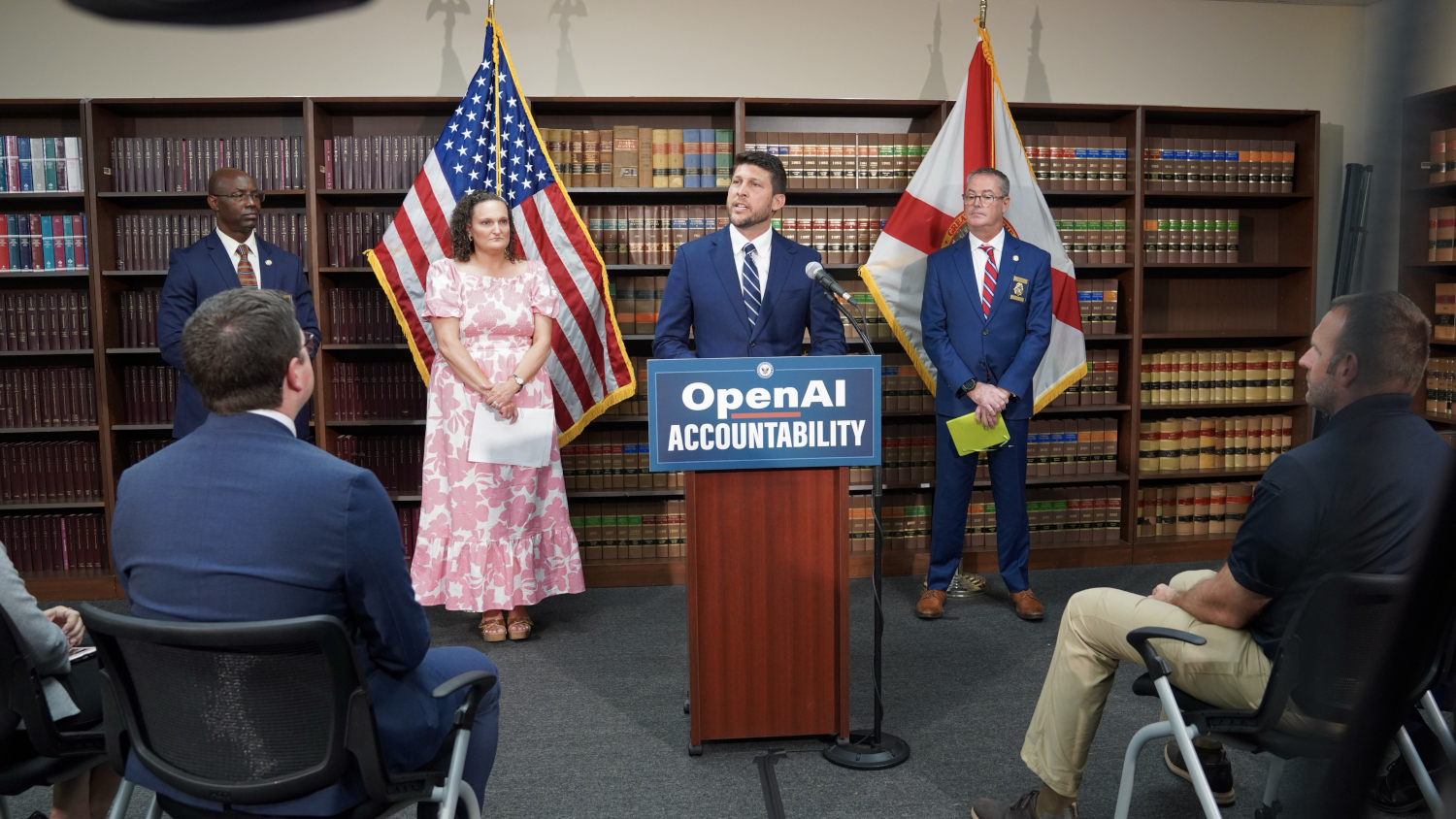
On September 28, 2026, Florida Attorney General James Uthmeier filed a motion asking a state court to block minors from accessing ChatGPT while the state’s broader lawsuit against OpenAI continues. No judge has granted the request yet, and ChatGPT remains available in Florida until a court orders otherwise.
What Florida Is Asking the Court to Do
Florida’s motion targets three specific areas: minor access, children’s data, and independent safety reviews for new AI models.
The motion was filed in Florida’s Tenth Judicial Circuit in Highlands County and seeks a temporary injunction, a court order that takes effect during litigation before any final judgment is reached.
On access, the state asks the court to block Florida minors from using ChatGPT entirely while the case proceeds. On data, the motion asks the court to restrict OpenAI from collecting or processing information from children under 13 unless the company provides clear disclosures, obtains verifiable parental consent, and applies reasonable security procedures. On development, the motion asks the court to prohibit OpenAI from building new AI models without independent third-party guardrails, meaning safety reviews conducted by outside experts before a product ships.
Florida’s Case vs. OpenAI’s Defense
Florida’s original lawsuit, filed in June 2026, accused OpenAI of deceptive trade practices, negligence, product-liability violations, and public-nuisance claims. The state alleges that OpenAI marketed ChatGPT to children despite known safety risks and inadequate protections for young users.
On age verification specifically, Florida’s complaint alleges that ChatGPT’s free version has no meaningful age-screening mechanism. According to the state’s filing, the paid version asks users to provide their age but does not independently verify it.
Citing research in the injunction motion, the state points to figures suggesting that 20% of preteens use AI chatbots, that 33% of adolescent users have discussed important personal matters with AI rather than with people, and that 24% have shared personal information with AI. The state cites these figures to argue that the risks to minors are current and concrete, not hypothetical. The underlying studies are not identified in the available reporting, and the figures should be understood as cited within Florida’s legal filings rather than independently verified research.
OpenAI disputes that framing. The company says it has built meaningful protections into its products, including a more protective experience for minors, an age-prediction tool, default safeguards that activate when the system is uncertain about a user’s age, and parental-monitoring tools. Whether those measures satisfy Florida law is precisely what the litigation will determine. No court has ruled on that question yet.
Why This Case Reaches Beyond Florida’s Borders
If the court grants the injunction, OpenAI would need to introduce more consequential age-screening for Florida users before the case concludes. The specific technical method, whether government-ID checks, biometric age estimation, or verified parental consent, is not specified in the state’s filings.
Any verification system robust enough to reliably exclude minors would likely require collecting more sensitive data from all users. That trade-off between restricting minors’ access and expanding data collection is a core tension the case raises, though no court has yet resolved it.
Where Things Stand Now
The September 28 filing is a request for temporary relief, not a final judgment, and ChatGPT’s availability in Florida has not changed.
A federal judge remanded the case to Florida’s Tenth Judicial Circuit in Highlands County in September 2026 after earlier proceedings in federal court. Until a judge rules on the motion, nothing about ChatGPT’s availability in Florida changes.