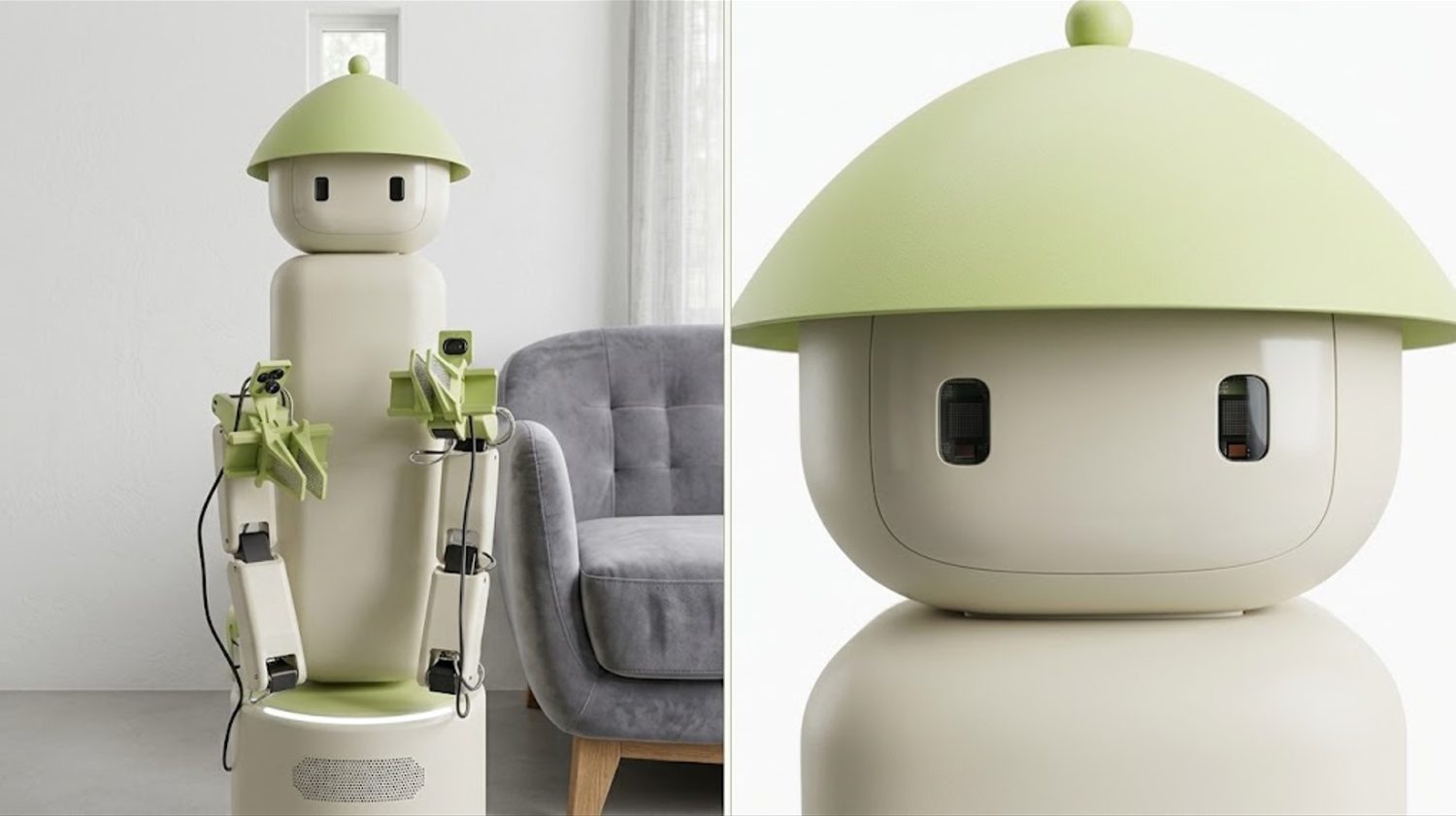
Most home robots promise to change your life. Flourish 1 promises to pick up your socks. That distinction, deliberate and unsentimental, is what San Francisco startup Flourish Robots is selling. The company emerged from stealth on September 29, 2026, opened pre-orders for the first 50 units at $3,555, and scheduled deliveries for December 2026.
What the Robot Actually Is
A wheeled, arm-equipped semi-humanoid built for light indoor chores rather than general-purpose household work.
Flourish 1 stands 3 feet 7 inches tall, weighs 44 pounds, and moves on a wheeled platform with a vertically adjustable torso rather than legs. The robot has a reported maximum lifting capacity of 3.3 pounds, or about 1.5 kilograms.
It uses cameras and LiDAR to navigate indoors. According to Flourish, its arms stop automatically when a person enters their reachable area, a safety approach that echoes work like the robotic knee exoskeleton developed to improve human-robot safety.
The wheeled design is a deliberate hardware compromise intended to reduce complexity and lower the purchase price. Flourish positions that constraint as the foundation of its value proposition, not a shortcoming.
According to Flourish, the robot can be taught to handle the following household tasks:
- Picking up shoes, clothes, and toys
- Wiping tables and fetching objects
- Watering plants
- Loading a dishwasher
- Clearing a cat litter box
Per CNET’s reporting, the robot cannot climb stairs, should not be exposed to water, must not handle breakable objects, and cannot carry anything heavier than the 3.3-pound manufacturer limit.
How You Teach It
Flourish’s mobile app lets you demonstrate a chore directly, with no coding required.
Owners use a mobile app to demonstrate tasks to the robot. Flourish claims a new chore takes roughly 30 minutes to teach, after which the robot can repeat or schedule it autonomously.
Each task is broken into sub-functions: navigation to locate an object, manipulation to grasp it, then navigation again to deliver it. Retrieving a single sock, for example, involves several discrete steps executed in sequence.
Rather than relying on a single universal model, Flourish fine-tunes its AI to individual homes, objects, and routines. According to Flourish, its models handle changes in object position, lighting, and clutter. A major home reorganization, however, could still affect performance.
The 30-minute learning estimate and the manufacturer-stated 12-hour battery runtime are company claims. No independent testing was available at launch.
The Price and What It Buys
At $3,555, Flourish 1 costs a fraction of competing humanoid systems, with trade-offs to match.
At $3,555 for the first 50 pre-orders, Flourish 1 sits well below higher-priced humanoid alternatives. Forbes reported that 1X’s NEO humanoid costs $20,000 outright or $499 per month. The gap is real, and so are the trade-offs: a wheeled base, slow operation, limited grippers, and a task profile confined to light indoor chores.
Flourish has raised a pre-seed round led by Families Fund. The amount was not disclosed.
The Honest Bottom Line
Buying at launch means accepting performance figures that have not been independently tested.
Purchasing a Flourish 1 at launch means accepting several unknowns. Real-world reliability across different homes remains unverified. Battery life, navigation quality, and task success rates are manufacturer figures, not independent benchmarks. Long-term durability, privacy controls, and cloud architecture were not detailed in the sources reviewed.
What Flourish is offering is narrow by design: a persistent, lower-cost assistant for repetitive light chores that can make your life easier. The December delivery window will show whether the hardware lives up to the pitch.