A toddler’s chemotherapy-resistant, metastatic liver cancer disappeared after two outpatient infusions of an experimental immune cell therapy, with no systemic toxicity detected. Researchers published the case in the New England Journal of Medicine, describing it as the first documented durable complete response to this class of treatment in a chemotherapy-resistant pediatric solid tumor. The result carries particular weight because CAR T-cell therapy has historically succeeded in blood cancers but repeatedly fallen short against solid tumors.
A Disease That Had Run Out of Options
Hepatoblastoma is the most common malignant liver tumor in children and carries a poor prognosis once frontline therapy fails. At diagnosis, the child had a primary liver tumor measuring 11.2 x 9.6 x 7.1 centimeters. Metastatic spread to the lungs and indications of bone involvement were also present.
He received three courses of chemotherapy, had his primary tumor surgically removed, and underwent two lung operations to clear metastases. The cancer returned anyway, with a new lung tumor.
How the Therapy Was Engineered to Target Liver Cancer Cells
Researchers enrolled the child in the CARE study (NCT04715191), a phase 1 trial led by Baylor College of Medicine and Texas Children’s Hospital. The experimental product, called CARE T cells, combined several design features:
- Target: Glypican-3 (GPC3), a cell-surface protein highly expressed in pediatric liver cancers but limited in normal tissue.
- Engineering: The patient’s own T cells, genetically modified with a chimeric antigen receptor to recognize and destroy GPC3-positive cancer cells.
- Armoring: Co-expression of interleukin-15 (IL-15) and interleukin-21 (IL-21) to improve T-cell survival, proliferation, and tumor-killing capacity.
- Safety switch: A built-in mechanism allowing clinicians to eliminate the CAR T cells via IV drug if serious toxicity occurs.
Two Infusions, Eight Weeks Apart, With No Detectable Disease After
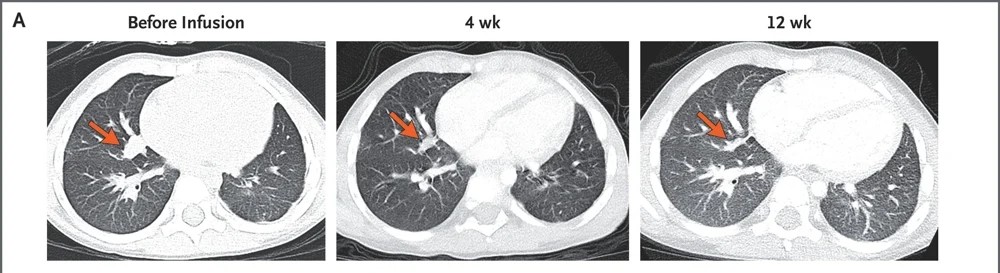
After the first infusion, CT scans showed tumors shrinking and alpha-fetoprotein (AFP), a tumor marker commonly elevated in hepatoblastoma, began to fall. Eight weeks later, the child received a second dose. Follow-up imaging showed no detectable disease, only residual scarring where tumors had been.
At the 12-month mark, he remained in complete remission. No dose-limiting toxicity occurred, no cytokine release syndrome developed, and the entire treatment course took place in the outpatient setting.
“This case demonstrates that a durable complete response in a chemotherapy-resistant solid tumor can be achieved entirely in the outpatient setting without systemic toxicity,” said David Steffin, MD, of Baylor College of Medicine, first author of the NEJM case report, as reported by Science Alert.
A Proof of Concept, Not Yet a Cure for Everyone
Liver cancer is the third leading cause of cancer-related death globally. Solid tumors have resisted CAR T therapy due to physical barriers, immunosuppressive microenvironments, and antigen variability. Achieving complete regression of hepatoblastoma in an outpatient setting marks a meaningful shift in what researchers believed possible. Prior CAR T treatments for blood cancers often required hospitalization and produced severe side effects.
The limits are equally important to state clearly. This is one patient in an early-phase trial, which primarily tests safety and dosing rather than efficacy. Prior GPC3-CAR T trials produced partial responses and disease control, not consistent complete remissions. Long-term effects beyond 12 months remain unknown, and the therapy is investigational with no FDA approval; it is available only within clinical trials.
“This study provides evidence that these novel CAR T cells may be a safe and effective modality for hepatoblastoma and highlights the need for further assessment in patients with GPC3+ solid tumors,” said co-author Andras Heczey, MD, of Seattle Children’s Hospital and the University of Washington, as reported by Science Alert.
What Comes Next
The CARE trial continues enrolling patients with GPC3-positive solid tumors at Baylor College of Medicine and Texas Children’s Hospital. A related trial, the IMPACT study at Seattle Children’s Hospital, is testing similar approaches in pediatric solid tumors. Larger, multi-patient studies are required before routine clinical use or regulatory review becomes viable.