A foldable phone has one job a normal phone doesn’t: it has to fold. Because of that most attempts at a good case for one fall apart right at the hinge.
Thick, soft cases seem like the obvious answer, since more material usually means more protection. On a foldable, though, it backfires. Soft materials deform under heat and pressure over months of use, so if your case started snug around the hinge, it can end up creating pressure points that fight the fold itself instead of protecting it. Thin cosmetic shells don’t have this problem because they drop hinge coverage entirely. This means the phone looks good, but its most vulnerable point is now exposed.
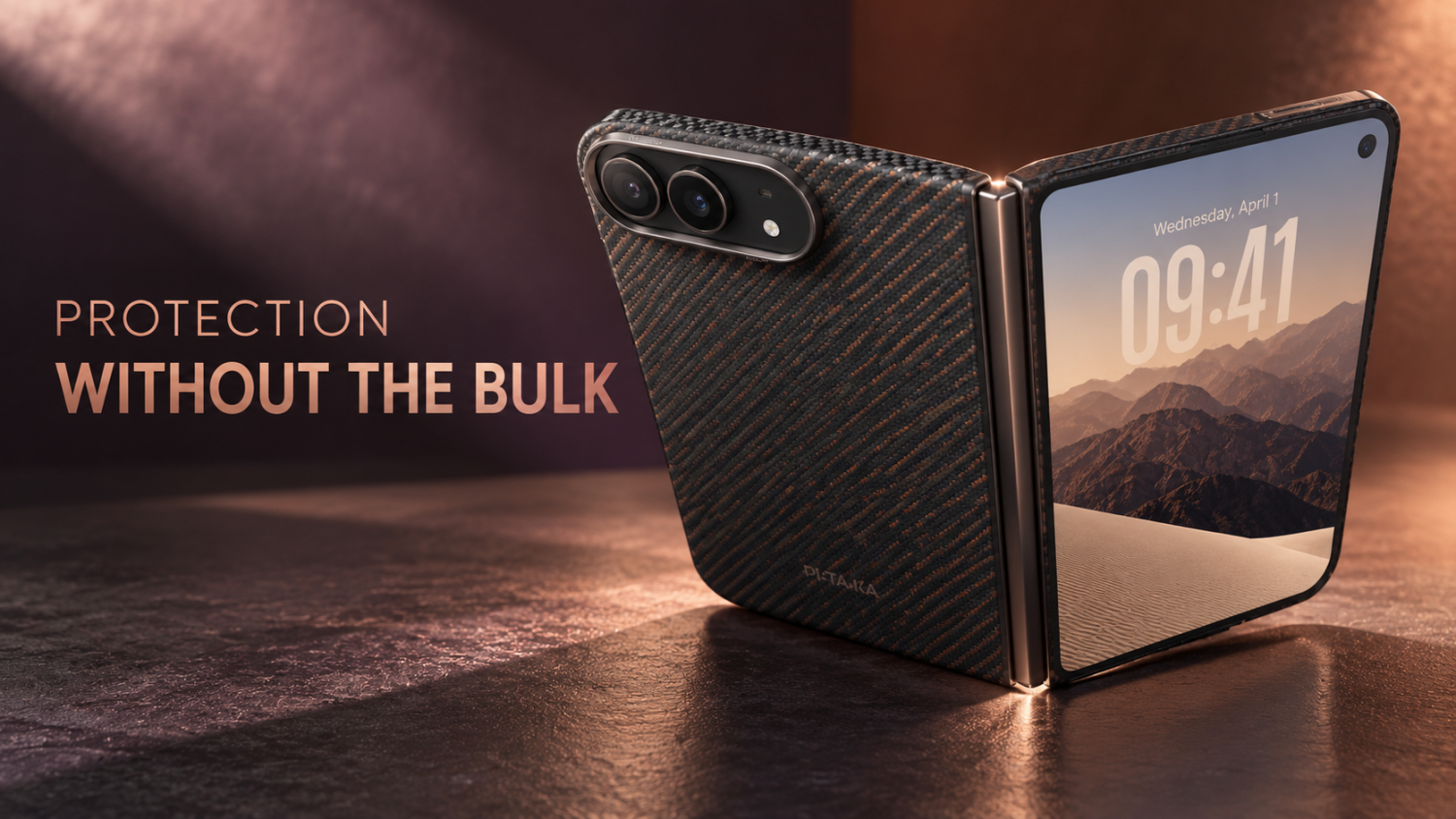
PITAKA built its Edge Case for the iPhone Duo around a material family that doesn’t have to choose between looking good and staying protected: aramid fiber.
This is the same material that’s used in aerospace engineering and body armor. It’s strong enough to protect without needing real thickness to do it, which is exactly what a case for a folding phone actually needs.

Two Pieces, Built for One Fold
The Edge Case for iPhone Duo comes as two separate pieces: a back shell and a front frame, sold individually or bundled together. It’s split intentionally to match how the phone itself works: two halves meeting at a hinge, so the case isn’t trying to force a single rigid shell around a device that’s built to bend.
The back shell runs $59.99 on its own. The front frame adds $54.99, or the pair together comes to $109.99 as a bundle. Both pieces use the same aramid weave construction PITAKA has built its whole case lineup around, adapted specifically for Apple’s first folding phone.

Why PITAKA Uses Aerospace Materials
A phone that folds flat needs a case that knows you’re going to do that. Every extra millimeter of thickness on a foldable gets felt twice, after all: once when it’s open and once when it folds shut on top of itself. Any bulk that would barely register on a normal phone becomes obvious fast.
Aramid fiber is the natural fit because it delivers real structural strength without needing the extra volume a soft case relies on to feel protective. On top of that, it holds its shape instead of gradually losing precision around the hinge the way TPU tends to over time. That’s the same reason it shows up in body armor and aerospace parts in the first place: strength that doesn’t depend on mass.
It’s also non-conductive, so it doesn’t interfere with wireless charging or signal the way some metal-reinforced case designs can, which matters much more on a foldable where hinge geometry already limits where hardware like that can go.

Protect More Than Your Foldables
The iPhone Duo case is just one part of PITAKA’s broader Edge Series, the brand’s line built around staying as close to the bare feel of the phone as possible.
PITAKA also makes a separate Guard Series for iPhone 18 Pro and Pro Max, the Cairn and Summa cases, built for rugged, everyday-carry protection instead of a minimal profile. Both build up from the same aramid material, but they’re aimed at different priorities.
Are you spending a lot of time outdoors? Grab the Cairn. Are you looking for your case to appear completely seamless with your phone? That’s what the Summa does.
If you’re going to have a phone that folds in half every time you put it away, you’ll want a case that not only keeps it protected, but keeps your phone from feeling like it’s barely going to fit in your pocket.