Running an industrial site with mixed terrain means running multiple robot fleets: wheeled AGVs for the warehouse floor, off-road vehicles for outdoor transport, quadrupeds for the unstructured stuff. Three procurement budgets. Three maintenance contracts. Three control systems that don’t talk to each other. Galileo Robotics, a Tianjin-based embodied-AI company founded in 2013, debuted Galileo X at World Robot Conference 2026 in Beijing with a pointed answer to that headache: one chassis, every terrain. The claim is ambitious. The public spec sheet is thin. Both things matter.
What Galileo X Actually Is
Think of it less like a robot dog and more like Unreal Engine licensing its core to every studio — mobility as the platform, not the application riding on top of it.
Confirmed specs and features at launch:
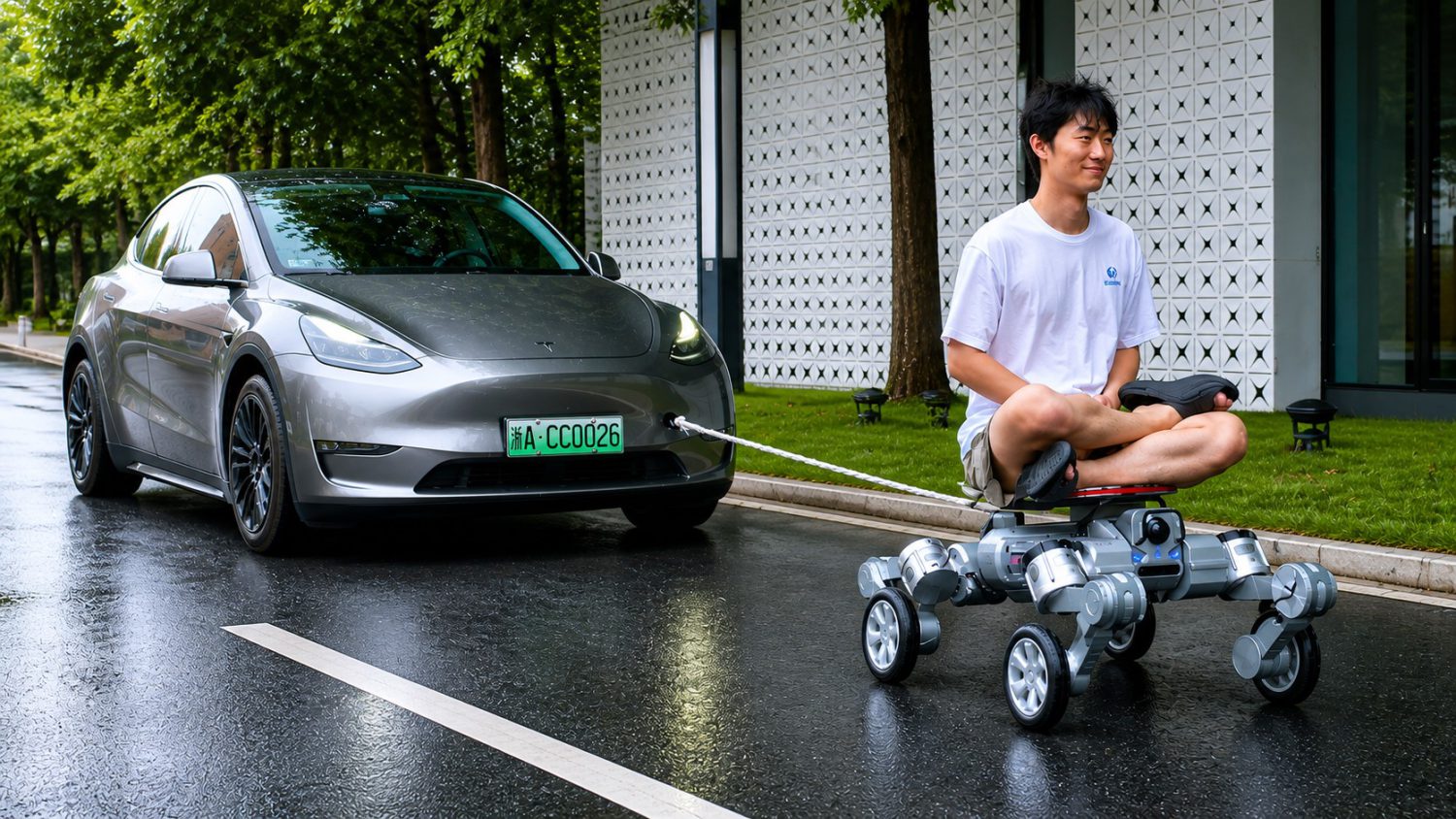
- Four articulated legs, each terminating in a wheel — roll on flat surfaces, step over obstacles when rolling stops working
- Joints with full 360-degree rotation, enabling posture adjustments and maneuvers that standard quadrupeds can’t execute
- Target payload capacity of approximately 200 kg rated payload — heavy-duty carrier territory, not a sensor-toting scout (note: the concept demo carried around 70 kg; 200 kg is the stated mass-production target)
- Proprietary Unified Embodied Ground Mobility System: a single hardware architecture and control framework bridging wheeled, vehicle-grade, and legged kinematics
- Open hardware and software interfaces planned for third-party algorithm developers and system integrators
Galileo describes this as reconstructing “the underlying logic and product paradigm” of next-generation ground robots — a clean-sheet design, not an iterative upgrade. For context, Boston Dynamics Spot tops out around 14 kg of payload in its standard configuration. If Galileo’s 200 kg target holds in production, that’s a different category of machine entirely — closer to a powered industrial cart that can also climb stairs.
The Gap Between the Demo Floor and the Job Site
Every compelling WRC showcase eventually has to answer the same question: does it work outside the convention center?
Here’s where you need to slow down.
No pricing has been disclosed. No delivery timeline. No full spec sheet covering speed, runtime, battery capacity, or environmental protection rating. No independent benchmark data exists — every performance claim traces back to Galileo’s own positioning and WRC demonstration footage. Robotica.es noted plainly in its August 2026 coverage that commercial performance “cannot yet be evaluated,” given the absence of published specs and validation from outside the manufacturer. The Melody Humanoid Robot launch earlier this year illustrated the same dynamic — splashy debut, real procurement questions trailing behind.
That’s not a fatal critique of the platform. It’s the normal state of a launch-event unveiling. But if you’re a system integrator evaluating mobile bases, or a logistics operator trying to retire three separate fleets, you’re still waiting for the datasheet that actually supports a procurement decision. Deployments like Snake Robots in real-world disaster conditions underscore just how wide the gap between a controlled demo and a validated job-site deployment can be.
The unified-chassis concept, if it holds past demo conditions, could genuinely compress fleet complexity. When Galileo publishes IP rating, cycle-life data, and third-party integration proof points, that’s the moment to run the numbers. Until then, watch for the spec sheet. Then decide.