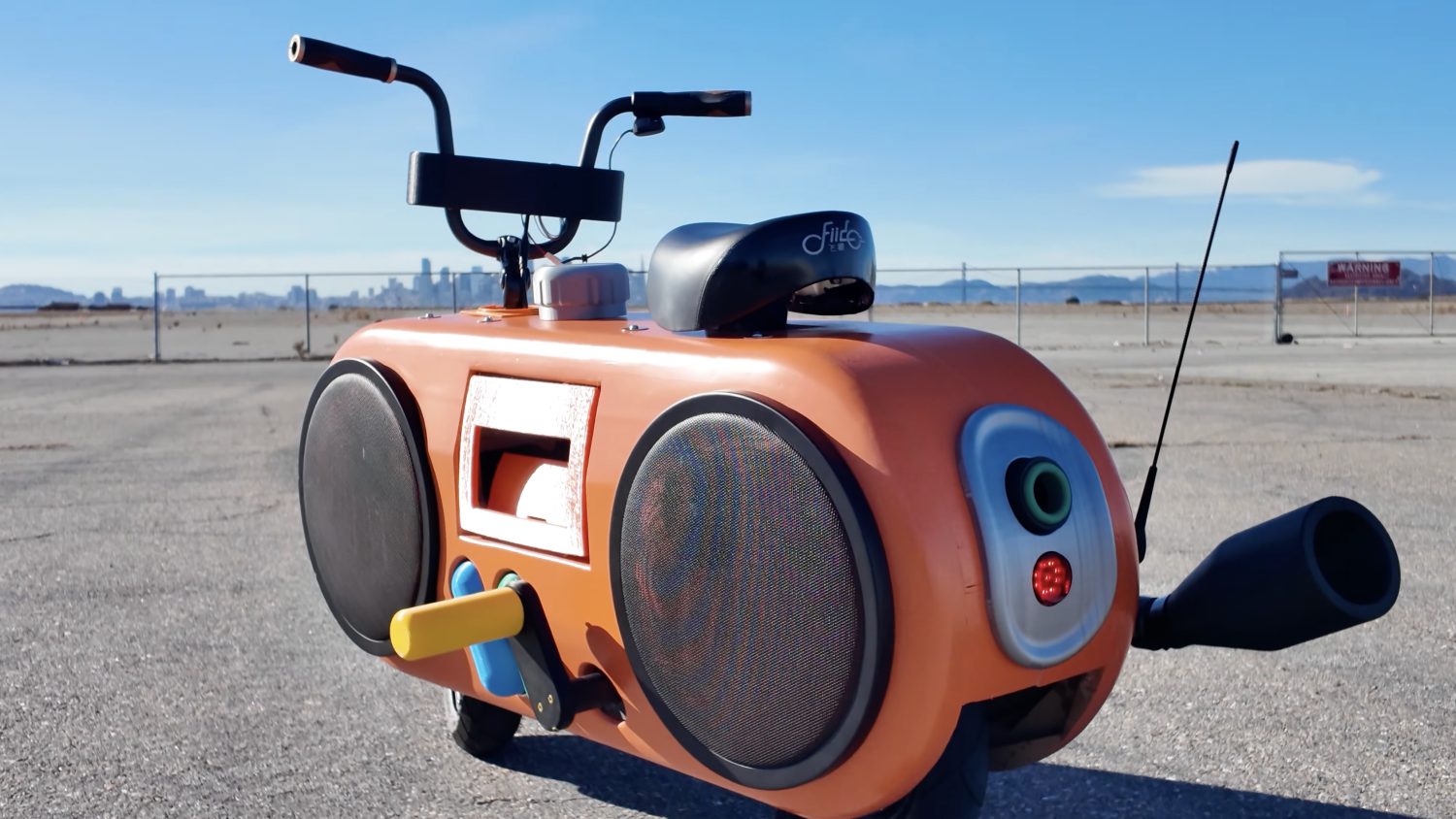
Someone looked at the cartoon orange radio bike from Mario Kart World — speaker cones for sides, cassette deck for a dashboard, antenna sticking up like it’s pulling in AM stations from 1987 — and decided it needed to exist on actual pavement, at actual speed. That someone is Sophia Tung, software engineer, YouTuber, and robotaxi investigator. She spent roughly a year of late nights turning a video game asset into a 65 mph electric bike gadgets enthusiast’s dream, with a Nintendo Switch 2 docked inside the cassette door. This is not cosplay. This is engineering.
From Game Asset to Street-Legal Hardware
A cartoon bike and a human body have very different opinions about proportion.
Tung started with photogrammetry — 3D reconstruction from game screenshots — to model the Tune Thumper‘s exact geometry. The 1:1 scale version was immediately impractical: too long, too tall for a real rider to sit and steer safely. Think of the gap between Fast & Furious stunt physics and an actual crash reconstruction report. She mounted the MDF shell onto a reused FTO motorcycle frame, then reversed the front fork to shrink the wheelbase from 84 cm to 77 cm. This kind of real-world recreation of fictional objects has become a passion project genre of its own.
A 3D-printed shell quoted at roughly $10,000 got scrapped fast. Cabinet builder Joe DiMaio spent weeks stacking and carving MDF sheets into the boombox curves you’d recognize from the game — splinters and 4 a.m. sessions included.
Key specs on the finished machine:
- 84-volt battery pack; top speed approximately 65 mph on 13-inch wheels
- Weight: roughly 70 pounds
- Functional speaker drivers installed at game-accurate positions
- MOSFET switch and DC converters handle lights and auxiliary power
- Apple CarPlay and extra ports hidden behind the cassette door
The first real-world test was Halloween night. The dashboard reset on every bump. A 3D-printed tail piece flew off mid-ride. A tire went flat.
People stopped and stared anyway.
The Cassette Door Hides a Nintendo Switch 2
Behind the retro facade, there’s a working game console dock powered by the bike itself.
Open the cassette door and you’ll find a Nintendo Switch 2 dock running off the bike’s own DC converters — no external power needed. A dedicated switch controls dock power; a USB-C monitor connects and runs without needing anything plugged into the wall. Front-panel buttons physically click and control audio playback, and at a Nintendo store demo, the music played, the dock powered a screen, and nothing fell off.
Tung built her audience investigating autonomous vehicles. Her 2024 Waymo parking lot livestream — lo-fi music, honking robotaxis, zero sleep — went viral and reportedly prompted Waymo to address the behavior. The Tune Thumper follows the same instinct: take something people experience passively and make it impossible to ignore.
After Halloween, Tung replaced a shorted controller by hand, reinforced the electronics against vibration, and kept riding. The bike isn’t commercially available and likely never will be. But as proof that a purely digital asset can become a functional, rideable machine — one that hits 65 mph and runs your Nintendo Switch — it’s difficult to argue with the result.