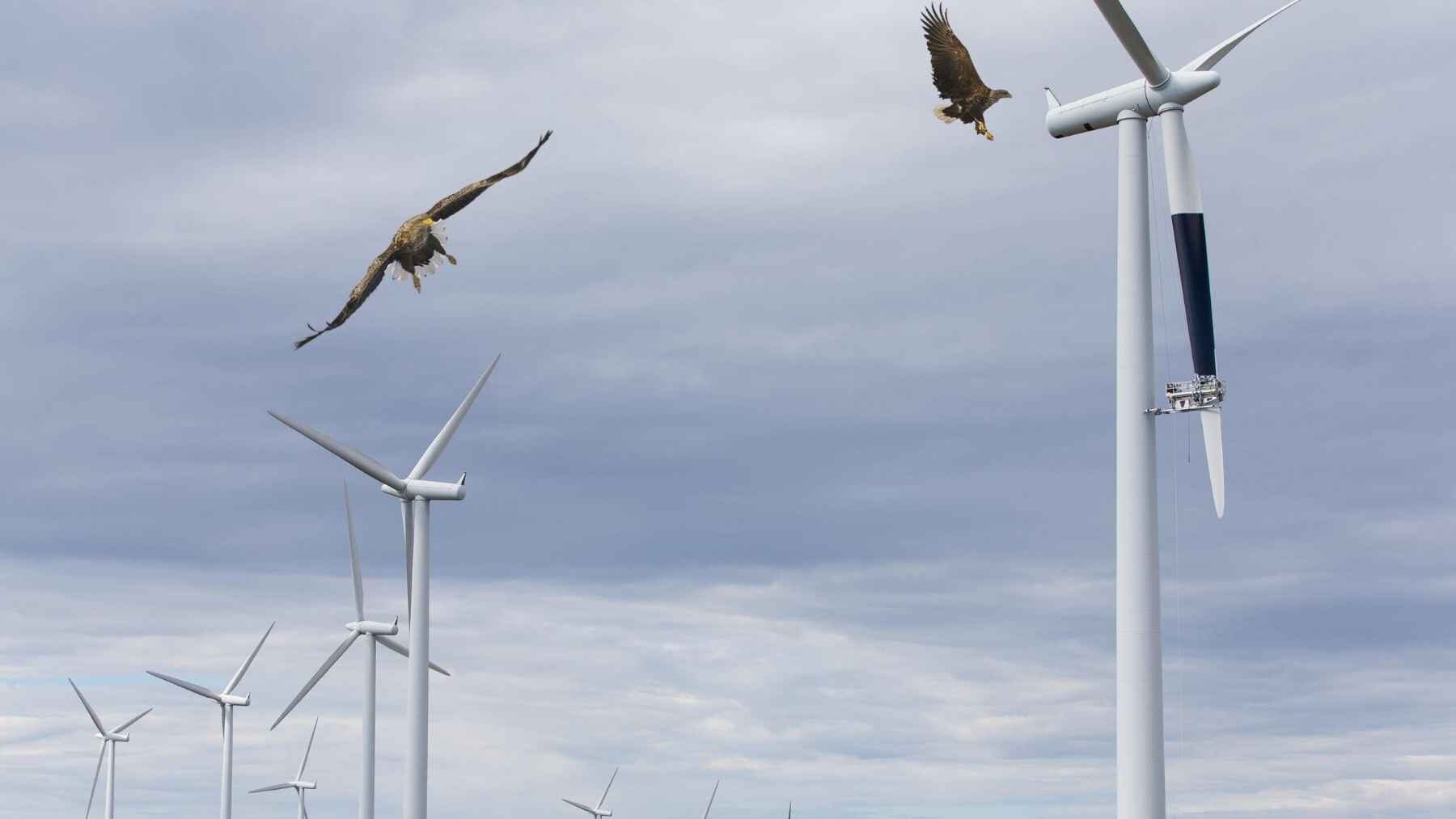
Spinning at tip speeds near 155 mph, wind turbine blades don’t look like blades anymore. They blur into a semi-transparent ghost-disk—open air, to a hunting eagle’s eye. That optical illusion, called motion smear, is roughly the same phenomenon that makes helicopter rotors vanish in action films. For white-tailed eagles, it’s fatal. Between 2005 and 2023, researchers logged 133 eagle carcasses at Norway’s Smøla wind farm. Most were adults—the birds most critical to keeping a population stable. Urban areas face their own version of this challenge; San Jose has a flock problem that similarly demands creative mitigation.
The Motion-Smear Problem – and a Ridiculously Simple Answer
A single coat of black paint on one blade produced results that surprised even the researchers who designed the experiment.
Published in Ecology and Evolution, the Smøla study reported a 71.9% average reduction in annual bird fatality rates at painted turbines versus unpainted controls—with a 95% confidence interval of 61.8–79.1%. That’s not a fluke. Scientists used a Before-After-Control-Impact (BACI) design: 7.5 years of pre-painting data, 3.5 years after, comparing four painted turbines against four neighboring white ones simultaneously. Trained dogs ran carcass searches within 100 meters of each turbine.
At the specific towers chosen for painting, six eagle carcasses had been recorded beforehand. After treatment, zero. The mechanism is straightforward: one black blade breaks up the rotor’s visual uniformity, giving birds something their eyes can actually register as a barrier rather than open sky.
What the Smøla Data Actually Shows
- Smøla operates 68 turbines at roughly 150 MW—enough to power 75,000–150,000 homes. This is a real, working wind farm, not a controlled lab.
- Only four turbines received black blades; four adjacent turbines remained all-white as controls.
- The confidence interval (61.8–79.1%) holds up statistically across multiple bird species, not just eagles.
- According to NINA’s 2024 follow-up report, zero white-tailed eagle collisions were recorded at painted turbines through 2023—though some control turbines also logged zero in certain periods, a statistical caveat worth remembering.
“Applying contrast painting to the rotor blades significantly reduced the collision risk for a range of birds.” — Smøla study authors, Ecology and Evolution
One Tool. Not a Universal Fix.
What works against an open Norwegian sky can disappear entirely into an industrial backdrop—and Eemshaven proved it.
Where Smøla’s open coastline made one black blade unmissable against the sky, Eemshaven’s industrial port landscape swallowed it whole. Seven turbines painted, seven controls, August 2021 through October 2024—species mix dominated by gulls, waders, starlings, and thrushes. Result: no significant reduction. Dutch officials reported no clear difference in casualties.
The leading explanation is visual clutter. Cranes, buildings, competing structures—the contrast that saves lives against clean coastal sky disappears into industrial noise. Think of it as camouflage that works perfectly across open tundra and vanishes entirely in a crowded marsh.
Black-blade painting earns its place where large raptors dominate, backgrounds are visually clean, and turbines sit on documented collision hot spots. It belongs in a mitigation toolkit alongside:
- micro-siting away from flight paths
- operational curtailment during peak migration
- sustained carcass monitoring
Mandatory black-blade regulations aren’t coming anytime soon; site-specific guidelines informed by local bird data are the realistic near-future.
The real question Smøla surfaces: can low-cost design tweaks let wind energy scale without shredding biodiversity? In the right place, with the right birds, against the right sky—maybe. Eemshaven says don’t assume. The science is still earning its verdict.